
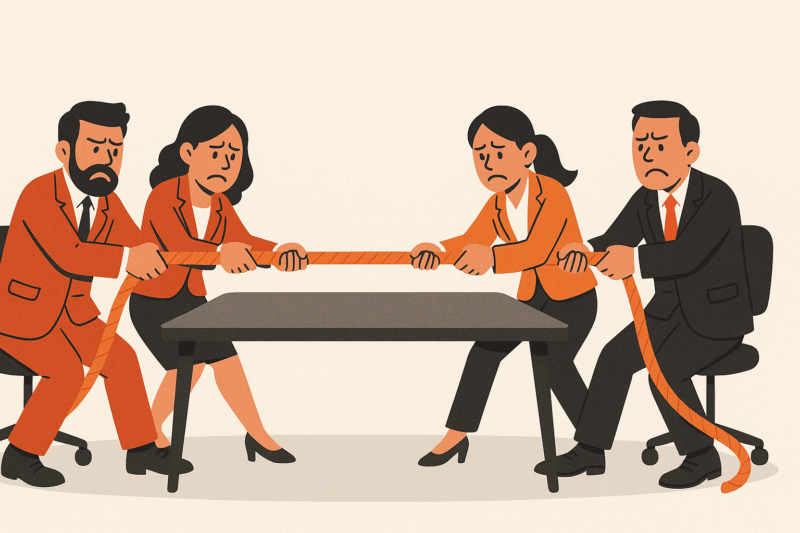
Growth doesn’t stall because you need more leads. It stalls when what’s happening inside can’t keep up with what buyers expect outside.
Most teams are moving fast, just not together. Marketing is optimizing campaigns. Sales is chasing a number. Product is launching on its own timeline. And buyers? They’re stuck in the middle, dealing with the disconnect. Messaging can only go so far when the mechanics underneath it aren’t working. The companies pulling ahead aren’t louder. They’re sharper, faster and aligned beneath the surface.
Alignment isn’t a nice-to-have. It’s the growth engine.
When your teams are synced — same buyer, same priorities, same story — things start to click.
Campaigns convert. Sales cycles shrink. Product launches land. Highly aligned companies grow revenue 58% faster and are 72% more profitable than those running in silos. That’s operational clarity doing its job.
Still, alignment gets sidelined. Teams set goals in separate docs, share wins in silos and work toward different definitions of success. If your teams don’t share a buyer definition and a shared outcome, you’re burning resources. You’re also slowing down decisions, weakening execution and missing signals that could sharpen positioning or close deals faster.
Silos don’t just slow you down — they cost you buyers
Buyers don’t care how your organization is structured. They care about how it feels to do business with you.
- One message on the site, another in the sales pitch
- Repeating the same story three times to get support
- Promised one thing in marketing, delivered something else in onboarding
Nearly 89% of customers have switched after a single bad experience. Half don’t even wait that long. Internal confusion always shows up externally. And when it does, buyers lose confidence. That’s when deals slow, sales stall and loyalty walks.
Dig deeper: 7 tips for building a B2B social presence that actually works
B2B buyers expect flow, not friction
Expectations have shifted. B2B buyers want clarity, consistency and control. They’ve been trained by seamless consumer experiences — and they carry that standard into every decision. More than 75% of B2B buyers expect a personalized, B2C-caliber experience and 60% will switch if the digital experience doesn’t deliver.
They want answers without chasing. Access without effort. And every touchpoint to feel connected. Disconnected systems lead to disjointed experiences. Buyers don’t want to fill in the gaps between your departments. They want one narrative — one that makes sense from first click to onboarding and beyond. What used to be acceptable friction is now a dealbreaker. When the experience feels inconsistent, buyers assume the product or service will be too. That hesitation kills momentum — and costs revenue.
Coordination drives conversion
Alignment creates the internal clarity that drives external results.
When marketing is dialed into product roadmaps.
When sales have visibility into true buyer intent.
When every team is solving from the same set of signals.
That’s when deals accelerate and customer trust deepens. Companies that unify marketing, sales and service are twice as likely to exceed revenue targets, according to McKinsey. Coordination makes strategy executable. Without it, even great plans stall. Strategy isn’t what’s written in the slide deck — it’s what teams can actually act on in real time.
What this means for companies
High-performing companies aren’t just investing in tools — they’re building a structure that actually supports momentum. When internal systems work together, market execution speeds up.
Teams operate on shared insights, not assumptions. Campaigns launch faster. Roadmaps stay focused. Customer experience feels intentional.
The benefits compound.
- Fewer handoff gaps
- Shorter sales cycles
- Higher retention
- Stronger pipeline visibility
- Faster iteration on product and positioning
And when every department is aligned around the same buyer, the brand shows up with more consistency. That builds confidence. And that confidence drives growth. Companies that build internal alignment into their operating model don’t just react better. They shape demand, move first and course-correct faster than competitors. That’s how they win markets — not just accounts. On the other hand, organizations that continue to treat alignment as a post-launch cleanup effort will continue to feel the drag. No matter how good the messaging is, if the foundation isn’t built to deliver, performance suffers.
Dig deeper: The case for and against CTV in 2026 B2B marketing budgets
If you want the market to move, start with your own team
Before chasing more demand, look inward.
Ask:
- Do your teams define the buyer the same way?
- Do they measure progress on the same scoreboard?
- Can they act on shared insights — or are they guessing based on siloed data?
Alignment won’t come from another campaign or platform. It comes from how you structure your teams, shape your systems and share your strategy.
The companies pulling ahead aren’t reacting faster. They’re built to respond better.
Not with more spend — but with sharper execution.
Not with more volume — but with less friction.
When alignment becomes part of how you operate, it becomes your edge.
Bottom line
If your teams can’t move together, your buyers won’t move either. But when everyone is operating from shared context and building toward a common outcome, momentum stops being a goal — and starts becoming your default.
That’s when your message lands cleaner. Your execution hits faster. Your brand earns trust at every touchpoint. Because real growth doesn’t start with the market, it starts with the mechanics that power it. Grow from the inside out and let the results speak for themselves.
Fuel up with free marketing insights.
Contributing authors are invited to create content for MarTech and are chosen for their expertise and contribution to the martech community. Our contributors work under the oversight of the editorial staff and contributions are checked for quality and relevance to our readers. MarTech is owned by Semrush. Contributor was not asked to make any direct or indirect mentions of Semrush. The opinions they express are their own.