
Why you can trust Creative Bloq
Our expert reviewers spend hours testing and comparing products and services so you can choose the best for you. Find out more about how we test.
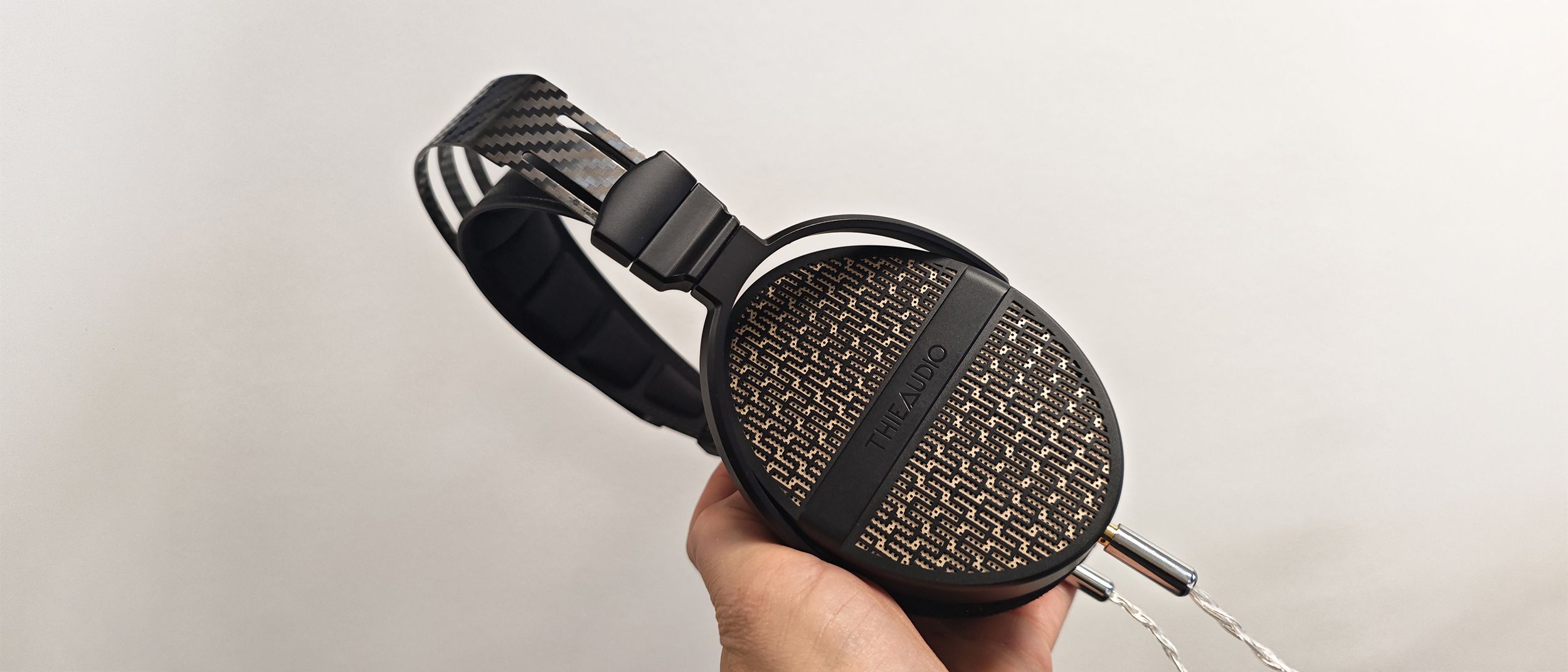
Although Thieaudio is renowned for producing some of the best loved in-ear monitors out there (27 since 2019), the company also has form making headphones. And, released on March 2026, the Cypher is their fourth and by far their most visually appealing one to date.
Specs
Price: $399/£350
Release: March 2026
Driver & housing: 50mm dynamic driver, (semi) open back
Material: Aluminium, stainless steel, carbon fibre, lambskin and velour
Cable: 1.5m, dual 3.5mm to 3.5mm (6.35mm adapter included)
Impedance: 32Ω
Sensitivity: 96dB/mW
Weight: 411g
But it’s also the Chinese company’s flagship headphone, and while you won’t really hear much about the Phantom, Wraith or Ghost these days, I have a feeling we’re going to be hearing about the Cypher for some time. That’s because I think it offers what a lot of treble-shy listeners will enjoy.
At $400, I won’t be recommending the Cypher as one of my picks of the best budget headphones, and if I were to make a list of the best mid-priced headphones out there, it may not make that list either. Here’s why…
Sound profile
(Image credit: Future)
Overall, the Thieaudio Cypher sounds warm and mostly dark. But with a bit of elevation around 6kHz, some notes sound brittle, though things stop short of sibilance. Add to that a lack of upper treble, and you get a warmth you can practically bathe in, but also darkness with detail… Huh?!
Bass: The Cypher’s bass extends far down to 20Hz with no roll off. This is not elevated bass, so not one for bassheads, but anyone who has heard open-back, dynamic driver headphones will no doubt be impressed with the Cypher’s reach into the lower frequencies. And that’s because the Cypher isn’t really an open-back.
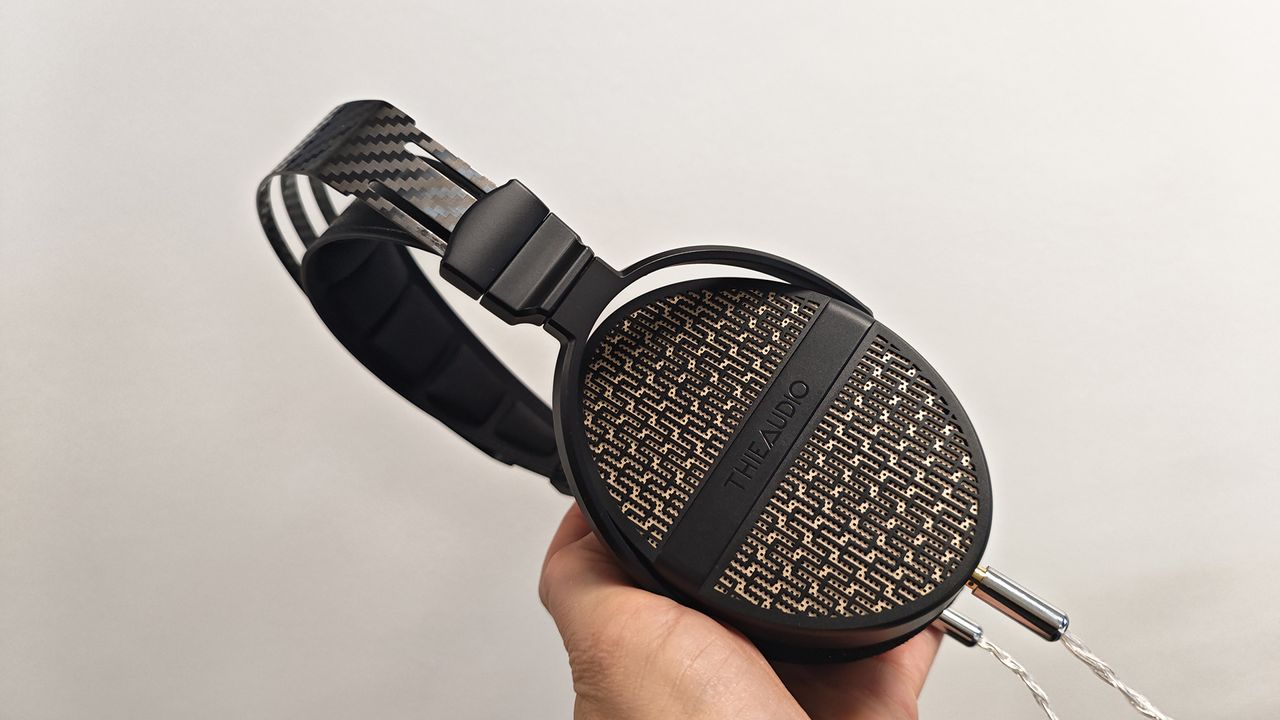
Sure, some air can travel through the ear cups, but as you can see in the image below, this is limited to pin-sized holes, so you don’t get the free flowing air that you’ll get with the Sennheiser HD 650 or the Hifiman Edition XV (discussed below). It’s this semi-open design, I think, which allows the Cypher to offer a fuller bass, and my bass test tracks bare this out. The string bass of Give Up the Funk and Other Side of the Game; the synth bass of Sexual Healing; the 808s of Humble; the kick drums of Sultans of Swing and Black Cow – they all sound as they should. Not over the top, not pushed back in the mix, but present and proud, and a lot of fun.
But if you’re chasing well-textured bass – that is, bass with a lot of detail to it – there are definitely better options out there, and that’s largely due to the Cypher’s treble response (see below).
(Image credit: Future)
Midrange: This is where the Cypher shines, with its full, largely natural-sounding midrange. Set against the Kemar Diffuse Field with -10dB tilt target, there’s a slight 2dB elevation for the mid bass and lower mids (from around 100-800Hz), which results in a warm, thick sound.
Then things get a little weird. There’s a scoop from 1kHz to 3kH in the upper midrange, which pushes instruments and vocals back a little, followed by an elevated 3-4kHz in the upper mids and a 6kHz spike in the lower treble. This is then followed by one of the darker upper-treble presentations I’ve seen in a headphone.
What does that all mean? Well, when you factor in that extended bass, the Cypher’s dark warmth is enjoyable for the most part, and when it all works it can sound luxurious on paired-back, vocal-led music such as Neil Young’s After the Goldrush.
Testing kit
(Image credit: Future)
For all my headphone and IEM reviews I play them through the Luxsin X8, Chord Mojo 2, and Fosi DS2 DAC/Amps, as well as my MacBook Air (M4). This ensures sufficient power for peak performance, while providing a transparent source for a clean, detailed signal. My music sources are Spotify Lossless and CDs.
But that 3-4kHz bump and 6kHz spike, in the context of the otherwise dark treble, means that when skipping through my music, I inevitably hit upon a mix that sounds both muffled and grating, as with a busier track such as The Jacksons’ Heartbreak Hotel.
This can be subtle, but the accumulative effect – when you factor in the tight clamp force and snug ear cups – is a soft, warm sound that is meant for extended listening, which I don’t actually want to listen to for more than an hour at a time.
Technicalities: As you’d imagine, the dark treble isn’t great for soundstage, but another contributing factor is that this is one of the most closed-back sounding open-back headphones I’ve heard. I don’t usually care too much about the soundstage effect, but when comparing the Cypher to the Hifiman Edition XV, which has a similar sound profile but is a proper open back, I found myself missing that open airiness.
Price, value & competition
The Hifiman Edition XV with purple Apos x Z Magia cable; the Cypher; and Sennheiser HD 650 with bespoke Custom Cans cable. (Image credit: Future)
Strictly on materials, design and packaging, I think the Thuieaudio Cypher is a solid value proposition at $399. It’s metal build and incredibly soft velour ear pads feels great in my hands. You also get a leather pouch to put your headphones and cable in, which is a nice touch that I’ve not seen before with audiophile headphones.
However, the Cypher’s value can only be judged in context to other similarly priced, similarly sounding headphones Unfortunately for the Cypher, the two alternatives I had to hand are an all-time classic and a recent star of 2025.
Cypher Vs Hifiman Edition VX
Both of these headphones have a similarly extended bass, and though the Edition XV’s midrange is a little more choppy on the graphs, it sounds very similar to my ears. And that includes that ‘Hifiman dip’ that they both share around 1-3kHz. The difference is that the Cypher has that peak at 6kHz, which the Edition XV does not, yet the Hifiman can has an extended treble with a lovely balanced air region.
What that means in practice is female vocals are more forward with the Cypher, but the Edition XV places them better in the mix. Overall the Edition XV has a more balanced midrange, and though some people may like the dynamic upper midrange / lower treble of the Cypher, I prefer the less energetic Edition XV, with it’s more ‘normal’ 5.5kHz.
The Edition XV sounds lush, warm yet has more detail than the Cypher. When combined with the roomier sound of the real open back Edition XV, plus its airy treble, all these details add up to the Edition XV sounding grander, less stuffy yet still coming across as warm.
The Cypher just shows how hard the Edition XV works to nail that dark-warm-balanced sound. And honestly, the Cypher does a decent job. But as it’s priced exactly the same as the Edition XV, I’m going to recommend you go for the headphone that does everything a little (and sometimes a lot) better.
(Image credit: Future)
Cypher Vs Sennheiser HD 650
The HD 650 is theoretically a more expensive headphone, at $580. But as it regularly sells for $379, and is currently on sale for $357 at Amazon, the comparison makes sense. Also it’s one of the most famous warm-sounding headphones, so it’s good to see where the Cypher stacks up against it.
Unfortunately, it’s a similar tale of treble when comparing with the legendary Sennheiser cans. Again, the HD 650 has a similar upper bass and lower midrange to the Cypher. Yet the airy treble that the HD 650 has really opens up its sound. That and, just like the Edition XV, the HD 650 is a real open back, unlike the half-open Cypher that sounds a little stuffy in comparison.
Another notable difference between the two is between 800Hz to 2kHz, where the Cypher dips and the HD 650 either fills in or elevates. This is the frequency of the clarinet, and when listening to Me and My Friends’ Before I Saw the Sea on the HD 650, the woodwind instruments feel fuller, more natural, and definitely more star than supporting role.
However, the Cypher does an awesome job with lead female vocalists – they may be placed deeper in the mix, but they’re smooth and lush all the same. The HD 650 simply portrays them in a more articulate way.
So, which would I buy? For lightness, a deft warm-balanced tuning, a natural midrange and a real open-back experience, it’s not even close – the HD 650 is a clear winner. I found myself really enjoying moments with the Cypher, but I don’t think there was one full track where I didn’t prefer the HD 650’s overall take on things.
Comfort & build
(Image credit: Future)
The Cypher is a clampy headphone, on a par with the Sennheiser HD 650, and very much noticeable when swapping to a easier set like the Edition XV. For the majority of the time I used it, it wasn’t a major issue, until several hours in and it began to dominate my attention. I have a slightly large head, since you’re asking, so if you have a smaller noggin, this may not be an issue for you.
Also, the ear pads aren’t very deep, or very wide, so my ears often brushed up against the inside and side of the ear cups. It’s more annoying than uncomfortable, but definitely worth noting, but it was just another thing that added up.
The build of the headphone is excellent. Lots of steel and carbon fibre, and I like a headphone that balances weight and heft with comfort, that gives you an experience every time you put them on. The opposite of this would be the Sony MDR-MV1, where it’s lightness actually reads as cheapness when you first start using it. The Cypher’s weight, and build, reads as quality, and that doesn’t diminish the more you use it.
The design of the headphone is excellent. I really appreciate the look of it, particularly the subtle flourishes: The patterned grills, the easily detachable ear cups that reveal more patterned metal work… it’s all very well judged, and enjoyable to have in my hands.
Should you buy it?
(Image credit: Future)
Cumulatively, I’ve spent many happy hours listening to the Thieaudio Cypher, especially to 1970s, vocal-led rock and EDM. It’s incredibly enjoyable to jump in the warm bath of tones of the former, and hear the Cypher’s bass stretch its legs on the latter.
But it wasn’t all plane sailing, and there were some tracks that didn’t do well with the Cypher’s sound profile. And at the end of my sessions, I was always slightly relieved to take the tightly clamped and snuggly fitted headphones off.
The Cypher definitely taught me something. I always thought I leaned to the warmer tuned IEM and headphone. And it turns out I do – when it’s done with a confident treble that reveals different dimensions of a mix that would otherwise be swamped.
Recent examples of this are the Mangird Tea Pro and the Edition XV. But because Thieaudio went warm with a spike in the lower instead of the higher treble, some tracks seem detailed and clear, and others seem dark and brittle.
However, if you’re not as sensitive to its 6kHz peak as I am, it’s a good option for treble-sensitive listeners that want a good midrange and a solidly built headphone, which they can play loud.
But if you want to be consistently excited and inspired every time you put your headphones on, I don’t think the Cypher is it.