
Why you can trust Creative Bloq
Our expert reviewers spend hours testing and comparing products and services so you can choose the best for you. Find out more about how we test.
In the world of desktop audio, aesthetics rarely seem top priority for manufacturers. A black, brushed-metal finish is common fare for digital-to-analog converters (DACs) and amps, and if it doesn’t have a fancy LED display on it, things start to look samey.
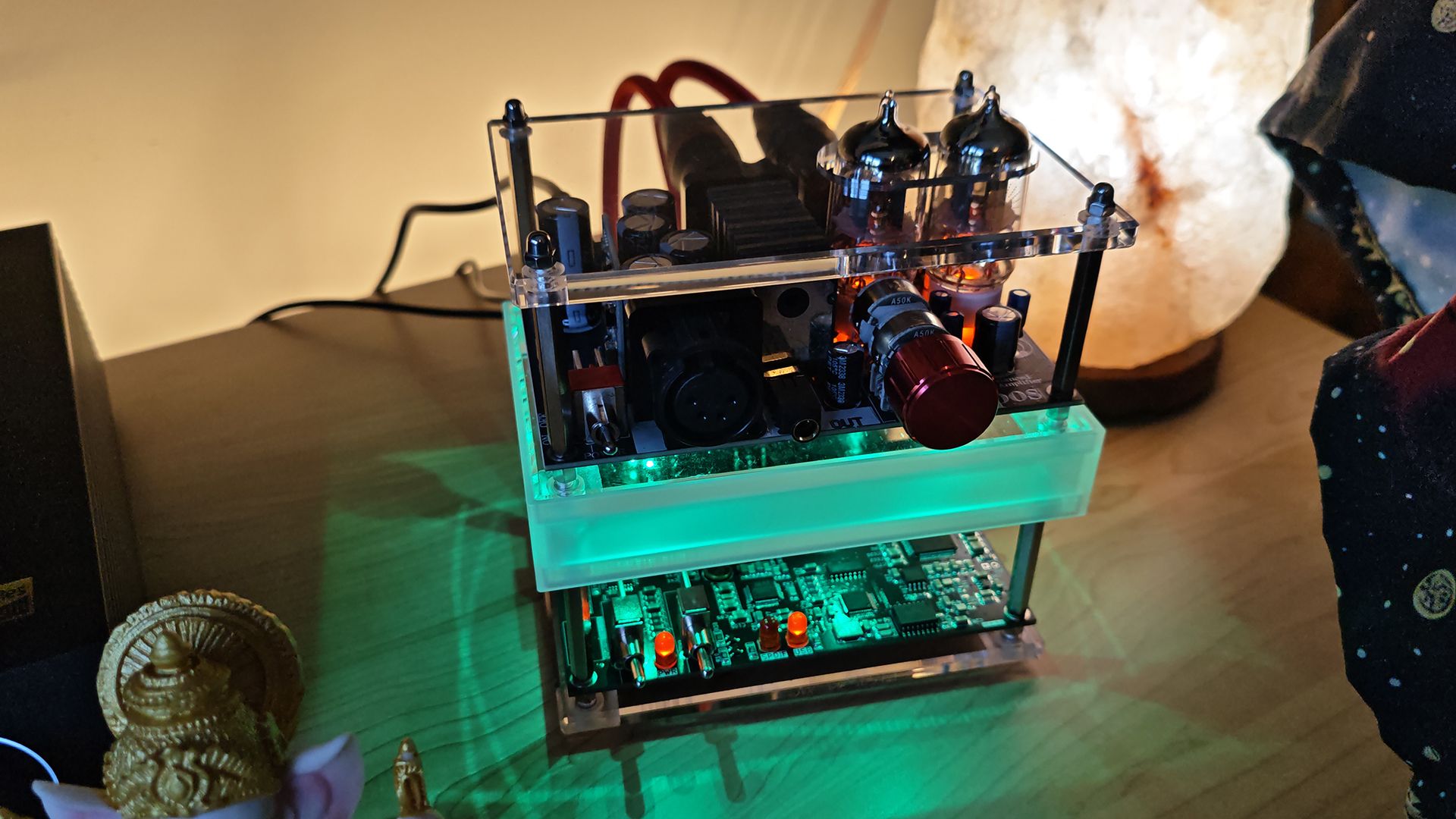
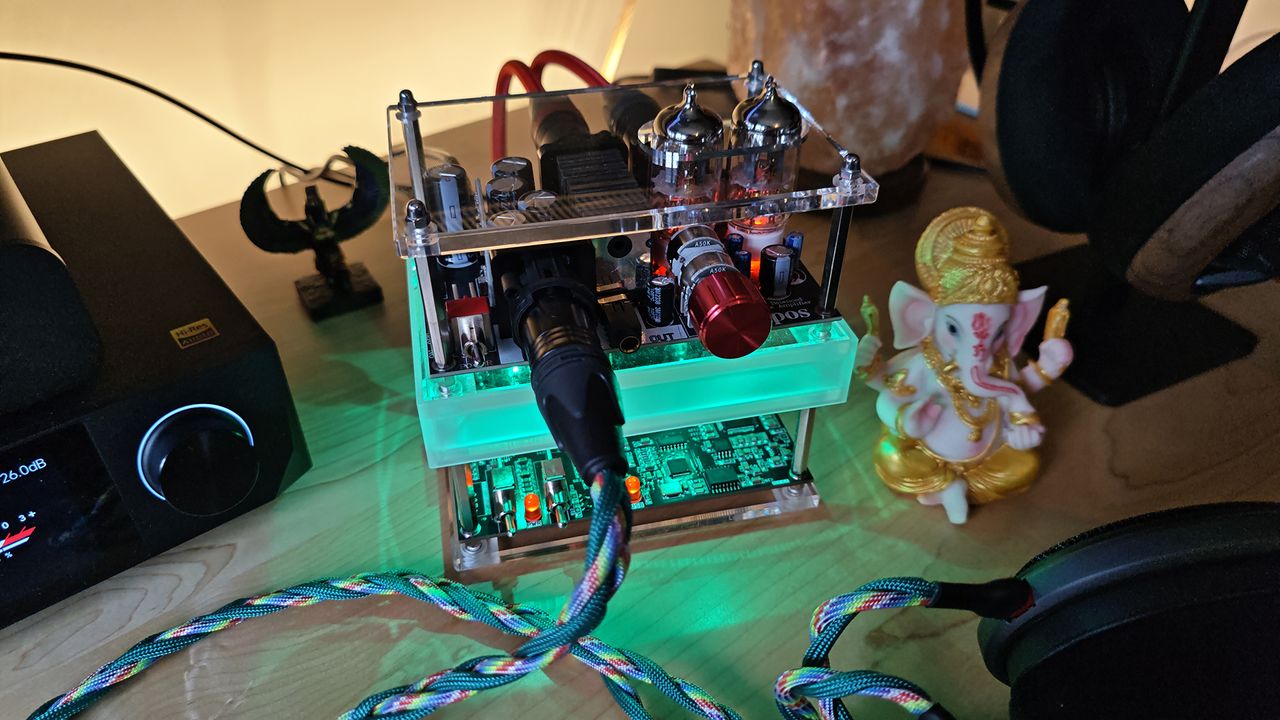
Enter Apos, an online retailer of audiophile equipment that’s made a name for itself with the Apos x collaborations and community-driven products, such as the Apos Gremlin headphone amp and the Apos x Geshelli Merlin DAC. Nothing looks even remotely like these two lads, and that fills my heart with joy.
Specs
Gremlin
Price: $120
Power output: 1250mW @ 32 ohms
Inputs: 2x XLR, 4.4mm (balanced)
Outputs: 4-pin XLR, 4.4mm (balanced)
Merlin
Price: $225
DAC Chip: AKM AK4493SEQ (Velvet Sound)
USB Interface: Amanero 768 (Galvanic Isolation)
Digital Inputs: USB-C, Optical, Coaxial
Analog Outputs: 2x 3-pin XLR (balanced), RCA (Single-Ended)
Max Sample Rate: 32-bit / 768kHz PCM, DSD512
Feature: Simultaneous active output (RCA and XLR)
In this review I’m going to dig into what the Gremlin and Merlin actually do, who they are aimed at, what audiophile headphones they best pair with, and whether you should buy both of them, just one or none.
You don’t need me to tell you that these are both niche pieces of audio equipment, and with the Gremlin’s balanced only approach, there will be barriers for many users. But after four months of using the Gremlin and Merlin as my primary desktop headphone amp and DAC, I believe – if you love your music and want something beautifully insane-looking on your desktop – they are barriers worth overcoming.
What is this and who’s it for?
Image 1 of 3
(Image credit: Future)(Image credit: Future)(Image credit: Future)
This is a wired headphone DAC (a converter of digital audio signal from your laptop/PC to an analogue signal) and amplifier (which takes that analogue signal and drives your passive headphones with it). That means you’ll need to have a digital audio source (mine is Spotify on my MacBook Air), and wired headphones – specifically headphones with an XLR or balanced 4.4mm cable (more on that in the cable section below).
A tube amp, like the Gremlin, gets its tonal characteristics by adding second-order harmonic distortion to the sound. Yes, you read that right – the Gremlin distorts your music. But this isn’t the distortion you’d get from a guitar amp turned up to 11. For each note that is played, the Gremlin slightly emphasises one octave higher (the second order harmonic). As an electrical signal passes through the vacuum tube, the tube subtly reshapes the wave, adding a tiny bit of that second order harmonic. The result is a richness, with notes feeling thicker. It can round off the sharp edges of digital recordings.
But the Gremlin is a hybrid tube amp, not just a standard tube amp. That means it colours the sound of the music to sound slightly warmer, but unlike other straightforward tube amps, it has solid-state transistors which provide enough voltage to power higher impedance headphones.
So, this set up is squarely aimed at audiophiles and/or creative professionals who love the tonal character of music over a clinically transparent presentation. If your day involves hours of editing or critical listening and you find modern solid-state gear a bit cold, this stack is for you.
If you’ve read this far, it won’t be a shock to you that all of this requires commitment! Well, there’s more… The Gremlin is a balanced-only amplifier. There are no 3.5mm jacks here (the most common termination). So if you haven’t already embraced 4.4mm or XLR cables, you’ll need to factor in the cost of a cable upgrade alongside the hardware.
What headphones do you need?
(Image credit: Future)
Unlike solid state headphone amps, it really matters what headphones you use with the Gremlin. This stack is a dream for high-impedance cans like the Sennheiser HD 600 or HD 650.
Impedance is electrical resistance. A high-impedance headphone like the Sennheiser HD 600 needs more voltage to move the drivers in its ear cups (they are harder to drive). But because they resist the electricity more, an amp with enough voltage can control their movement more precisely. The Gremlin is such a high-voltage amp, but it also features low damping factor – unlike solid-state amps that act like emergency brakes, a tube hybrid allows the drivers to resonate just a millisecond longer after the signal stops. That’s part of the reason for the atmospheric sense of space you get with tube amps.
But there’s another factor. High impedance headphones don’t have a flat resistance – their impedance spikes at certain frequencies. For the HD 600, with its 300Ω impedance, its impedance spike occurs at the mid-bass frequency (around 100Hz). Its impedance jumps up to 500Ω.
Now, because of a phenomenon called the voltage divider effect, the tube amp actually delivers more power to the frequencies where the headphone’s impedance is highest. As that’s the mid-bass area for the HD 600, you get a mid-bass boost. Add to that the second-order harmonic distortion, and the low damping factor, and you get that warmer tube sound.
Little Gremlin
(Image credit: Future)
At just $120, the Apos Gremlin is a strange little monster of an amp. It’s a fully balanced, class A hybrid tube amplifier – specs that usually come with a $300+ price tag. It comes with Ray Tubes CORE 12AU7 tubes, but you can start tube rolling, and replace them with various alternatives, for varying degrees of distortion. However, as a hybrid, its solid-state stage provides 1250mW of raw power, meaning it can handle even the most hard-to-drive planar headphones.
The Gremlin’s connectivity is actually one of its highlights. That’s because, unlike many desktop amps, the Gremlin features both dual 3-pin XLR inputs (which connects to the Merlin, or another DAC) and a 4.4mm Pentaconn input. This means you can buy the Gremlin as a standalone unit and run it off a simple mobile DAC, like the $80 FiiO KA13, using a 4.4mm-to-4.4mm balanced cable. That makes it incredibly versatile.
Compared to the tube/hybrid Schiit Vali 3 ($189) or the solid state Topping L30 II ($149), the Gremlin is more like a boutique instrument than a consumer appliance. And though it offers exceptional value, there are trade-offs. It’s a tube amp, so it runs hot and demands open-air ventilation. It’s not quite hot enough to burn you, but still, I wouldn’t put anything near the tubes when it’s on.
While it doesn’t match the distortion-free measurements of the Topping, it will offer a wider sense of space. By keeping the left and right signals physically isolated through its balanced circuitry, it minimises crosstalk (the leaking of sound between channels) which creates a more distinct and uncluttered stereo image. That’s something solid-state options at this price point will struggle to replicate.
Magic Merlin
(Image credit: Future)
The Merlin is the brains of the outfit, and so costs more than the Gremlin, retailing at $225. Developed with the wizards at Geshelli Labs, it uses a AKM AK4493SEQ chip and Amanero 768 USB module. And if spec sheets and marketing gumph is to be believed, this essentially shields the audio signal from the electrical noise generated by my MacBook’s USB port, giving me a cleaner floor for my music.
That may as well be Greek to me, but what I do understand is that the Merlin has both XLR (balanced) and RCA (single-ended) outputs that can be active at the same time. That means I can run the XLRs into the Gremlin for my headphone listening, while also running the RCAs into my Dali Kupid speakers. There’s no need to flip a switch or menu-dive to swap between speakers and cans.
To me, reviewing the sound of a DAC seems slightly insane. As you can’t ever hear it in isolation, what you’re really reviewing is the tube amp it’s running through, or more realistically the headphones or speakers that you’re hearing the music from. For me, the Merlin has some very impressive tech in it, and it does its job without any issues. It also looks great.
And that would be both its top strength and weakness – it’s pared-back design. You’re either going to love or hate the look and interface of the Merlin. With just two toggle switches and no screen, you might think it a bit dated compared to modern rivals. But for me, its set and forget reliability and its unique look, are more than enough to justify its price.
Cable connections: Be balanced
Image 1 of 2
(Image credit: Future)(Image credit: Future)
In the headphone world, you either get balanced or single-ended cables. Single-ended is the 3.5mm jack that nearly everyone has used, and they share a single ground wire for both the left and right channels. Balanced is a technically more advanced cable that comes with a 4.4mm jack, and although there is fierce argument about whether most people can actually tell the difference between the two, the technology behind them is indisputable.
Basically, balanced connections provide more raw power, which is really useful for when you’ve got high impedance headphones, like my HD 600. It provides the headroom needed for dynamic peaks (like a sudden drum blast) to sound effortless rather than compressed.
For this review I got the Apos x Z Reviews Magia Cable ($180) with a 4.4mm termination for the Gremlin and two 3.5mm terminations at the headphone end. It’s an equally bold aesthetic choice, featuring a thick, purple braided copper design that complements (clashes?!) with the Gremlin’s industrial look and glowing tubes. But my lord, is it expensive!
Luckily, as most of my listening was done on the HD 600 headphone, I needed a specialist – that’s where Custom Cans came in. Their cables are designed with ultra-low capacitance, which means the amp doesn’t waste so much energy charging the cable itself, which can in turn reduce high-frequencies. By not being an energy suck, their cables ensure the Gremlin’s output is efficient.
There’s other reasons I went with Custom Cans bespoke cables. First they offer XLR, single-ended and balanced cables. Secondly, my HD 600 uses proprietary two-pin terminations, and Custom Cans offers these. They use litz wire, where each individual copper strand is insulated, which basically means the signal transmission is consistent across the entire frequency spectrum.
The way some people talk about cables in audio, you’d be forgiven to think that some cables include a volt of pure magic in them. Actually a great cable can come down to maintaining phase integrity through objectively good engineering.
When you factor in the dizzying number of colour ways you can get your cable in with Custom Cans, selecting the right cable starts to look a lot less like a necessary evil, and more an integral ingredient in the whole audio process. The rainbow and turquoise combo balanced XLR cable was too good to ignore!
Should you buy it?
Image 1 of 2
(Image credit: Future)(Image credit: Future)
Today, the Apos Gremlin and Merlin stack stands out from the competition somewhat. No, I don’t just mean its insane look – though there’s something special about the glowing green lights and red of the cables and volume knob, not to mention the naked Perspex housing. This is modular, character-driven audio kit, and you’re either going to love it, or be absolutely baffled by it.
If you’re a creative professional who finds clinical, digital audio tiring, this combo is the most affordable way to inject some warm analog soul into your workflow. And you don’t have to get both of them to start with – you can start with the Gremlin and a 4.4mm source, then add the Merlin later for a full speaker/headphone hub. Together, for $345, you’re getting a professional-grade system that understands that audio is meant to be felt, not just measured. For $120 you’re getting a kick-ass headphone amp that can be used with an inexpensive DAC dongle. I’ve found it to be the perfect first tube amp, and I’m genuinely excited to start experimenting more with it… how often can you say that about a piece of desktop audio kit?!