
Why you can trust Creative Bloq
Our expert reviewers spend hours testing and comparing products and services so you can choose the best for you. Find out more about how we test.
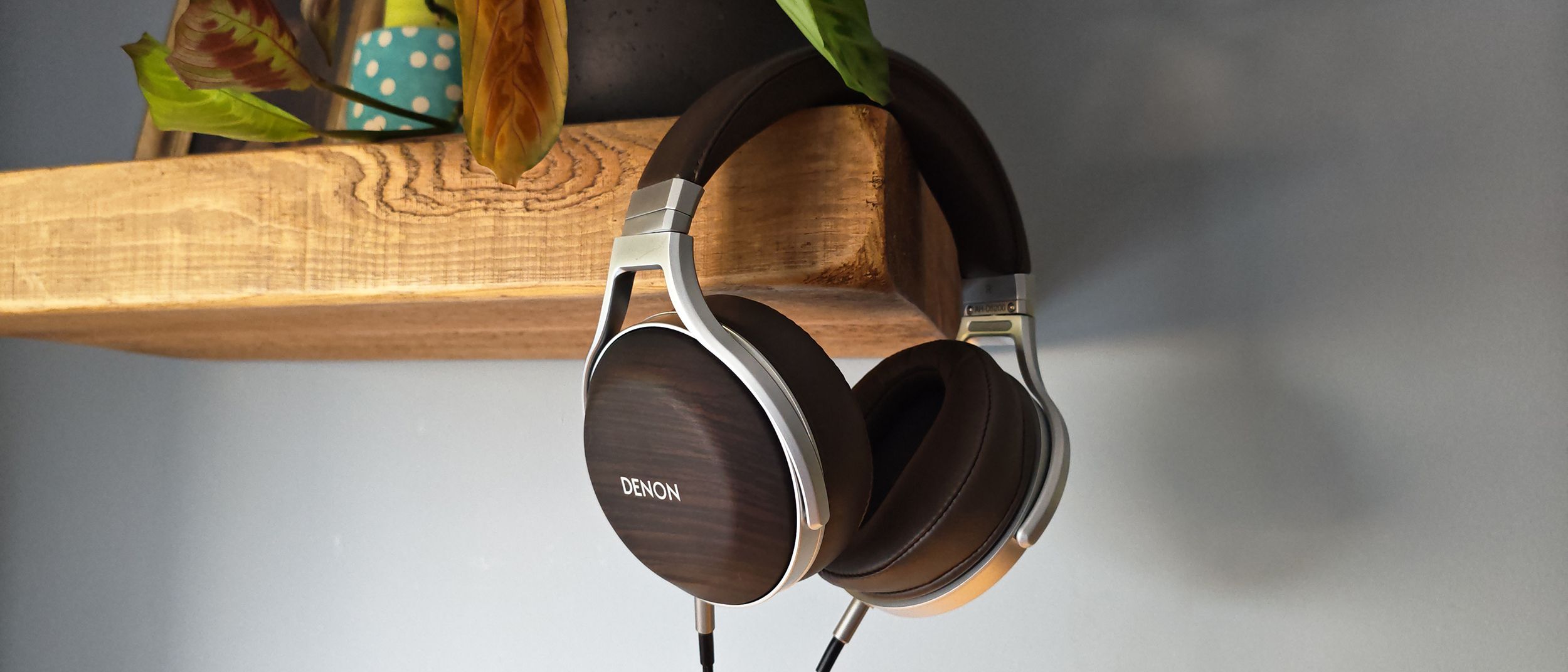
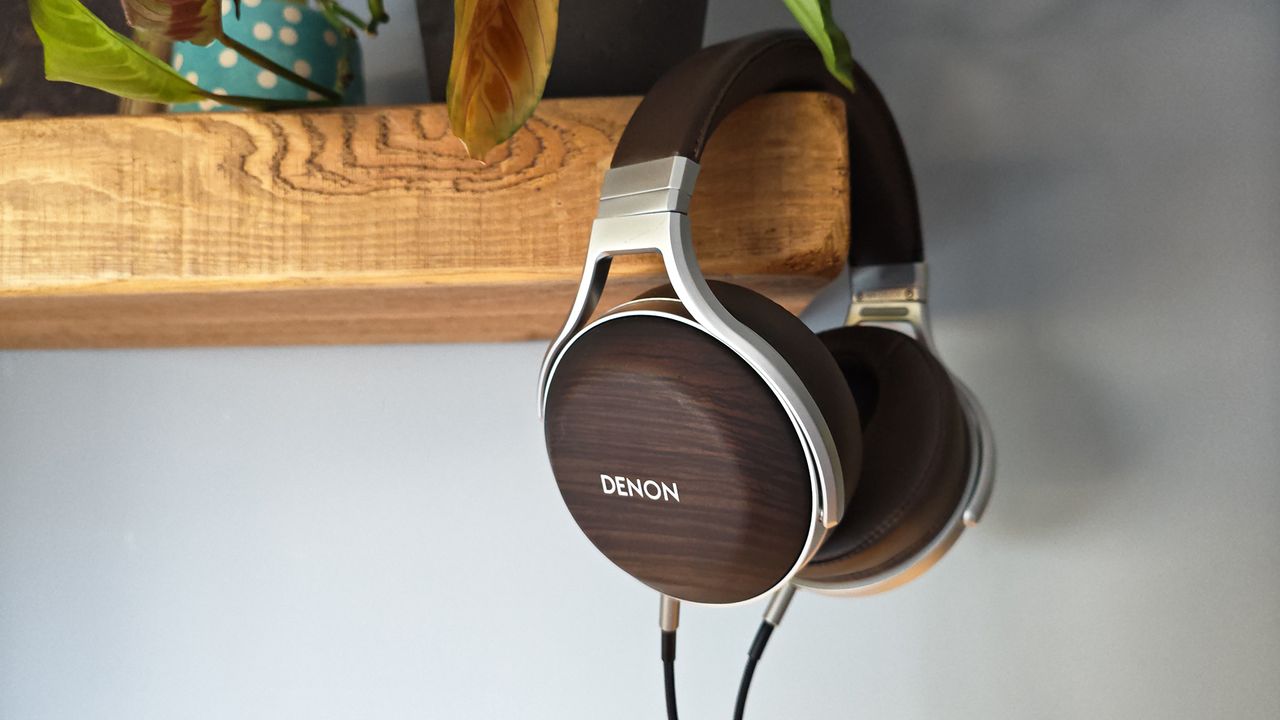
Denon haven’t made things easy for themselves with the AH-D5200s. After using them for around four months, I really, really like them, but they’re far from perfect. My short review based purely on sound: they’re one of my favourite headphones. There’s punchy bass, warm, smooth mids and a well-balanced treble response of well-placed peaks for detail. It’s a luxury sound for the masses, and I love it.
But with a retail price of $799 (actual prices range from $400 to $700), and a new generation of good quality budget closed back headphones out there, that recommendation comes with a few provisos. One thing’s for sure, they’re not making my list of the best budget audiophile headphones.
Specs
Driver & housing: 50mm Free Edge
Wood: Zebrawood
Cables: 3 metre 6.3mm & 1.3 metre 3.5mm, both with dual 3.5mm connectors
Impedance: 24Ω
Sensitivity: 103dB/mW
Frequency response: 5Hz to 40kHz
Weight: 385g
Perhaps most impressively (or weirdly?) the Denon AH-D5200s outshine their other two siblings, the AH-D7200 and the AH-D9200, both of which are considerably more expensive ($1,000 and $1,599, respectively).
Ultimately, I think the Denon AH-D5200s could be the perfect headphones for someone. But I suggest you read my full review before deciding whether that someone is you.
Sound profile
Image 1 of 3
(Image credit: Future)(Image credit: Future)(Image credit: Future)
Overall, the Denon AH-D5200s offer a balanced U-shape sound profile (a less extreme version of the high bass, recessed mids, high treble V-shape profile). The bass isn’t sub-focussed, but concentrates on a punchy, clean mid-bass. The mids do catch some of that warmth, and vocals will be too recessed for some, but I think they work well with a chilled out treble, offering clarity with 5-6kHz and 11kHz peaks. They are not about hyper detail or realistic timbre, though there is a nice level of detail and good separation between instruments.
Bass: This is the star of the show. Denon make the most of its 50mm dynamic drivers, made in Japan from a rigid, low-mass nanofibre material. Designed to minimise distortion, what you get is a clear, punchy bass, that only bloats into the lower mids a bit. I really like the clear layering of bass on tracks like Morph the Cat by Donald Fagen. The bass guitar is big and the kick drum thumps, and they are distinct and not mushed into one bassy blob.
Mids: Some of the reviews that I’ve found on the 5200s (such as Josh Valour’s) mention that the mids are a little disappointing. They’re definitely not the star of the show – if you want that, with all the realistic timbre that comes with it, the Sennheiser HD 600s, at just shy of $300, is still your best bet. But I like the colouration of the 5200’s mids. They’re creamy and make all vocals and instruments sound great – definitely not great if you want a neutral realism.
One thing of note, the 5200s perform that upper mids recess magic trick, where a scoop between 1.5kHz to 3kHz pushes vocals back a bit, and in so doing create the ‘feel’ of a deeper soundstage. I’m really not a mids purist, and I think this is done really well here. I’m also not someone that chases soundstage, so as long as vocals aren’t pushed too far back, as with the 5200s, I quite like this colouration.
Treble: The Denon AH-D5200s take a soft approach to treble that accentuates the smooth mids, and warm lower mids / bass, with a touch of treble detail here (5kHz) and there (11kHz). This presentation of treble is not sibilant or harsh to me, but if you’re sensitive to those areas, it might be for you.
Detail, separation, imaging: I think the level of detail is pretty good. I mean, that’s really not what this headphone is trying to excel at. But putting on slk by K-Lone – a track comprised of various static crackles that play separately in both ears, over a wash of synths and a steady beat, and the 5200s pick up a lot of the crackly detail. It’s not exciting, it’s measured.
I like the separation between instruments you get with the 5200s – case in point the bass guitar and the kick drum, mentioned above. But when you get to imaging – where the instrument is positioned in the sweep of music – they’re all pretty close together. A great test track for this is Michael Jackson’s Workin’ Day and Night. Starting with layered, rhythmic vocals and cowbell, soon electric guitar, Moog bass, drums, synth and piano join all together. This could (and does) sound like a mess with poor imaging headphones. But you can pick everything out with the 5200s – there’s space between each element. And yet, if you’re expecting some super wide presentation of the elements, well, I guess you’ll be wanting an open back headphone.
Price, value, competition
Image 1 of 2
(Image credit: Future)(Image credit: Future)
Price, competition and value. The AH-D5200s originally retailed at $799 in 2018. Now, that is flat out insane in 2026. There’s no way, today, these headphones can justify that cost (and luckily you can pick them up around $400–$500). Bottom line: There’s far too much competition at lower price points in 2026 for $800 to make sense for this sound presentation in this build.
This hints at a bigger problem in Denon’s high end headphone range – it’s out of step with trends in the industry. The closed back Fiio FT1 ($160, 2024), Sennheiser HD 620S ($300, 2024), and Focal Azurys ($549 $399, 2024) are three recent closed back headphones that offer a compelling (and in the Azurys, a similar) sound profile while undercutting the Denon 5200s price massively.
Denon’s AH-D range comes from a distant past (actually only 8 years ago), just before the explosion of Chinese audio companies changed customers’ expectations, and pulled Western brands into step. You can buy a lot more for a lot less these days (especially when it comes to budget IEMs), and established audio brands can’t afford to rest on their laurels. Either provide a great headphone for a reasonable price, or get left behind…
Or, I guess, position your product as a luxury item, and get fewer, but fully committed customers buy your product. In context to Denon’s line-up, that might make sense with the $1,599 AH-D9200, but it really doesn’t with the 5200s. It’s not as pretty as the 9200s yet, for me, it has a more enjoyable sound profile. And everything else about the build is the same…
That means the 5200s sit awkwardly in the headphone landscape in 2026, and though I really enjoy their sound, buying the 5200s only makes sense to me when their price is reduced.
Image 1 of 2
(Image credit: Future)(Image credit: Future)
When it comes to the Denon AH-D line up, the 5200 is my favourite of the three… in some areas.
When it comes to sound profile, they handily beat the 7200s. Vocals seem clearer and more up front with the 5200s; the 7200s seem more in your head, and boxy. With a slightly less pronounced bass combined with the recessed 1.5 – 3kh vocal range of frequencies, the 7200s are warm to the point of being a claustrophobic damp blanket (there’s a visual for you!). The 5200s present backing vocals wider, and there’s more room in between the voices to give them clarity and impact. The treble of the 7200s is also a lot softer for me (as I can’t make out the 16/17kHz peak that some charts show). Overall: meh…
The 9200s regain that clarity and wideness of vocals. There’s crisper treble to be enjoyed here – like the 5200s, but more. In fact, after swapping between all three headphones like a mad man, I feel the 7200s come of poorly when it comes to mids. There’s mud to be found there! It’s an intimate presentation… is what I’d say if I was being generous. But at $900, we can be a little harsher than that.
To justify the 9200s $1,500 asking price, we can be brutal.
Basically, I think the 5200s are a better headphone that the 9200s. You can dress up the 9200s sound signature however you like – it’s V-shaped, with pretty harsh treble (though admittedly excellent bass). And when that harsh spotlight is shone on the mids, with that 1.5 to 3kHz scoop, you end up with some sticky yet slightly hollow vocals. Compare that with the smooth vocals of the 5200s, and I think the 9200s are probably for only a select listener that loves its specific profile (but that isn’t me).
Comfort & build
Image 1 of 3
(Image credit: Future)(Image credit: Future)(Image credit: Future)
Comfort is a bit of an issue with the Denon AH-D5200s. There are softer ear cushions out there – like the marshmallow-like cups of the FT1 and FT 1 Pros from FiiO. The ear cups are also a specific rounded rectangle shape, which is very much not reflective of the human ear. It’s nice to have some room around your ears, and the 5200s don’t offer that. However, I don’t want to overstate this – the ear pads are still comfortable enough… just not $800 comfortable.
With the headband, it’s got some cushion, and I someone moving from a commercial set, like Sony‘s XM range, would call them padded. But again, if you want me to spend $800, I expect supreme comfort wherever possible. And you just don’t get that with this headband. It takes about 25 minutes of use before I get a slight hot spot at the top of my head, and uninterrupted listening for several hours is not really an option.
Weirdly, although the 5200s are the cheapest of the three Denon AH-D range, it has the most comfortable headband. The 7200s and 9200s both have the same headband with extra stitching. That looks great, but practically it just offers less depth of padding for your head… really, did no one test these out?!
The build of the 5200 is fantastic. The combination of leather and metal is expertly done. I really like the laddering clicks you get when extending the headband. It also feels like it’s indestructible. That’s a great feeling to have when putting them on for (part of )an evening’s listening.
One thing I am confused about is Zebrawood ear cups. They are light, and I’m sure they offer dampening effects are the main reason that the 5200’s bass doesn’t bounce around your head. But why on earth did they dye it dark brown? Natural Zebrawood is beautifully contrasted, light and dark. By dying it a dark chocolate brown, which is slightly darker than the lighter brown leather, they actually look cheaper… perhaps this was purposeful to make it less appealing than the other two (which retain their natural, beautiful wood finishes). Whatever the reason, it’s a huge fail for me (note: it’s hard to tell from my photos, as they look better than the wood in real life).
Should you buy it?
Image 1 of 2
(Image credit: Future)(Image credit: Future)
I really like Denon AH-D5200’s sound signature. But I find it hard to recommend anyone buy them at their retail price, not with the comfort issues that they present. I also think closed back headphones have come a long way since these were released in 2018, and there’s way better value options out there (though admittedly, not matching this exact sound signature).
However, if you find these at $500 or lower, and you’re after really good bass with smooth, warm-leaning mids, and an unintrusive treble response, the 5200s are worth every penny… as long as you can find an extra support band or cushioning for the hot spot-inducing headband.