
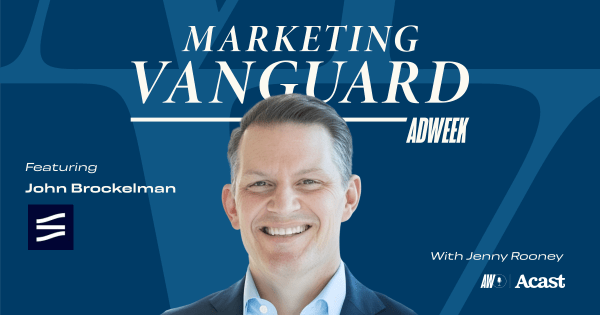
Financial services marketing is one of the hardest kinds of marketing to crack. But John Brockelman and his team at State Street Investment Management have proven, campaign after campaign, that it can be done well and done right. Tune in for his playbook on how financial services marketers can drive growth, connection and culture.
What you’ll learn:
- How to align marketing with sales and business objectives
- The importance of simplifying brand architecture for market expansion
- How to build intentional talent strategies by mixing specialized and generalist expertise
- Why guerrilla marketing and experiential activations outperform traditional advertising in regulated industries
- How to use strategic partnerships to reach new audiences
- How to scale AI adoption across marketing operations without replacing human creativity
John Brockelman is the chief marketing officer at State Street Investment Management. He is known for his expertise in brand transformation and audience-centered marketing strategy. With a unique background spanning nine years in Massachusetts politics and campaign management, followed by leadership roles at Fidelity Investments, John brings unconventional thinking to financial services marketing.
In his time with State Street, he has spearheaded the iconic “Fearless Girl” campaign and recently led State Street’s strategic rebrand and expansion into the retail investment market, including landmark partnerships with the WNBA and innovative campaigns across global markets like Japan.
His award-winning work, recognized at Cannes Lions, Clios, and Effies, demonstrates how purpose-driven, out-of-category thinking can drive meaningful business results while maintaining brand authenticity.
Episode Highlights:
[07:59] Start by Aligning Marketing with Sales and Business Objectives — John explains that when he became CMO, his immediate priority was tightly integrating marketing with the sales organization and business objectives, rather than focusing solely on brand awareness. This alignment is critical for CMOs working in regulated industries like financial services, where marketing must directly influence pipeline opportunities, new sales and client retention. For example, in his case, by establishing this connection early, he transformed State Street’s marketing from a cost center into a growth engine that drives measurable results. For CMOs in large companies, this framework ensures marketing investments deliver ROI and become indispensable to executive leadership.
[11:29] Simplify Brand Architecture When Expanding into New Markets — When State Street needed to reach retail investors, advisors, and institutions simultaneously, Brockelman recognized that their brand name “Global Advisors” no longer communicated their value proposition clearly. He discovered that clients simply called them “State Street,” revealing that the old brand architecture created confusion rather than clarity. The solution was rebranding to a simplified, unified name that immediately conveyed what the company does across all customer segments. This insight is vital for CMOs managing brands across B2B and B2C channels, where different audiences may interpret the same name entirely differently.
[14:49] How Data-Driven Partnerships Help Reach New Audiences Authentically — Rather than pursuing partnerships based on brand prestige alone, John analyzed the WNBA fan base data and discovered they had a significantly higher percentage of active retail investors—making it the perfect strategic fit for State Street’s retail expansion goals. This data-driven approach transformed what could have been a vanity sponsorship into a high-ROI partnership that naturally aligns brand values with target customer behavior. Opting for partnerships like these transforms partnerships from marketing tactics into strategic growth levers.
[22:32] The Three Core Areas You Should Deploy AI — John outlines a three-pronged AI strategy: marketing optimization (efficiency in ad buying and content acceleration), customer experience (personalization at scale) and analytics (attribution and ROI insights), rather than attempting a company-wide AI transformation all at once. This dimensional approach prevents the common pitfall of CMOs who pursue AI broadly without clarity on where it delivers the highest ROI. For CMOs in large organizations, this dimensional framework provides a roadmap to build AI capability progressively, allocate resources strategically and communicate progress to the C-suite in business-outcome terms.