
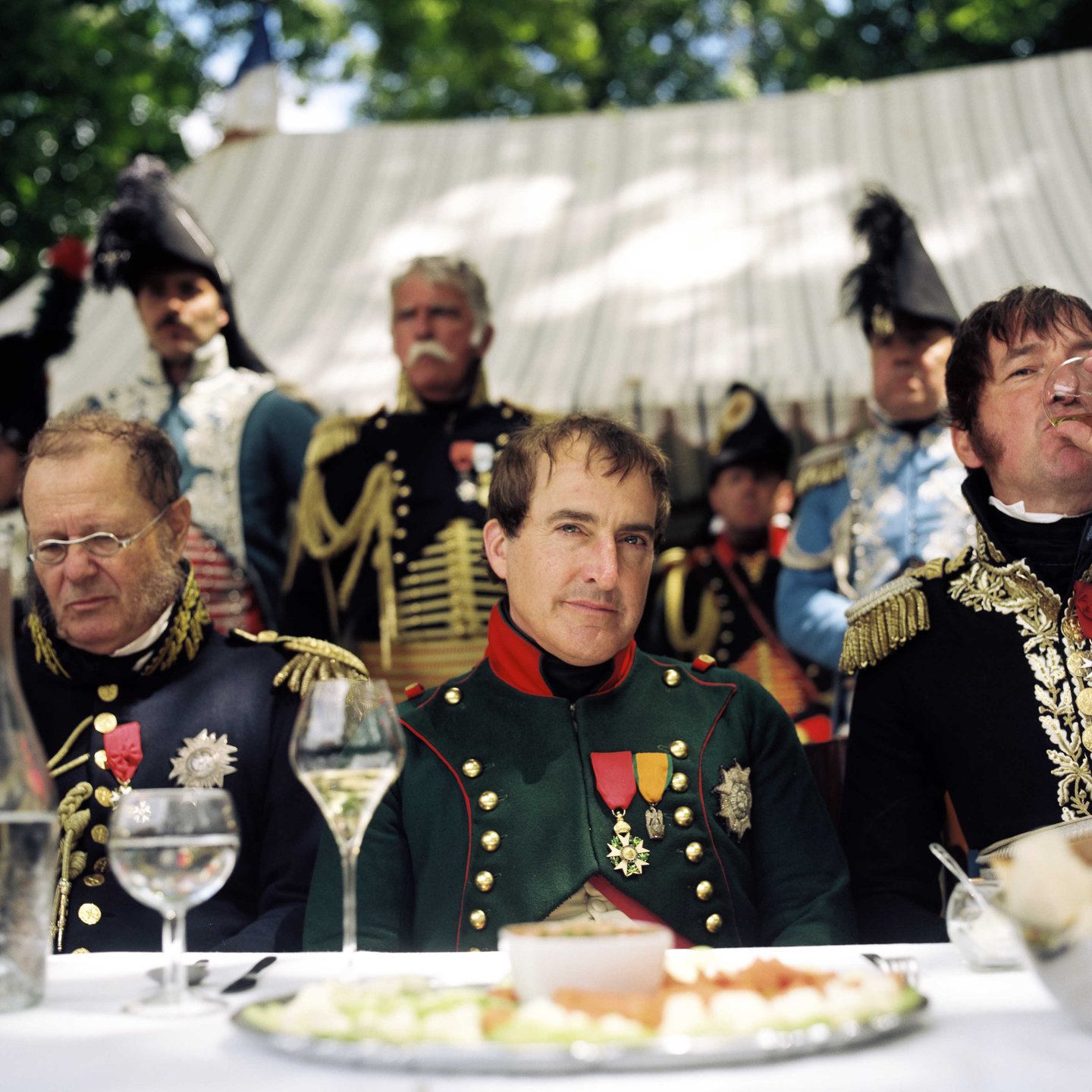
Reenactments are rigorously planned, and each have their own interesting (and often contrasting) rules. For example, at the Waterloo reenactment, Ana and any other non-reanctors are strictly not allowed on the battlefield, whereas, in the reenactment of the Battle of Vimerio, Ana was permitted access, with one stipulation: she had to dress up as a civil woman from the nineteenth century. Such regimented structures meant Ana had to be equally as intentional and pre-planned, emailing countries and organising permission, booking accommodation and food. When shooting the Waterloo battle on location, “I stayed at Le 1815 Hotel, which faces the battlefield. I ate at the restaurant Wellington just off the battlefield,” says Ana. “I’m fascinated by how everything had meaning and, in a way, evoked the battle.”
What Ana couldn’t have accounted for was the sensory bombardment of the events, even if there was no ‘real’ artillery. “The very first battle reenactment I shot was a disaster as the sound of the cannons was so strong that it seemed my body was shaking,” recalls Ana. “I had to run back to my hotel to get a Xanax and ended up missing the rest of the battle.” From then on, Ana knew earplugs and chemical relaxants were a must.
If you weren’t privy to the timeline of the invention of the camera and the fact that no photography of battles like Waterloo exist, you really could trick someone into thinking that Ana’s images are ‘real’. The haze of smoke above stationary soldiers, the calm after the storm of a battle, the majestic moustache on one heavily decorated actor (there are no iPhone faces in sight here), down to the prevalence of young, unsmiling fresh-faced men – the most-common human fodder of war. This dedication to as-close-as-possible rendition from Ana, taken on an original Hasselblad camera and 120mm film, is what makes it so satisfying when murmurs of modern life do emerge; take, for example, a horde of reenactors making their way onto a double-decker coach. Including these small moments of modernity – which almost feel like a buffer, a glitch in the image or a slippage of time – was a technique recommended to Ana by the photographer Martin Parr when she asked for advice for shooting battle reenactments on a Zoom call in September 2025, three months before his passing.
The desire to make the series wasn’t one only of historical interest, but personal too; Ana had a family member who fought in the Portuguese Napoleonic Battles, and her grandfather had somehow acquired the military jacket of General Beresford, a Marshal who fought in the battles. “My grandfather was a man of his time, so not too nostalgic, but he had a direct connection to this theme,” says Ana. “It led me to reflect on how time is not linear: one second I’m trying on a military jacket from a man who fought at these battles; the next I find myself in the centre of the battle reenactment, with the cannons and artillery.” Ana told her grandfather about her intentions to make the project a few days before he passed away – an instance that became her driving motivation, resulting in a captivating body of work that holds two contradictory yet inseparable things at its core: “traces of both life and death”.