
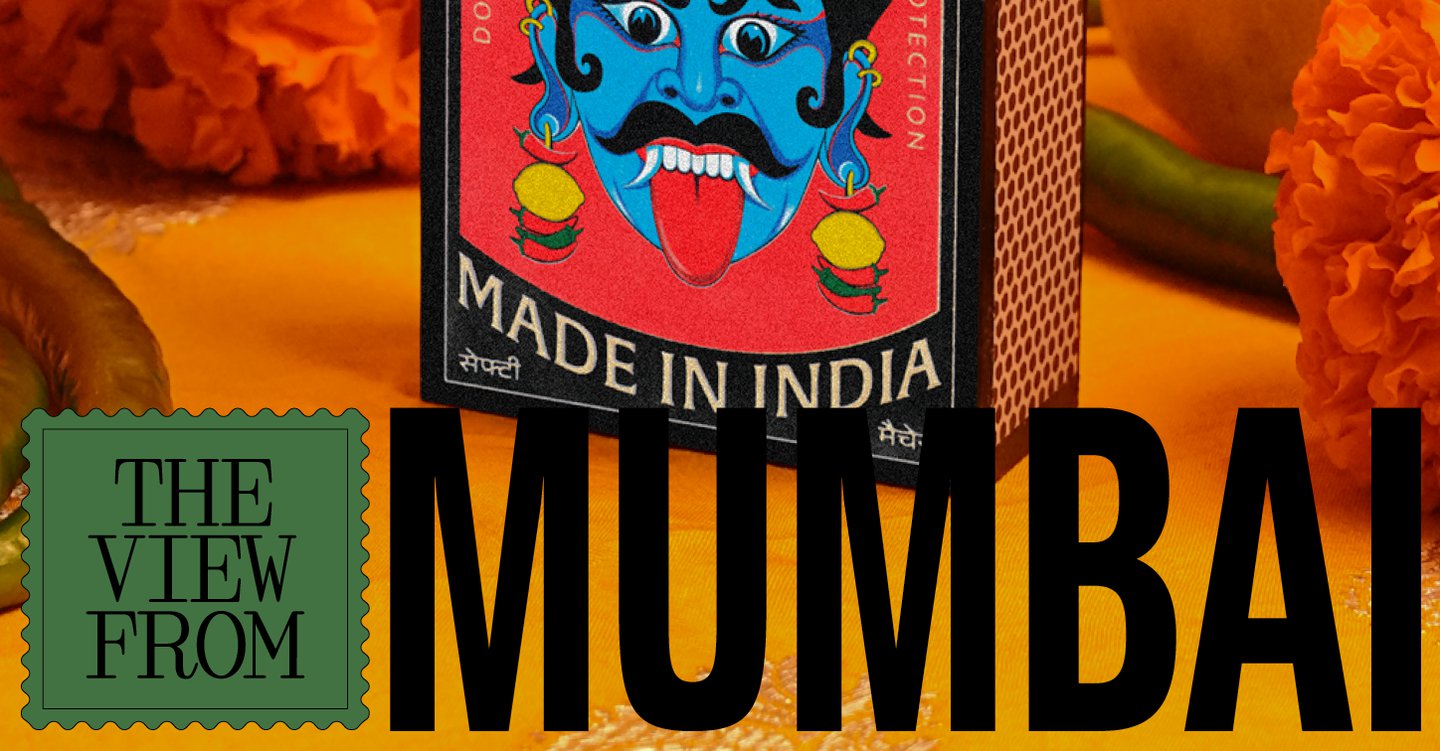
Maachis
Designer Sonal Nagwani, who started Maachis with Kevin Thomas and is now running it on her own, used to build miniature furniture out of matchboxes while growing up. “That tactile, almost obsessive relationship with the object never really left me,” she says.
Years later, she found phillumenist Gautam Hemmady’s matchbox archive through the Tasveer Ghar project on Google Arts & Culture. “The collection has thousands of labels documenting India through its visual grammar. The matchbox is the most democratic gallery that has ever existed, and the archives show just how wide their reach was and how consciously those anonymous designers used it to advertise, document, comment, and represent ideas that didn’t have other public platforms,” says Sonal. Along with Hemmady’s work, Farid Bawa’s work on the revival of Indian truck art also inspired the Maachis team.
Soon after these encounters, Sonal made it her mission to reimagine the matchbox for today’s world, and this led to the birth of Maachis, a contemporary design project that creates collectible objects. The idea, she says, is not to impose a contemporary message onto a heritage form but to find the thread already embedded in it and take it forward. “Social commentary was always in the matchbox’s DNA, and Hemmady’s collection showed us how early and boldly that started. We are just continuing that tradition.”
She cites one of the early boxes, ‘Swatantra’, as an example. The word means freedom, which was reinterpreted through the lens of queer rights. The Maachis team continued exploring it with their work: body positivity with ‘Sundari’, anti-evil-eye humour with ‘Anti Nazar’, and female autonomy with ‘Bullet Rani’, among others.
The object itself evolved, too. Maachis’ collectible matchboxes are crafted from wood, with magnets at both ends. Sonal designs many of the boxes herself, but also collaborates with other artists on a royalty basis. She is currently working with collaborators on a series exploring the subcultures and histories specific to various cities across India. “On formats, there is a lot more coming, including lifestyle and home products,” she adds.
Looking ahead, Sonal wants Maachis to be known for maximalism. She says: “The matchbox is inherently maximalist in the most unexpected way. It’s tiny but carries so much: pattern, colour, story, history, commentary. I want to push that further in terms of style and scale. We did a Maachis installation for a restaurant in Hyderabad, and that experience showed how far this visual language can stretch. That’s the direction I want to keep moving in: spaces, objects, and collaborations with artists and brands who share the same love for bold, layered, story-rich design.”