September 1, 2026
How Did This Get Approved?
Some weeks, the work is the story. This week, the approval process became the story.
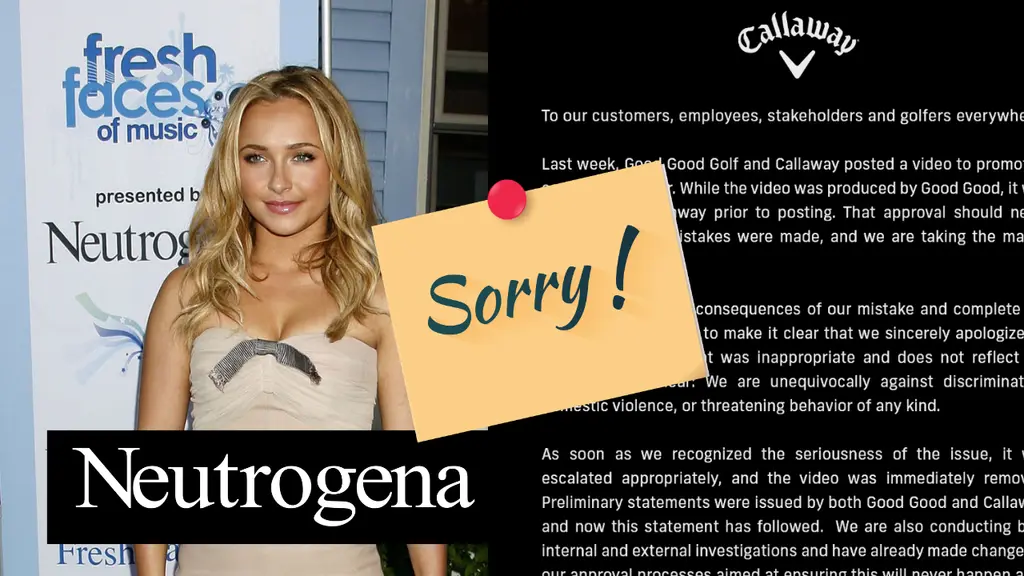
Callaway ended its partnership with Good Good Golf after a promotional video depicted violence against a woman. The fallout moved far beyond angry comments. Retailers removed merchandise, Good Good withdrew from sponsoring a PGA Tour event, Golf Channel canceled a related program, and Callaway committed $1 million to organizations addressing violence against women.
The controversy arrived during a broader run of brand crises. Target removed a children's Halloween costume that critics compared to racist minstrel imagery. Neutrogena acknowledged that it made former ambassador Hayden Panettiere feel unsupported when she spoke about postpartum depression. Texas Roadhouse confronted a different kind of crisis when viral food-tampering allegations were investigated and described by the company as a hoax.
These stories are not equivalent. Some involved work that should never have been approved. Another involved allegations a company said were false. The common lesson is that creative judgment, cultural awareness, fact-checking and crisis response are now inseparable parts of brand management.
Somebody must always be empowered to ask: What does this communicate? Who could it harm? Is it true? And what happens after it leaves the room?
Let's get into it.
The Gradient Team
The Lead
Callaway and Good Good Golf
Good Good posted the video on August 20 and deleted it the same day. The consequences continued. Callaway terminated its three-year partnership, Good Good withdrew from a PGA Tour title sponsorship, Dick's Sporting Goods removed merchandise, and Golf Channel canceled a related program. Callaway also pledged $1 million to organizations addressing violence against women.
Why it matters: This was not simply a social-media scolding. A creative approval failure disrupted distribution, sponsorship, content and commercial relationships.
Target
Target removed a children's clown costume after critics said its imagery recalled racist minstrel caricatures. The company apologized and said it was reviewing how the product reached the marketplace.
Why it matters: Cultural review cannot stop with advertising. Product design, merchandising, e-commerce photography and retail copy all shape the brand.
Neutrogena
Neutrogena acknowledged that it made Hayden Panettiere feel unsupported when she spoke publicly about postpartum depression. The statement came after criticism following her death, and the company said it would invest in women's health.
Why it matters: A delayed response can create a second controversy when audiences believe the brand avoided the substance of an ambassador's experience.
Texas Roadhouse
Viral posts alleged that employees had tampered with food served to Black customers. Texas Roadhouse said it investigated the claims with a third party and found no evidence supporting them.
Why it matters: Not every backlash is evidence of corporate wrongdoing. Communications teams must establish the facts, respond quickly and avoid treating an unverified allegation as a confirmed event.
On Our Radar
GRADIENT ORIGINAL ANALYSIS
The real issue is not that audiences are suddenly more sensitive. It is that brands operate in public, creators publish at speed, cultural meaning travels instantly, and screenshots outlive deleted posts.
Creative leaders therefore need more than taste. They need an approval system that identifies reputational risk before release and distinguishes a legitimate failure from misinformation after release.
Dentsu's AI-transparency commitment fits inside this larger conversation. As more work is generated, adapted and distributed through automated tools, documentation and human review become more important, not less.
What to do Monday: Add a red-team review before high-risk work goes live. Include someone outside the core creative team, someone close to the community being depicted, a communications or brand-safety lead, and one named person with the authority to stop publication.
The Work
When Packaging Becomes the Campaign
Betty Crocker is turning a packaging refresh into something people can wear, photograph and discuss.
Its Bettier Than Ever refresh includes updated packaging and The Betty Ate Collection, three limited-edition cake-slice handbags inspired by cake-mix flavors. The $89 vegan-leather bags connect product design, fashion, social content and retail timing. The first drop is available, and a second drop is scheduled for September 10 at 9:00 a.m. ET.
Why it matters: The strongest brand extensions do not feel randomly attached to the product. Betty Crocker translated recognizable packaging codes into a collectible object built for conversation. Performance results are not yet available, but the creative strategy is visual, ownable and naturally social.
Behind the Work
The General Mills announcement lists Edelman as a media contact but does not identify every creative, design or production partner. The GRADIENT will not assign campaign credit until the contributing teams are verified.
Icons We Lost
Dolly Parton: Creativity, Ownership and Generosity
Dolly Parton leaves behind more than a catalog of beloved music. She built a career across songwriting, film, television, tourism and philanthropy without losing the voice that made the work unmistakably hers.
In the United States, her streams increased more than 2,000 percent immediately following her death. Her career remains a lesson in originality, longevity, business judgment and using success to create opportunity for others.
Yayoi Kusama: A Visual Language Without Limits
Yayoi Kusama proved that a singular creative language could move across galleries, public spaces, fashion, merchandise and popular culture without losing its identity.
Her polka dots, pumpkins and Infinity Mirror Rooms became globally recognizable. Her brand collaborations demonstrated how an artist partnership can become a cultural event rather than a simple endorsement.
Creative Moves
Omnicom Media launches Hearts United
NETWORK CONSOLIDATION
On August 28, Omnicom Media officially launched Hearts United, combining Hearts & Science and Mediahub. The new network will operate in 40 markets with approximately $9.1 billion in 2025 billings. Nicole Estebanell leads the U.S. operation and Ross Jenkins leads EMEA.
Omnicom Media also said it had won $4.1 billion in new client billings in 2026 through the announcement date, citing Adidas, Delta, Dyson, IBM, Mark Anthony Brands, Novo Nordisk, On and Subway.
Why it matters: The move creates another scaled global media network and shows how holding companies are reorganizing brands around data, buying power and client growth. Omnicom did not disclose workforce effects, so The GRADIENT is not characterizing the launch as a layoff event.
Havas wins Peroni Nastro Azzurro globally
ACCOUNT WIN
Asahi Europe & International selected Havas after a review that included incumbent McCann, adam&eve\TBWA and Leo. The change places Peroni and Asahi Super Dry under one global creative partner.
Why it matters: Clients continue to consolidate global brand platforms when they believe one partner can create greater consistency across markets.
Taboola expands with NBC News
MEDIA PARTNERSHIP
Taboola's Realize platform will support global programmatic display across NBCNews.com and TODAY.com, expanding a relationship that previously centered on native advertising and recommendations.
Why it matters: Performance platforms are looking beyond a single format and positioning themselves as broader infrastructure for the open web.
Burson brings Limbik and Decipher technology in-house
ACQUISITION
Burson acquired the cognitive-AI company whose technology supports Decipher, a platform designed to forecast how communications may resonate across audiences in more than 60 markets.
Why it matters: Communications agencies increasingly want proprietary products, engineering talent and control of the technology roadmap.
Workforce Watch
No newly verified major advertising-industry workforce reduction cleared The GRADIENT's publication threshold between the August 16 cutoff and August 30. Earlier WPP, VideoAmp and Comscore reporting is not repeated without a material new development.
In gaming, the independent ASGC tracker reported 10,140 confirmed industry layoffs through August 11 and projected 14,666 for the full year. This is an independent estimate, not an official industry count, and should be read as a directional workforce signal.
Advertising + Creative
Advertising + Creative
The biggest advertising lesson this issue is operational. Creative reputation is influenced by everyone who touches an idea, product or response, not only the team that makes the final asset.
The Havas win also shows that account consolidation remains active. A global creative remit can offer consistency, but it raises the stakes for local cultural review. One platform still needs enough flexibility to work responsibly across markets.
Media + Money
Media + Money
Hearts United is the issue's most consequential agency-business development. Scale is the promise: larger buying influence, shared intelligence and a broader client footprint. The test will be whether the new network preserves distinct strategic thinking while delivering operating efficiency.
Taboola's expanded NBC News relationship is another infrastructure story. Buyers should ask whether broader access produces measurable incremental value without weakening publisher control, contextual safeguards or audience trust.
PR + Communications
PR + Communications
Burson's acquisition of Limbik brings cognitive-AI technology, engineering and research talent into the agency. Predictive tools can add another signal to strategic judgment, but they should not be presented as certainty. Communications teams still need cultural context, qualitative research, responsible data practices and human accountability.
The backlash stories also provide a crisis reminder: do not publish a generic statement before the facts and the brand's own role are clear. A response should address the actual concern, identify what is changing and avoid language that sounds designed only to quiet the news cycle.
Creator + Influence
Creator + Influence
The Good Good case demonstrates how creator partnerships now sit inside a network of connected commercial relationships. A single piece of content affected sponsorship, retail, television and brand equity.
Creators need a clear review path for sponsored content. Brands need contracts that define approval rights, crisis cooperation, permitted uses and termination terms. Both sides need a named decision-maker when speed and judgment come into conflict.
The lesson is not to make creator work bland. It is to build a system that protects bold ideas from becoming careless ones.
Creative Technology + Gaming
Dentsu Makes AI Transparency an Agency Commitment
Dentsu says it is the first global marketing and advertising group to sign the EU Code of Practice on Transparency of AI-Generated Content. The code supports transparency requirements under the EU AI Act that took effect August 2, 2026.
Dentsu says it will develop operational workflows, technology capabilities, employee training and labeling practices for certain AI-generated or manipulated client content.
Why it matters: Creative teams working across markets need consistent rules for labeling, detection, approvals and documentation. Transparency can no longer live only inside legal review.
IFA Expands Its Content-Creation Floor
IFA Berlin says its Content Creation Show Area will grow by 70 percent and span two halls from September 4 to 8. The program includes cameras, drones, lenses, studio tools, storage, VR, AR and AI-enabled editing.
Why it matters: Creator tools are being treated as a connected production ecosystem, not a collection of individual devices.
Film, TV + Production
Venice opens with an active public program
The 83rd Venice International Film Festival runs September 2-12. Online ticket sales opened August 29. The official program also added NAZA, a Guardian-produced documentary, on August 24.
TIFF publishes its complete 2026 schedule
The Toronto International Film Festival runs September 10-20 with 293 titles. The inaugural TIFF: The Market runs September 10-16, adding a formal business and rights marketplace alongside the public festival.
Business of Creative
Five approval terms to settle before the work goes live
- Final approval: Identify the one person who can authorize publication and the one person who can stop it.
- Cultural and factual review: Define which work requires specialist review, community context or claims verification.
- Creator responsibilities: State what content requires brand approval and what remains within the creator's independent voice.
- Crisis cooperation: Set response times, points of contact and responsibilities if the work creates controversy.
- Removal and termination: Clarify when content can be removed, what happens to paid media and merchandise, and which breaches can end the relationship.
The goal is not bureaucracy. It is clarity before the pressure arrives.
Opportunities
PhotoVogue: Brave New Visions
Final deadline is September 11th (2026-09-11)
A global open call for artists 18+ working in photography, video and multimedia. Three grants total $12,000; AI-generated work is not permitted.
More Opportunities
WATCH DOCS Film Festival
Deadline: September 15 (2026-09-15)
Open to socially engaged documentary films produced in 2025 or 2026.
Campaign BIG Global Awards
Second deadline: September 17 | Final deadline: October 22 (2026-09-17 – 2026-10-22)
Global awards program for creative work with a focus on ideas and impact. Review categories, fees and eligibility before submitting.
ONE Asia Creative Awards
Final deadline: September 18 (2026-09-18)
Open to work from across the Asia-Pacific region. Confirm category eligibility, regional requirements and fees before entry.
Black Public Media Open Call
Opens September 1 | Deadline: October 1 (2026-09-01 – 2026-10-01)
Open to nonfiction projects suitable for public media. Five projects will be invited into talent development and one is expected to receive a PitchBLACK award; review rights, deliverables and participation terms carefully.
Upcoming Events
Fast Company Innovation Festival
September 14-17 (2026-09-14 – 2026-09-17)
Four days of innovation and insight from the leaders, companies and creative thinkers designing the future — thought-provoking talks through behind-the-scenes company tours.
SHOWCASE Retail + Commerce Media Upfront
September 2 (2026-09-02)
Invite-only, one-day program at The Times Center for retail media networks, brand leaders and agency buyers.
83rd Venice International Film Festival
September 2–12 (2026-09-02 – 2026-09-12)
The public screening schedule is live and tickets are sold online while seats remain available. Accreditation-holder reservations begin August 27.
IFA Berlin
September 4-8 (2026-09-04 – 2026-09-08)
The world's most important event for consumer electronics and home appliances. Every September, 1,900+ exhibitors from 49 countries meet 220,000+ visitors at Messe Berlin to launch products and close deals.
Toronto International Film Festival
September 11-14th September 10–20 (2026-09-10 – 2026-09-20)
TIFF published its 2026 schedule on August 11. Member ticket sales run August 21–27, the Insider, Visa and Under-25 presale is August 28, and public sales open August 31. TIFF: The Market runs September 10–16.
IBC2026
September 11–14 (2026-09-11 – 2026-09-14)
Broadcast, media, entertainment and production technology at the RAI.