
October 1, 2026
Accountability is becoming part of the brief
From Clean Creatives
1:Introduction
The summer of 2026 will be remembered as one of the hottest on record and a precursor to an El Niño weather event that scientists predict will be the largest in at least 1,000 years. It is projected to cause global supply chain shocks, devastating weather patterns, and could “push 50 million people into acute hunger.” But the mainstream media continually fails to link these events to climate change.
Despite headlines about extreme heat, most news stories made no mention of climate change, the 57 fossil fuel polluters responsible for 80% of global carbon emissions since 2016, or the industries that enable their operations – such as the communications industry.
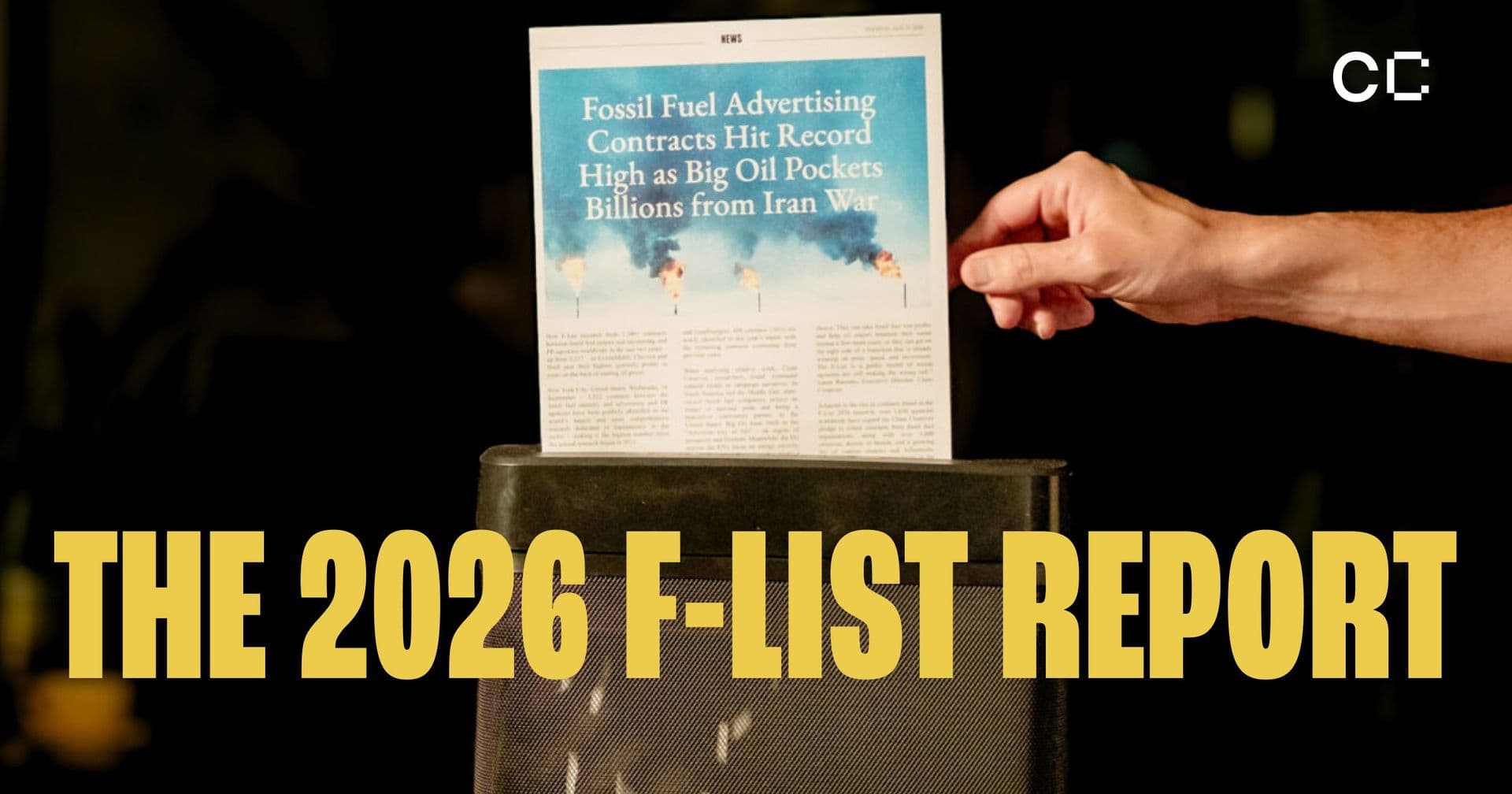
This is Big Oil’s marketing machine at work. While oil majors made $93 billion in three months from the Iran war and climate crisis, their agencies have quietly distanced themselves from that work – even as they continue to protect their fossil fuel clients’ social license and obscure the truth. This is the creative cover-up.
Today’s creative campaigns are positioning oil and gas as indispensable to energy security and economic stability, when oil and gas demand is actually slowing down and solar PV met the largest share (27%) of growth in global energy demand. We have the solutions we need, but the fossil fuel industry is stirring fear and insecurity to delay climate action.
We believe that creatives should have the tools and information to come to their own conclusions. Here is the work you weren’t meant to see.
Written by Nayantara Dutta, Head of Research, Clean Creatives
Meet the research team
Nayantara Dutta
Head of Research
Alice Rogovoy
Researcher
Rinni Haji Amran
Researcher
Tom Robinson
Researcher and Data Analyst
2:Why we publish the F-List
The F-List is the largest public database that records relationships between advertising and PR agencies and their fossil fuel clients. Drawing entirely from public records, it stands as a source of truth in a time of disinformation.
In our sixth year of research, the F-List 2026 contains the highest number of contracts since the annual research began, with a record 1321 contracts from 802 agencies and 386 fossil fuel clients in 2025 and 2026.
Over the years, this report has led to transparency and accountability in the industry. After Havas won Shell’s global media contract in 2024, four Havas agencies were stripped of their B Corp certification and Havas, as a whole, was barred from future certification. This was a direct result of F-List research and the concerns it raised.
We have created tools to help creatives, agencies and brands make informed choices, like our database of Clean Creatives-certified agencies to help creatives find their next job and brands to find agencies to hire.
Today, over 1,650 agencies and 4,600 creatives have signed the Clean Creatives pledge to decline future work with fossil fuel clients. We have a global community ready to welcome anyone who wants to use their power for good.
3:Behind the data
2026 Methodology
The 2026 F-List reflects all contracts Clean Creatives identified between agencies and fossil fuel clients globally in 2025 and 2026.
Contracts marked with an asterisk (*) have evidence of termination, but are included if active at any point in these two years.
Our research is based entirely on public records, which include lobbying databases, government filings, LinkedIn ads, award show databases, creative portfolios and social media posts. While public records provide verifiable proof of a contract, this methodology means that our database is not exhaustive. Additional contracts may exist that have not been disclosed externally. Contracts are sorted by region, and we categorize a contract as “Global” if we find evidence in at least two regions.
We welcome updates from any agencies that have ended their fossil fuel contracts. In most cases, we require over three sources to verify an F-List contract; sources can be provided on request.
We consider an agency to be any advertising or PR company that provides these services: full-service, creative, digital, PR, media, production, public affairs, data, market research, animation, motion design, events, OOH, sponsorship & sports, trade groups and brand studios within large publishing companies. The following are excluded from the F-List, as they do not directly work on public influence fossil fuel campaigns: recruitment, packaging design, post-production, casting and internal communications.
We consider a fossil fuel company to be any company with over 50% of revenue or generation from fossil fuels, including: oil majors, majority fossil fuel utilities, gas utilities, petrol distributors, oil and gas production, midstream oil and gas, LNG companies, LPG companies, coal production, oil and gas services, refinery companies, lobbying groups, and some exceptions primarily in the business of fossil fuels, such as petrochemicals, oil and gas trading, and oil and gas conferences. A list of clients meeting this definition is available in our fossil client database.
What’s new this year
This year, we focused on longitudinal analysis, using our six years of data to identify themes and geographical trends over time. The report now includes year-over-year comparative data, showing how fossil fuel contracts have shifted across the industry.
For the first time, we have published our historical database, recording all years a contract was found active. Previously, the F-List indicated only if a contract was active in the current or previous calendar year. Now, the complete contract history is available, including how long each relationship has been active.
Dirty Work, our new interactive case studies database, provides more access into the creative work and conflicts of interest behind the F-List.
Our fossil fuel client database has grown from 500 to 769 clients, and geographical representation has expanded from 67 to 73 countries.
AI disclosure
Each contract on the F-List has been discovered and fact-checked by our research team using public records. AI has not been used for data analysis and has not informed any of the conclusions in this report. Our researchers have used AI as an advanced search engine to find:
- primary sources like annual reports and sustainability disclosures, to inform human analysis of whether a company derives over 50% of revenue or generation from fossil fuels
- holding company structures, to determine whether agencies are independently owned
- names of fossil fuel clients, for use in open source research
4:Key findings
Natural gas in the Global South
Natural gas is being positioned as a driver of progress and is the theme of many new fossil fuel campaigns, such as Tokyo Gas’ 2026 campaign which highlights how LNG led to economic growth in Japan and Naturgas’ ‘‘Gracias Al Gas” campaign that encourages Colombians to post social media videos thanking natural gas for its role in their daily lives, crediting natural gas with helping Colombians eat, bathe, move and breathe cleaner air.
Economic insecurity
Oil companies are positioning themselves as essential to modern economies. Dentsu X Thailand’s campaign for PTT responds to young people’s desire to move abroad by framing an oil company’s prosperity as a reason to stay. Dentsu agency Carat’s digital ads for Chevron, meanwhile, credit the company’s tax revenue with funding public services and infrastructure in Australia.
Humanizing energy
In Yello Germany’s mockumentary “Welcome to the Sonnenborgs”, produced by Odaline, bsp media, Jung von Matt and Mutabor, the energy transition is staged as a humorous lifestyle choice. In the web series, a sustainable family moves in next door to climate villain Klyma Wandl – Yello’s recurring fictional character whose name is a play on the German term for ‘climate change’ – framing the climate crisis as a matter of individual consumer morality, instead of a consequence of large polluters. Similarly, in E.ON Energy Sweden’s 2025 “Jag är Energin (I am Energy)” campaign, by BBDO and Pine Studios, energy speaks in first-person, saying “my presence keeps the world moving, but I’m taken for granted until I’m gone.” By personifying energy, the campaign uses themes of fear and scarcity to position fossil fuel energy supply as an essential service.
A look at the numbers’
The 2026 F-List uncovers 1321 contracts from 802 agencies and 386 fossil fuel clients in 73 countries.
Most of these contracts are appearing in a public database for the first time: 733 contracts (55%) are exclusives that have not previously appeared in news coverage, and 588 (45%) have been reported on before.
Most agencies have stayed on the F-List: 503 agencies (63%) listed in the 2025 F-List continue to appear in the 2026 F-List, while 299 agencies (37%) are new to the list this year, not including agencies that have been consolidated or renamed. Lastly, 186 agencies that were on the 2025 F-List have since dropped off, either due to a lack of evidence or their contracts ending.
Holdcos vs. independents
Holding company contracts account for 303 (23%) of this year’s F-List, with 1018 (77%) from independent agencies – a similar ratio to 2025, which had 295 (24%) holdco contracts and 918 (76%) independent contracts. In absolute terms, holdco contracts grew by nine year-over-year, a 3% increase, reflecting continued relationships between major holding company agencies and fossil fuel clients.
Holding companies
View all (7) View all holding companies (7)
Top agencies
View all (802) View all agencies (802)
Top clients
View all (386) View all fossil fuel clients (386)
5:Holding company analysis
The state of the industry
Since 1961, the advertising industry has been defined by the holding company model and the “Big Six” networks. In recent years, however, legacy brands and institutions have been dismantled by mergers, most notably Omnicom’s acquisition of IPG in November 2025. In 2026, WPP announced it is moving “from a holding company structure to a single company”, and Dentsu relaunched 360i, a digital agency, which was previously folded into Dentsu Creative, to stand out “in an era of acquisitions.”
2026 has also been marked by mass layoffs and displacement across the industry. Despite multiple holding companies setting SBTi targets and partnering with Ad Net Zero and the UN Global Compact, none have made a tangible commitment to addressing emissions across all areas of their business, like signing the Clean Creatives pledge. Agencies routinely disclose operational emissions from offices, travel, and printing, but none have addressed the advertised emissions generated by working for fossil fuel clients.
Dentsu
Dentsu has maintained consistent sustainability reporting over the years, but notably excludes the emissions generated by the fossil fuel products they market from its GHG emissions disclosure. In their 2026 climate report, they acknowledge the risk posed by clients who do not “adapt to low-carbon consumer behavior” and identify the opportunity to access “new markets, suppliers and companies emerging during the low-carbon transition.”
Despite this, Dentsu has steadily expanded its fossil fuel portfolio. Since last year, Dentsu’s F-List contracts have increased from 18 to 24, with four new contracts from Dentsu Creative, including two new contracts in Europe for Orlen and GRDF. Our analysis shows that Dentsu holds 88% of its fossil fuel portfolio across just two regions: UK & EU (50%) and APAC (38%). Dentsu may acknowledge the business opportunity for its clients in going green, but has not invested in it yet itself.
In 2023, Dentsu followed Purpose Disruptors’ methodology and published its advertised emissions – the emissions driven by increased sales from its advertising – which were 32 times higher than its operational footprint. Dentsu acknowledged that taking responsibility could “influence Dentsu’s reputation as a climate leader,” but has not repeated this methodology in subsequent reports.
Clean Creatives’ Fossil Fuel Income Risk Exposure (FFIRE) index identifies Dentsu as the holding company with the smallest relative percentage of revenue from fossil fuel clients (0.15%), giving it the clearest financial pathway of any major holding company to step away from fossil fuel work.
DJE Holdings (Edelman)
Edelman is the most notorious PR agency for its harm to the climate, and has repeatedly covered up the tracks of that work. Over the years, the agency has handled PR for the UN Climate Talks while simultaneously representing the world’s worst polluters including ADNOC, Chevron and Shell.
Edelman’s 2026 Trust Barometer identifies misinformation as a key threat to society, yet the agency has a documented history of creating astroturfing campaigns for the American Petroleum Institute and launching a platform for ExxonMobil to obstruct climate legislation.
In 2021, Edelman responded to Clean Creatives’ open letter to drop fossil fuel clients by saying “we have an obligation to do more — not less — work related to climate change,” but they client roster tells a different story. Clean Creatives’ Fossil Fuel Income Risk Exposure (FFIRE) index estimates that Edelman is financially dependent on fossil fuel income at a rate more than 8 times higher than other holding companies, with an estimated 5.64% of revenue from fossil fuel contracts.
In 2025, Edelman announced a climate transition plan to meet its SBTi targets and “prepare…for a low-carbon future,” but has not publicly shared the details. While the agency recognizes the climate risks of flooding and heat waves on its business, it takes no responsibility for the role its clients play in fueling those risks. Edelman’s F-List contracts have decreased from 10 to 8; Clean Creatives attributes this decrease to a lack of public disclosure rather than a change in business practice.
Havas

Originally published by Clean Creatives