
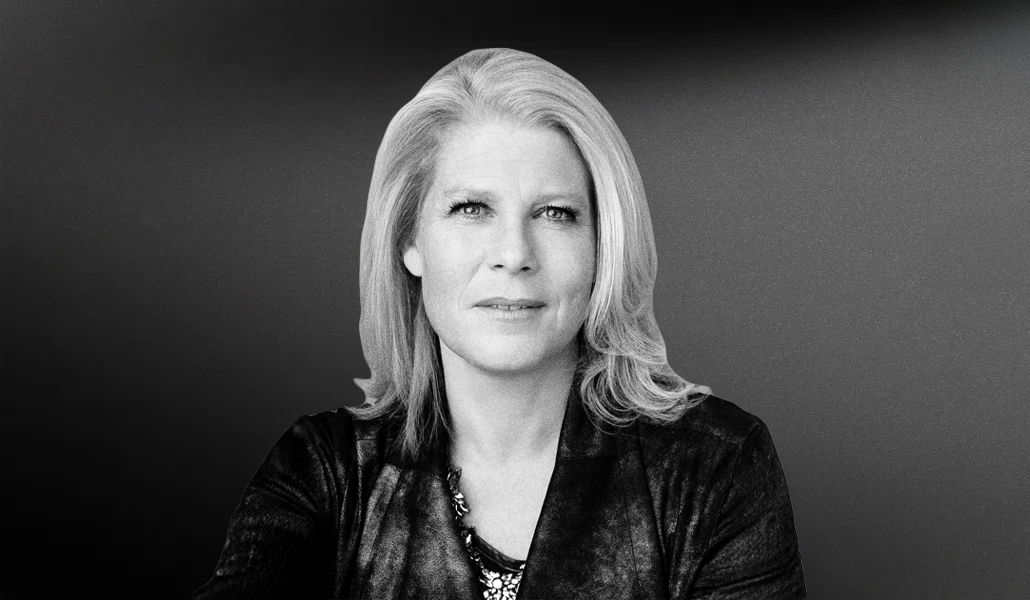
Anyone in the marketing or agency world knows Linda Boff. The longtime CMO for GE in its heyday, Boff is somewhat of a marketing guru, having worked with multiple agencies over her years.
Today she’s the CEO of independent marketing services group Said Differently, which is private-equity owned and operates a bit differently than your usual agency. For one, it’s fully remote and runs on only about 25 full-time staffers, with a network of about 2,000 people available on a freelance basis for whatever it is the client needs. Most of the work is project-based, and Boff proudly declared no client — which includes UNICEF, designer Marc Jacobs, Honeywell and Brookfield, and a roster of some 25 B2C and B2B clients — has never not returned for a second project.
Boff believes in creative tension that’s not “acerbic,” as she put it, and ran her marketing at GE with a variety of agencies to come up with the solutions that worked best for that industrial giant’s needs.
“I found it very valuable to assemble a group of agency partners and thinkers, and it was by design to have people who were, in some ways, competitors with each other around the table,” said Boff. “We had no issues with having BBDO and the Barbarian Group and Mekanism and Gary Vee all around the table … I’m a fan of tension because I think tension can create greatness, particularly on the on the creative side. And so, the fact that people had differing points of view, I thought made our brand stronger.”
And while she still maintains connections with some of today’s holding company leaders, she has become a full-throated believer in the independent model because of its flexibility and because technology has reduced the import of scale in this business.
Boff shared her thoughts in an interview that’s been edited for space and clarity.
Talk about why you joined Said Differently two years ago and what differentiates it from other independents.
When I met with Said Differently, I was so struck that the co-founders [Rachel Barek and Brian Skahan] had created a version of what I had always tried to do at GE, which was to bring voices together and use those divergent voices to the benefit of the brand. And what Said Differently was founded on — and we we still adhere to this — is that those voices don’t need to be full time employees under a single roof. In fact, we don’t have roofs, we don’t have halls. We’re virtual.
What we do have is people in the spaces that you would imagine: creative, production, strategy, etc. We have a network of a couple thousand people who are just a couple degrees of separation. It’s people we’ve worked with, and we deploy them against every new project in a way that a tailor does things. It’s something that fits that fits you, and doesn’t fit somebody else. That tailoring is the magic of what we do.
The model seems to reflect the need for greater flexibility.
The model is precision over size. We think of ourselves in a boutique way, but boutique with scale, if you will, because our our ability to cast is not who’s in the hallways, but everybody in the world, so to speak.
What kind of client does that attract?
We we are not for everybody. That’s OK. It’s better in this world to have some lanes. I think that we do particularly well with B2B, which is growing quite a bit for us. Financial services, IT services, professional services. We’ve worked with law firms. Maybe I play a bit of a role here because of my GE DNA. I think the the most interesting challenges in our industry are often the ones that, on the surface, may not seem as sizzly, but need love and attention.
And the mining for the brand truth — there’s always a brand truth, and it’s always something that can be expressed in a way that can make you fall in love with a brand.
That makes you very different from the holding company model, and even many other independents that have built large staffs.
I do think independents are having a genuine moment. I hope it’s more than a moment. I hope it’s a movement. Because we don’t have the the layers of approval. We don’t have practices standing in our way. We don’t have share owners that we are obliged to satisfy every quarter. I know the importance of that, but it’s not something that we have to think about. What we have to think about is what our clients’ needs are, and how we can move at their speed, not just to keep pace, but hopefully stay ahead of them. I think it goes back a little bit to what I said: precision over size.
I have wonderful friends at the holdcos. I root for them fiercely. That being said, the holdcos are figuring their way out, some in different stages than others. I worry a little bit about where the clients fall in all of that. Because that’s our business. We are a service business designed to hopefully bring an outside voice and perspective to create magic and growth. That’s our job.
And the quicker we can get about doing that job, the better I think our clients are. It’s hard to be a woolly mammoth and move at the speed of the smaller agencies.
I think that’s that’s worst case scenario. Those things depress what is the intent of the many people you and I know in this industry. I think the intent is good. It’s the downward pressure.
What are the best and the most challenging things about being owned by private equity?
There is tremendous clarity about what direction you need to go and what number you’re playing for —what those metrics and KPIs are … I like knowing what it is we’re playing for, and then figuring out how we are exceptional at doing that.
Private equity varies by owner. In the case of Said Differently, we have a benevolent private equity owner that has no interest in doing my job — what our strategy is, who we hire. And yet is there as needed for coaching in the right ways. That said, I have spent way too long knowing that financial discipline is part of the deal. You always have a boss.
Color by numbers
The Association of National Advertisers last week released another report, this one on influencer marketing — and the last that longtime evp Bill Duggan has been associated with, as he steps down after 26 years at the organization. Part of the report includes a study of 102 respondents in marketing about the practice. Turns out vetting them cuts across all concerns. Some results:
- When asked to rate the importance of each step in the influencer marketing process on a scale of 1-5 (5 being the most important), the most important turned out to be selecting (100%) and vetting influencers (97%). Lowest was agency compensation (37%).
- When asked to rate the ease/difficulty of each step in the influencer marketing process (5 being the most difficult), the most difficult were measurement (32%) and vetting influencers (25%).
- Finally, when asked to identify the steps of the influencer marketing process that provide opportunities to eliminate waste and optimize investment, on a scale of 1 to 5, where 5 Is highest, negotiation and contracting, vetting, selecting and agency comp all tied at 32% for highest. Measurement was close behind at 29%.
Takeoff & landing
- Omnicom Media officially announced the launch of Hearts United, which is the combination of former IPG media agency Mediahub and Omnicom’s Hearts & Science. The combined shops will operate across 40 markets, tallying some $9.1 billion in 2025 media spend. Nicole Estebanell, who was CEO of Mediahub, will be U.S. CEO.
- Worldwide Partners added 10 new agency partners across Europe, North America, Latin America and Asia Pacific, including Mediasmith, experiential shop Penta Marketing in LatAm, Polish full-service shop Keino Grupa and Austrian digital agency page 84.
- Marketing & tech agency Merge acquired St. Louis-based Brado’s Insight and Digital practices, expanding its behavioral research and GEO capabilities.
- Personnel moves: Mediaplus Netherlands named Tessa van der Starre its new CEO, following an 18 year run at WPP … Omnicom Media U.K. promoted Frederica Constable to chief growth officer … WPP Media in India promoted Pratik Thakkar to vp, client services.
Direct quote
“If other platforms follow Meta in completely locking out teens during certain hours, and putting default time limits on their content, the entire social ecosystem could shift. This could mean greater adoption of emerging social platforms not beholden to these restrictions, or it could even signal an entirely new behavioral shift away from social media consumption, which would have downstream impacts as the users age out of the restrictions but lack the reliance on the platform.”
—Jack Johnston, senior director of social, innovation & growth at Tinuiti, about Meta’s $18 billion settlement with several states for violating marketing rules to children.