
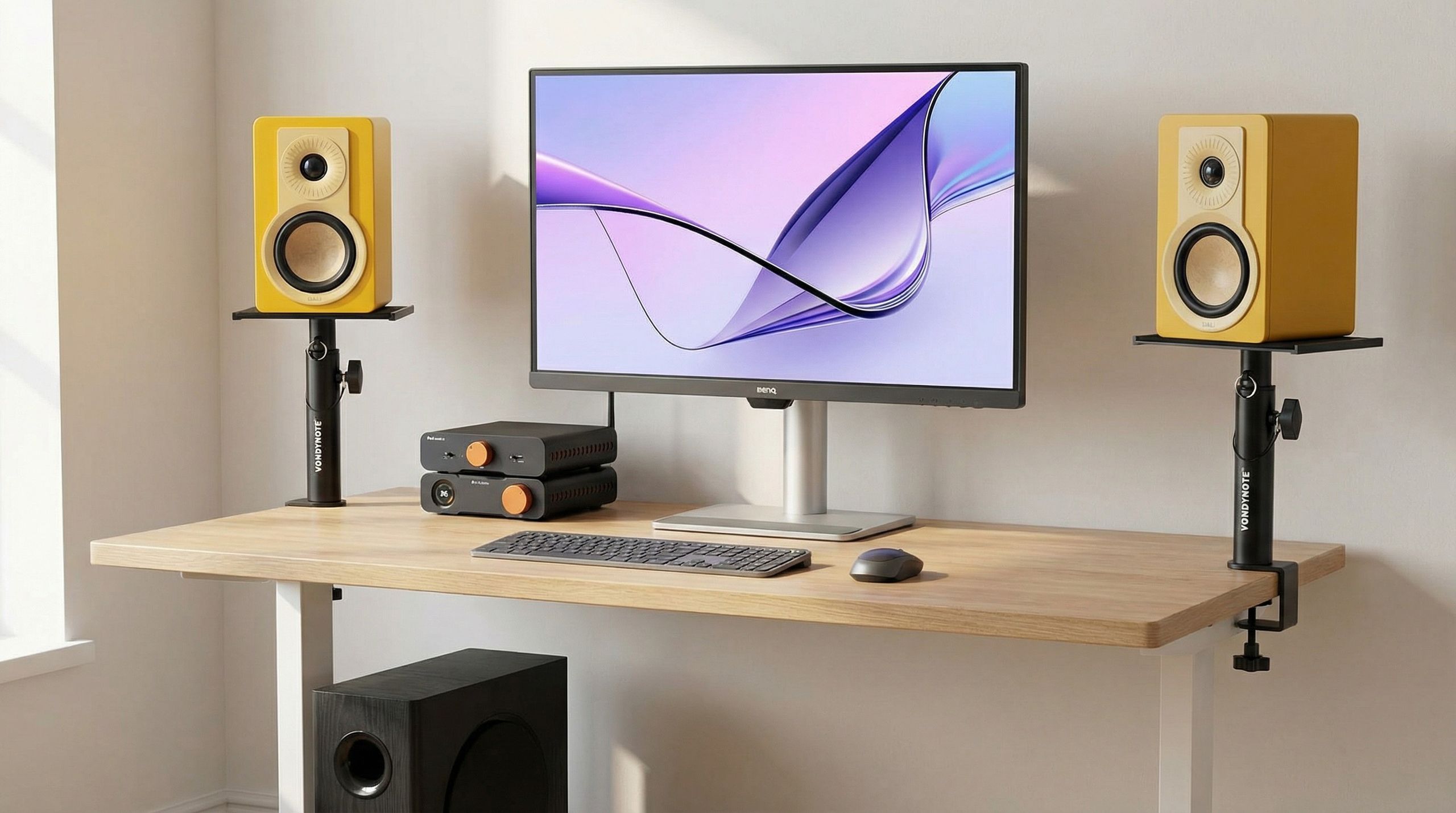
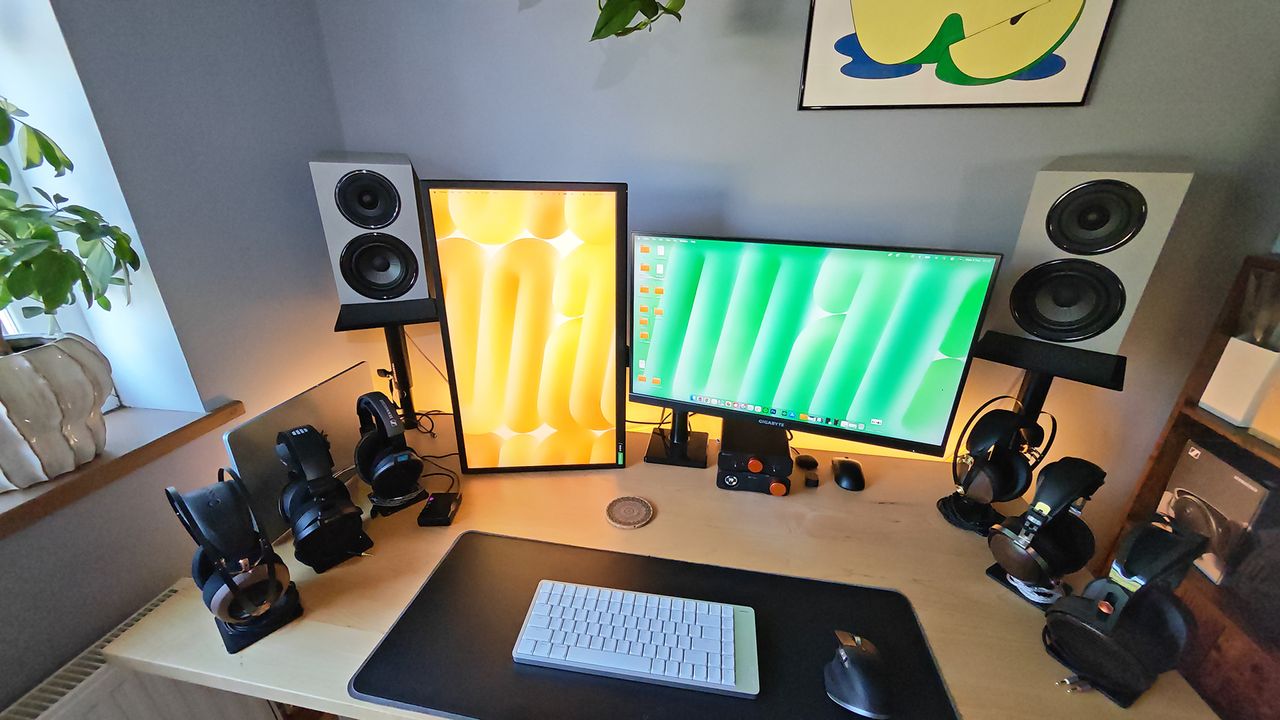
Chances are, you’re just like me. You’ve always loved music, but building your own hi-fi system was something that other people did – older people with way more disposable income than you! Sure, music is one of the few things in life that consistently brings you joy, but whatever Bluetooth desktop speakers you bought in the sale will be just fine.
But investing in an entry-level hi-fi system can be affordable and will have a massively positive impact on your day, week, life! It’s something I’ve discovered when reviewing the best budget audiophile headphones, and affordable IEMs – in audio, the return on investment of a few hundred dollars can be startling.
You may like
I gave myself a budget of $1,000 for this system, but I’ve also added my ultimate budget option for each component below, to make the current best budget system, while getting a meaningful hi-fi upgrade – all for just $350.
Speakers
Image 1 of 3
(Image credit: Future)(Image credit: Future)(Image credit: Future)
Passive speakers will be the most important part of your first hi-fi set up. Unlike your active Bluetooth speakers, passive speakers need power from an amp to play. The upside is they offer longevity (with less moving parts in them, they can last a decade or more) and flexibility (you can modify the rest of your set up around them).
Nothing will dictate the personality of your hi-fi system like speakers, so this is where the majority of your money will go.
I chose two options for my set up. The recently released Wharfedale Diamond 12.1i series, and the new DALI Kupids – both announced in late 2025, and both excellent while offering two different sound signatures.
Wharfedale Diamond 12.1i: $499/£249
Image 1 of 2
(Image credit: Future)(Image credit: Future)
Sound profile: The Wharfedale Diamond 12.1is are a warm pair of speakers, offering a rich midrange, where the vocals and most instruments reside. I loved the 12.1i’s smooth tonality, and vocal-heavy tracks sounded organic, never harsh. I could listen to these all day and never feel like my ears were getting tired (as sometimes happens with overly bright speakers/headphones).
A massive plus to these when compared to the Kupids (other then the lower price) is that they bring a lot more bass – down to 45Hz compared to the Kupid’s 63Hz. That means you could do without the sub woofer (and save yourself $160), and bring your budget down to more like $840.
In fact, the 12.1i bass is significantly more articulate than the equally priced 12.1 speakers (2020), which adds to their value proposition. I find the bass is textured, and though I’m sure there are speakers that provide more slamming mid-bass, everything I played through the 12.1is sounded full-bodied.
You may like
Why they’re great: Designed by renowned speaker engineer Karl-Heinz Fink, they use a polypropylene cone and a sophisticated motor system that’s all about control and accuracy. This is more of a refined sound than you would usually expect from a $499/£249 pair of speakers. They also look and feel like a quality product twice their price (I love the grey finish).
Designed by the legendary Karl-Heinz Fink, these speakers punch way above their weight class. They use Wharfedale’s Klarity, a proprietary material used for mid/bass driver diaphragms. It’s a mix of self-damping polypropylene and mica, so it doesn’t ring like metal does, and results in fast, punchy transients. What the hell does any of that mean? It means the speaker cone is rigid enough to move with absolute precision but also to stop the millisecond the music does. Musically, you get all of the snap and none of the blur – crisp and immediate.
DALI Kupid: $600/£299
Image 1 of 2
(Image credit: Future)(Image credit: Future)
Sound profile: The DALI Kupids offer an exciting, energetic sound. There’s a refreshing brightness to them, so there’s plenty of detail to be picked out of your favourite music. Using them for a couple of weeks, I loved the crystal clear, live sound and how my music was presented transparently. Small detail like fingers sliding across guitar strings and subtle details of vocalists all jump out more.
Like the Wharfedale speakers, their cones can stop and start almost instantly, giving percussions a pleasing “snap” to them. But things are a lot sparkly than with the Wharfedales. Because of the crisp and airy high frequencies, there’s more of a sense of space with the smaller Kupids. Imaging (where instruments sit in distinct pockets around your head) is stronger with the Kupids than the 12.1is.
However, you will want the subwoofer with the Kupids, as their bass response only reaching down to around 63Hz. I certainly felt that they came alive with the added bass.
Why they’re great: First of all, if you can get the yellow models, they’re just about the coolest-looking speakers on sale right now. I love them.
The Kupids are also designed to shine on your desktop, as they’re not fussed with the exact position they sit. With their 4.5-inch wood fibre woofer and 26mm soft dome tweeter, they project a wide soundstage, so noobs like me don’t have to worry about positioning them for them to sound their best. True, I got some speaker stands (see below) which easily position the speakers, but that was more for clearing space on my desk. The Kupids sounded great whether they were sitting on my desk or lifted and angled.
Ultimate budget: Neumi BS5: $140
Why they’re great: Released in 2019 and selling for just $140, the Neumi BS5s use a 5-inch woofer that produces some low-end warmth, so at a pinch you can use these without an added subwoofer (if you’re budget dictates).
The Neumi BS5s are more on the smooth, neutral side of things, which might sound like the Wharfedales – and both use polypropylene (a type of plastic) for their speaker cones. But the difference is in the quality of materials which results in far tighter control over how the speakers stops and starts with the 12.1is… long story short, the Neumi BS5 sounds great for the price, but they don’t compete particularly well to either the Wharfedales or DALIs (and they’re really not meant to).
They will still sound meaningfully better than most Bluetooth desktop speakers.
DAC & AMP
(Image credit: Future)
Fosi ZD3 & ZA3 $330 $290
This is the engine of the set up – the digital to analog converter (DAC) and the amplifier. If I’m honest, this was always the part of audiophilia that put me off. It seemed overly technical, complex, and I didn’t really understand why people cared so much about these two extra components… Just give me the music!
The truth is, it’s not that complicated at all. And the matching Fosi ZD3 & ZA3 look class!
Your DAC converts all the ones and zeros of the digital data of your streamed music into an analog electrical signal. That conversion needs to be accurate and noise-free before it gets amplified and sent to your speakers, otherwise it’d sound horrible. The cleaner the better. Easy.
What is actively not made clear in the audio world, is that you don’t need to spend lots of money on DACs and amps to reach a point where you are dealing with as clean a signal as your ears will be able to fathom. You can achieve a measurable point of sufficient transparency with a DAC that costs around $200. The point of diminishing returns is when a DAC reaches a signal-to-noise and distortion ratio (SINAD) of around 115dB, which is cleaner than the human ear can detect. The Fosi ZD3 DAC reaches 120dB and costs $180.
Pay more than (roughly) $200 on a DAC, and you’re paying for extra features, a prettier chassis, a brand name, more inputs… and a one way ticket into confirmation bias (‘I know it sounds better because I spent $3,000 on it!!’)
The amp is a similar story, though to get zero measurable distortion at maximum volume, you’ll need to pay north of $800. However, I’m presuming you don’t work in a warehouse, and as this is a hi-fi set up for a more modest-sized home office, the Fosi ZA3 amp is more than you’ll need to drive your new speakers louder than you’ll probably want to drive them, without them straining.
In fact, the ZA3 uses a Texas Instruments TPA3255 chip, which measures as cleanly as amps costing more than $700. Yet it costs only $150.
I chose this pair of Fosi components because they offer excellent value, they look cool (with their black and orange colour pallet), and with them I have the option to scale up to more power-hungry speakers in the future.
However, if you want the absolute best budget options for DAC & amps…
Ultimate budget: SMSL SU-1 ($85) & Aiyima A07 ($70)
The Aiyima A07 amp uses the same TPA3255 chip as the Fosi ZA3, but strips away all other features except a volume knob. You’re also not getting the Fosi stack’s XLR cables, which prevents any hum caused by electrical interference from your computer. Instead, the SMSL SU-1 /Aiyima combo uses RCA cables, which are more prone to picking up background noise.
The Fosi ZA3 includes a Subwoofer Out, controlled by the main volume knob. On the Aiyima A07, the Subwoofer Out is actually just a pass-through, meaning if you turn the speakers up, the sub doesn’t get louder with them. For me, the Fosi option is worth the extra $80 just to avoid having to adjust two volume knobs every time I want to whack up the bass.
The Fosi pair is also more future proof than this ultimate budget option, as you can buy another ZA3 amp and power two power-hungry, floor-standing speakers, should you ever relocate your home office to that warehouse we were talking about.
Subwoofer
Edifier T5s subwoofer: $160
Image 1 of 2
(Image credit: Future)(Image credit: Future)
As the Kupid speakers don’t have a massive low frequency presence, and it’s nice to have the option of topping up the 12.1is (though not necessary) they’ll benefit from a dedicated subwoofer to bring that low end to the party. You can put together your first set up without a subwoofer… but having listened to both speakers with and without the sub, you’re getting a far better hi-fi experience with it.
The Edifier T5s (released late 2025) is an 8-inch subwoofer with a built-in 70W amplifier that delivers a controlled bass down to 35Hz, rather than just fuzzy booming that you’ll get with crappier options.
It also features a low pass filter dial that allows you to blend its bass with the Kupids or Diamond 12.1is, so you can’t tell where the speaker ends and the subwoofer begins. I’ve spent plenty of time increasing and decreasing the sub to get that ideal blend of extra bass… and sometimes I just crank it up because bass is life.
Ultimate budget option? Unlike the other parts, the Edifier T5s is the ultimate budget option. At $160 it offers quality bass that is both punchy and warm, and with the low pass filter, you can set it and forget it.
Speaker stands/clamps
Vondynote Clamps: $37
These are not essential for your first hi-fi set up, especially if you’re getting the DALI Kupids, which are less affected by positioning. But getting the Vondynote clamp stands allowed me to reclaim some desktop space, and with the included tilting foam wedges and ability to swivel, I could position the speakers directly at my ears.
This, especially for the Wharfedale Diamond 12.1is, improved the stereo imaging that I got from them. Also, stands eradicate the potential of ‘desk rattle’, when you’re playing loud and they start vibrating.
Ultimate budget option? Again, these are also the stands I would choose as part of my ultimate budget set up, as I can’t find any clamp stands of this quality for under $50.
Set up at a glance