
It’s been two weeks since the Super Bowl, but the most important data from advertising’s biggest night lands now, after the noise has died and the industry has moved on to arguing about something else.
That’s the problem.
Every year, the game becomes a weeklong festival of hot takes, rankings, and creative commentary. The game itself produces a clear winner, but in the industry, we speak too generally about Super Bowl advertising as if it’s all the same. But the game produces winners and losers in advertising as well.
Which is why Ipsos deserves more attention this week than anything written during the frenzied days in the run up or immediately after the Super Bowl.
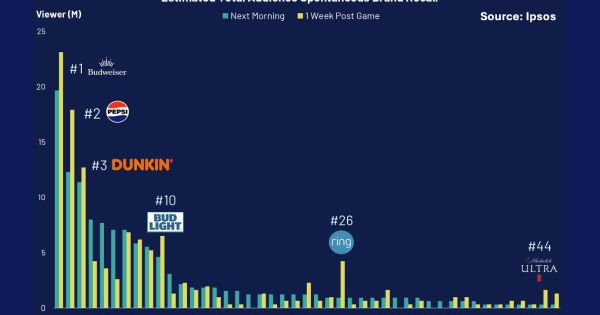
The research firm tracked spontaneous brand recall among Super Bowl viewers: the simplest and most demanding test in advertising. Just a survey asking consumers which brands they remembered being advertised during the game.
Ipsos measured it the next morning. And again, a week later.
The results make for deeply uncomfortable reading for many of the brands that committed their budget and teams to a 30- or 60-second spot.
Budweiser was the Seahawks of the evening.
Its “American Icons” spot—a foal and a newly-hatched bald eagle growing up together over the years to Lynyrd Skynyrd’s ‘Free Bird’—achieved spontaneous recall of nearly twenty million viewers the morning after the game.
A week later, that number had climbed to twenty-three million. Perhaps a signature of a campaign that made it into actual memory rather than mere social feeds.
Pepsi came second, 12 million viewers still able to recall the brand the next day. Their polar bear blind taste test—Coca-Cola’s own mascot choosing Pepsi over Coke—landed because it was built on decades of competitive positioning and the oldest tactic from the cola wars: the challenge.
Dunkin finished third at 11 million, Ben Affleck’s star spangled sitcom parody was exactly what all good advertising should be: emotionally engaging, distinctively coded, impossible to misattribute.
These three brands make a compelling case that the Super Bowl advertising works. Spend well, follow your strategy, and put your name into millions of minds and leave it there for a week. Factor in a hundred million viewers, the additional coverage, social amplification, and the required $8 million investment looks seriously worth it—particularly in the fragmented, chaotic media landscape we now inhabit.
Then there is the Patriots’ side of the chart.
More than half the brands in the Ipsos data effectively wasted their investment, gaining less than a percentage point of recall a day after their ad ran. Each spent what most companies deploy as an entire year’s marketing budget. Each one has very little to show for it.
Ring managed 26th place with less than one million viewers recalling the brand the next day—a 20th of Budweiser’s number. Recall numbers picked up in the subsequent days, likely from the outcry surrounding the unwelcome AI narrative contained in its message.
Michelob Ultra came 44th out of 45 brands, after running a glossy, star-studded spot featuring Kurt Russell, Chloe Kim, and T.J. Oshie. It cost a packet to produce, north of $8 million to air, and was instantly forgotten by almost every viewer of the big game. While recall picked up a week later that was most likely from “ghost recall” from its other significant ad spend around the Olympics.
It’s perhaps unfair to single out these two brands when almost two thirds of those advertising during the Super Bowl failed so miserably to reach even the lowest bar in the persuasion hierarchy.
Ipsos
So what separates the winners from the losers? It’s mostly a story of consistency.
Michelob Ultra and Ring made special Super Bowl ads. Budweiser and Pepsi didn’t. They extended long-running campaigns into the Super Bowl opportunity. It’s not a small distinction.
This was the 48th time the Clydesdales appeared during the game. Forty-eight years of the same visual assets and the same emotional territory. Think of it the other way: decades of ignoring hot agencies and ambitious new CMOs wanting to “put their stamp on things.” Either way, the sight of a horse trotting across a field now makes 20 million people think of one beer and one beer only.
These kinds of long-running campaigns outperform short, opportunistic ones by margins that should embarrass every creative director who has ever pitched a “fresh direction.” Binet and Field at the IPA. The Ehrenberg-Bass Institute. System1. All of them show that the longer you run a campaign, the more effective it becomes. The more distinctive your assets, the faster your brand registers in memory and bypasses the analytical mind entirely.
Most marketers know this. But very few act on it, because patience is not rewarded in quarterly business cycles and it certainly won’t win any industry awards.
Our industry is structurally biased toward newness. Marketers want to make new ads, and their agencies, who get paid handsomely to create new work and nothing to run the old, aren’t incentivized to argue with them.
Some brands used the biggest advertising night of the year to launch something bespoke, something special, something that will live nowhere after this column runs.
Budweiser used it to add one more chapter to something it started building before most of the CMOs were born. The Clydesdales are not a campaign. They are forty-eight years of compound creativity, a lesson in holding the wheel and staying the course.
It’s not a complicated lesson. It’s just one that the industry has no financial incentive to learn or any institutional capacity to retain.