
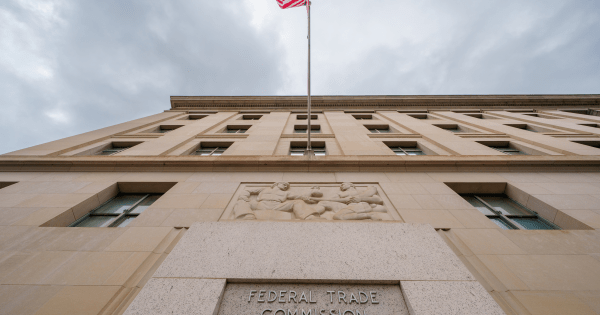
Ad-verification firm Integral Ad Science is one of 16 media credibility and news rating organizations being investigated by the U.S. Federal Trade Commission over alleged advertiser boycotts of right-wing media, according to a lawsuit concerning the probe.
The detail appeared in Feb. 2 amendments to a lawsuit filed in a federal court against the FTC from the nonprofit research group Global Disinformation Index (GDI)—another organization being investigated.
In June, under the leadership of Andrew Ferguson, a Trump appointee, the FTC launched an investigation into purported collusion among media credibility groups to boycott conservative media platforms and publishers. As part of that probe, the FTC issued a series of Civil Investigative Demand (CID) letters. Similar to subpoenas, CID letters require that recipients produce requested documentation and respond to specific inquiries. In some of these letters, the government demanded wide swaths of information, including years of communications, records, and financial reports.
GDI’s lawsuit alleges that the CID letter it received is retaliatory and violates GDI’s First Amendment rights by punishing protected speech.
And, in recent amendments made to its complaint, GDI explicitly said that IAS is being probed, too—an unreported detail. “IAS is one of the other 16 non-profit entities that the FTC seeks information about in GDI’s CID,” the complaint reads, “and on information and belief, IAS is one of the other 16 organizations that received a CID related to the Commission’s investigation into an advertiser boycott.”
Notably, GDI’s complaint does not name any other recipients of CIDs or parties under FTC investigation whose names have not already been reported. It also alleges that IAS cut ties with GDI amid FTC scrutiny, and said GDI’s business has suffered in the aftermath.
In December, IAS wrote in a blog post that it would no longer use GDI to support a contextual brand safety product it offers. “As part of IAS’s continuous efforts to improve its offerings for clients and maintain enhanced control over brand safety, IAS has determined to discontinue the use of the limited input from the Global Disinformation Index (GDI) in our Context Control Avoidance solution,” it said.
The groups had worked together since 2021.
In a statement to ADWEEK, GDI said it believes that IAS’s decision to stop using GDI’s risk assessments for media environments “may leave all advertisers who use IAS tools less well protected from brand unsuitable content.”
IAS declined to a request for comment, and the FTC did not respond to an inquiry from ADWEEK.
The broader list of media credibility firms that received CID letters from the FTC last year was not made public, though ADWEEK confirmed that Media Matters for America and Ad Fontes Media both received CIDs. Since then, a federal court granted a preliminary injunction to Media Matters, temporarily barring the FTC from investigating the organization; the court determined that the CID was “a retaliatory act” for Media Matters’ criticism of Elon Musk. GDI is now seeking a preliminary injunction as well, it confirmed.
On Feb. 6, NewsGuard confirmed that it received a CID letter in a new lawsuit against the FTC and chairman Andrew Ferguson. Much like GDI’s lawsuit, NewsGuard claims that the federal agency unlawfully levied its regulatory power against the organization to retaliate against and censor NewsGuard, claiming it went so far as to bar ad agency holding company Omnicom from doing business with NewsGuard.
Launched last summer, the FTC’s investigation arrived less than a year after a congressional investigation determined that members of a preeminent coalition of advertising organizations known as the Global Alliance for Responsible Media, or GARM, colluded to withhold ad spend from right-leaning outlets like Fox News, The Daily Wire, and Breitbart. It was a finding that prompted X, under the oversight of Elon Musk, to sue GARM and its parent the World Federation of Advertisers, alleging they pressured advertisers into boycotting sites including X. GARM shuttered days after the lawsuit was filed.