
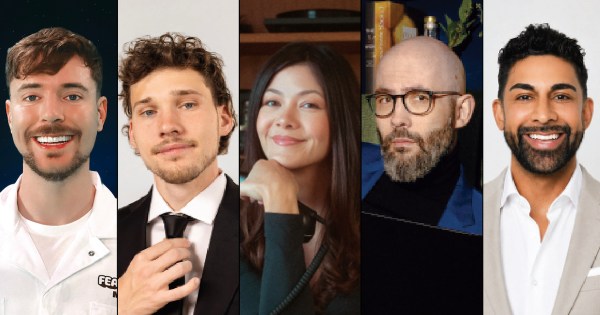
The following is a teaser of ADWEEK’s August cover story, which was featured in On Background with Mark Stenberg, a free, weekly newsletter that explores the key themes shaping the media industry. You can sign up for it here.
On a Friday morning in June, Jimmy Donaldson—better known as MrBeast—notched a digital media milestone, becoming the first person to surpass 500 million subscribers on YouTube, making his viewership larger than the combined populations of the U.S. and Canada.
But inside his North Carolina studio hangs a plaque that has little to do with subscriber counts. It reads “YouTube first,” a motto that still governs the Beast Industries operation, according to its chief executive Jeff Housenbold, even if the company it anchors no longer looks much like a YouTube channel.
Instead, the business now more closely resembles a diversified conglomerate, encompassing a chocolate brand, a toy manufacturer, a brand studio, a competition show on Prime Video, a financial services app, and, coming later this year, a mobile telecommunications platform.
Donaldson, who uploaded his first video to YouTube 14 years ago, is the most visible example of a shift that has been building for years: Creators, expanding beyond their native platforms, are maturing into media companies. The same personalities who once measured success in views and subscribers are now guided by balance sheets and equity value. They are restructuring into parent companies, hiring chief executives, launching products, and, in some cases, courting the same institutional capital that funds traditional media.
In 2026, U.S. brands will spend at least $21 billion on creators, nearly double the 2022 figure, according to eMarketer. Perhaps more telling, the revenue gap between web publishers’ programmatic display businesses and creator earnings, which publishers led by 44% in 2022, has collapsed to roughly 26% today.
“Creators are not becoming the new media companies,” Housenbold told ADWEEK. “They are media companies.”
Becoming a media mogul follows a consistent set of mechanics. A creator builds an audience on a platform they do not own, then starts businesses on top of it that they do.
This model is not new. Hank Green and Mythical Entertainment were among the first YouTube creators to parlay their online followings into broader media companies, noted Andrew Graham, head of business development at CAA Creators.
Still, the space needed time to mature. Audience attention had begun to shift toward creators, but the commercial infrastructure, personnel, and advertising budgets still lagged years behind.
In recent months, however, a series of events has pushed the market past an inflection point.
To read the rest of the story, click here.
FOR Scoops, Sharp Analysis, and Insider Context
By submitting your email, you agree to our Terms of Use and Privacy Policy . You may opt-out anytime by clicking ‘unsubscribe’ from the newsletter or from your account.
Subscribe
Loading…
Talking Heds
Hearst Hurt (SCOOP): Two weeks ago, Hearst Magazines named Chris Berend as its first chief content and experience officer, signaling an evolution in editorial direction that would emphasize events as core to the portfolio. In tandem with the appointment, the general managers Ronak Patel and Alicianne Rand, who led the lifestyle and luxury groups, respectively, stepped down, according to a person familiar with the matter. And last week, Good Housekeeping underwent a small round of layoffs that nonetheless represented a substantial cut to its editorial team. The reductions are a rare instance of unease at the privately held company, whose editorial operations are largely subsidized by its unglamorous but lucrative enterprise holdings, which include the bonds grading firm Fitch Ratings. The layoffs also coincide with the announcement from Hearst Corp. that the company is buying out Disney’s 50% stake in A&E Networks for $1.2 billion. Naturally, these two decisions are not explicitly related, but the optics have proven a tough pill internally.
Track Stars (EXCLUSIVE): As a complement to my August cover story detailing the rise of creators as media companies, I profiled one of the more promising entrants in this emerging field: Track Star, a social video franchise helmed by Jack Coyne and, as of January, financially backed by Gus Wenner, the former CEO of Rolling Stone and son of its founder, Jann Wenner. The story has an enticing narrative simplicity: Wenner, a scion of legacy media, betting on Coyne, an avatar of the next generation. Together, the two aim to build Track Star into a music media empire tailormade for a new set of consumer behaviors. The company recently brought on its first chief revenue officer, as well as its first outside talent, and it plans to unveil a slate of new shows, live events, and digital products in the coming months.
A Perfectly Imperfect Substack: The newsletter brand Perfectly Imperfect, which skyrocketed to virality during the pandemic by asking a rotating set of IYKYK tastemakers about their interests, announced last week its intent to launch a platform intended to rival Substack. According to an email describing the product, sent by founder Tyler Bainbridge, the platform will look like if Tumblr had a newsletter ecosystem, with “best-in-class community features, monetization, customization, lower rates, and comprehensive audience analytics.” Bainbridge did not respond to my request for comment, but the product is worth keeping an eye on. Perfectly Imperfect has built a far more curated brand than Substack or Beehiiv, and it will be interesting to see how it plans to use that element of taste as a differentiating factor.
The Creator Events Boom (EXCLUSIVE): It is no secret that events have become a linchpin of the media business. But now they are growing in adoption among a separate cohort of publisher: creators. A handful of solo or independent operators, including news creators like Oliver Darcy, Alex Heath, and Bryan Morrissey, are launching or expanding their events footprint, while Emily Sundberg has thrown subscriber parties in cities across the Western Hemisphere. Smooth Media, a creator monetization firm, will announce Thursday that it has hired Rita Ruan, most recently the senior events producer at Dow Jones, to lead its experiential efforts. The trend is not necessarily groundbreaking on its own; instead, it is further evidence that everything media companies are doing, creators are set to replicate—likely with better margins.
Baesler Insider (EXCLUSIVE): When Axel Springer executive Claudius Senst announced in a company meeting on Tuesday that the interim CEO of Business Insider, Christian Baesler, would be taking on the role full-time, the audience gasped, according to a video recording of the moment. But when I heard the news, I blanched. I had reported several weeks ago that Baesler had no plans to adopt the position full-time, owing to a personal project he had raised money for and staffed. I was prepared to eat my fair share of crow, after dressing down my source, of course, before Baesler admitted to me that both were true. Prior to assuming the interim job, Baesler raised capital and staffed a startup, in which he remains an investor. Baesler declined to share any more details about the company, saying only that music will play a role in it and it does not compete with either BI or Axel Springer. Whatever it does, Baesler found the future of BI a more compelling proposition, a bet that hopefully he does not come to regret.
Quote/Unquote
Christian Baesler was named CEO of Business Insider this week, converting what had been billed as an interim role into a permanent one, a move so surprising that staff gasped when it was announced internally.
Baesler had spent three years advising the company before stepping in as interim CEO on June 1, drawing on prior leadership experience at BuzzFeed and Complex. He will now oversee a newsroom led by editor-in-chief Jamie Heller, formerly of The Wall Street Journal, as the Axel Springer property looks to transition beyond the era of web traffic and scale.
This interview has been edited.
Mark Stenberg: You were in this role in an interim capacity for months, and all the messaging suggested it was temporary. What changed?
Christian Baesler: I started June 1 in an interim role after advising for three years. As I was here, it became apparent to me how clear the opportunity is, despite how challenged media is. The website is no longer growing, but we have massive scale on YouTube and on LinkedIn. Most of our monetization has been focused on the website, so there is a lot of opportunity to apply what we were doing at Complex. I was clear upfront that this was going to just be interim, but when I saw the opportunities, I changed my mind.
Mark: I heard you had your own project that was going to preclude you from taking the CEO role full-time. How wrong was I about that?
Christian: This is true. As I left my regular full-time work and was advising companies, I was building a startup. It only became more formal with leadership and capital recently, which was part of why I did not want to commit to full-time. The startup will now continue without me—I’ll remain a shareholder and continue advising on growth—but my full-time focus is on Business Insider.
Mark: What is your vision for BI?
Christian: Historically a lot of the focus was on traffic to the website, which is still a large portion of our revenue and still has huge opportunity. But we have tens of millions of subscribers on YouTube and get millions of organic views there weekly. Similarly on social: we have tens of millions of followers across our channels, and very little monetization is coming from there. At BuzzFeed and Complex, a large percentage of our revenue came from social sponsorship, so that’s a huge near-term opportunity.
Mark: Part of your blueprint is focusing your coverage on your strongest verticals. What will those be?
Christian: Out of the gate, we are going to focus on four franchises: CMO Insider, Small Business Insider, Markets Insider, and AI Insider. Some are more developed than others—CMO Insider, for instance, is robust already, with high sponsorship rates, CMO roundtables, a newsletter, and a podcast. The others are in various states of development, but they all will have a variety of touchpoints, including YouTube series and events. We plan to launch more in the coming months.
Mark: What would you say to BI staffers who are concerned that an Axel Springer executive is now at the helm?
Christian: I feel like I’ve been transparent in my leadership style about the challenges we’re seeing at the company, including traffic, while also outlining the opportunities. I’d hope it gives them confidence that I’ve been at companies elsewhere in the U.S. that have been market-leading, and I hope it’s a good sign that the Axel Springer team trusts me.
Pulled Quotes
“The long and short (and legal) of it is that we have agreed to rebrand and cease use of the Gourmet trademark as part of a confidential settlement agreement with Condé Nast.”
[Untitled Food Magazine] staff, on why they are changing their name
READ MORE
“The trade-off is that many customers may never actually own their device and may never stop making monthly payments.”
Bloomberg Media’s Mark Gurman, on Apple’s new payment plan strategy
READ MORE
“I’m trending on the internet?”
Celebrity chef Emeril Lagasse, after clips from his old Food Network series went viral
READ MORE
“Specifically, sources said Coplan has gone on to claim at parties and in office meetings alike that the relationship ended when Lopes Lara … ‘cucked’ Mansour.”
The NY Post’s Marc Vartabedian, on the animus between the founders of Polymarket and Kalshi
READ MORE