
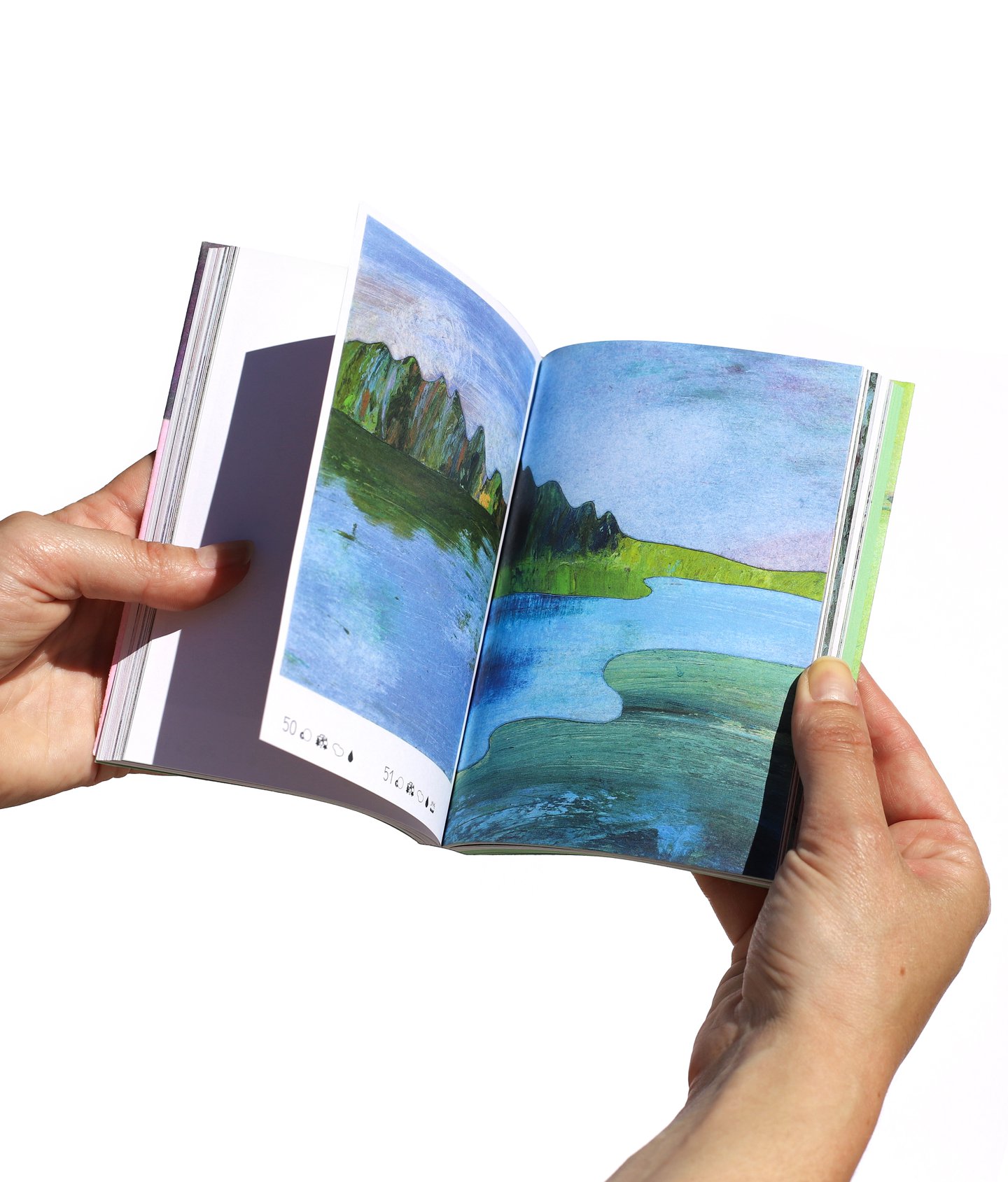
“My intention was to create an object that would encourage pictorial experimentation,” says Marianne. “I wanted to create a book where different types of images and narratives intersect, reflecting the richness and complexity of what unfolds in this forest environment.” She also chose a small format to reflect the residency’s remote, immersive nature. “I liked the idea of depicting such a vast landscape – a whole world – in small formats,” she says.
Originally, Marianne planned for the book to be more “didactic”, with diagrams to explain scientific processes. “But during my residencies, exploring the forest with the scientists and our discussions with them were so rich and spontaneous that it was difficult to choose which concept or idea to illustrate over another. It would have felt somewhat arbitrary,” she says. The artist soon realised that what she really wanted was a book of drawings, but one that held onto the project’s scientific side. She began working more intensively on the pastels, reshaping the book’s overall look and content. During her second residency, she decided to weave the stories she’d heard into a glossary, inviting paleoecologist Dorian Gaboriau and land guardian Mélanie Bellefleur, a member of the Innu Indigenous community, to contribute.
In the end, the book emerged as a dialogue between three different perspectives on the same subject: an artistic one, through Marianne’s personal and poetic experience of the residency; a scientific one, informed by a paleoecologist’s research; and a third rooted in place, through the perspective of a land guardian. A single physical object, holding the forest’s many stories in one place.