
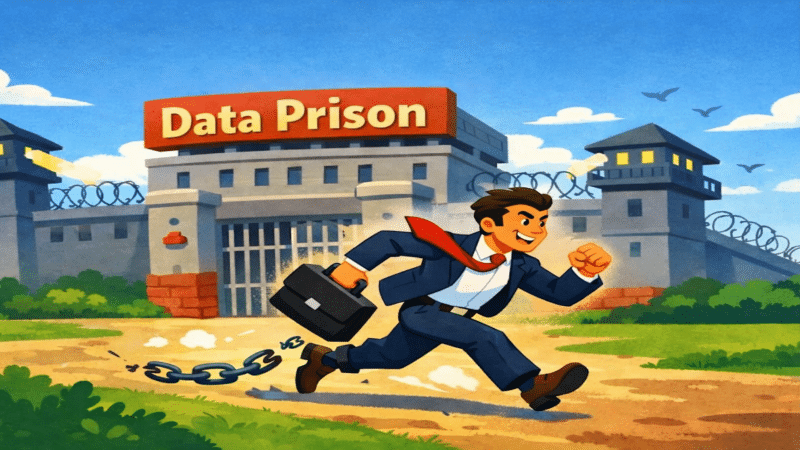
We know the pressure of being told to “break down silos” while new ones seem to pop up every time a new channel or tool is added to the stack. It’s a persistent reality in this role that technology often moves faster than our ability to connect it.
At the March 2026 MarTech Conference, the session “Break out of data prison with a strategy to end the silos” tackled this head-on. Moderated by Cyndi Greenglass, president of Livingston Strategies, the panel featured Dan Dipiazzo, chief marketing experience officer at the Georgia Aquarium; Zack Wenthe, director of product marketing and customer data evangelist at Tealium; and AnnMarie Willis, CEO of Leverage Lab.
Why the “perfect” solution is a myth
It’s a common hurdle to search for one universal tool to solve fragmentation. However, Wenthe pointed out an uncomfortable truth: silos are effectively permanent. As we add specialized tools for CRM, ticketing, or ecommerce, data naturally fragments.
The path forward isn’t about eliminating silos entirely; it’s about building a framework to manage them. As Willis noted, the goal should be finding where unified data has the biggest business impact — like retention or revenue growth—rather than chasing a theoretical ideal.
Lessons from the front lines: The Georgia Aquarium
Dipiazzo shared a grounded perspective from the Georgia Aquarium, where systems for ticketing, donor management and retail were all sourced to solve specific operational needs — but not necessarily to talk to one another.
His team’s journey to a functional customer data platform (CDP) has been a two-year evolution. The lesson here? Expect the process to take longer than you hope. It’s better to do it right than to do it fast. By starting with simple tactics like retargeting, they proved the value of unified data before scaling up.
Culture: The ultimate data gatekeeper
We see the friction that occurs when technical debt meets organizational silos. Willis described how the most significant shift for one enterprise client wasn’t the data ecosystem itself, but the creation of cross-functional “SWAT teams.”
When you align teams around shared customer insights rather than isolated channels, you start to bridge the gap between departments. Strong executive leadership is the fuel for this change. Often, a project kickoff is the first time stakeholders from different departments have even met—proving that the “plumbing” of a business is as much about people as it is about APIs.
Get MarTech Insights That Matter
Platform news, strategy analysis, and industry trends. Trusted by 40,000+ marketing professionals.
AI as your newest teammate
Let’s tackle the role of AI. Wenthe described AI as a “force multiplier” that can accelerate the “drudgery” of data prep — labeling, cleaning and categorizing datasets that used to take months.
- Filling the gaps: Willis highlighted how AI can infer missing values to create a more complete customer profile.
- Scaling the team: For smaller organizations like the Georgia Aquarium, AI features help summarize feedback and identify trends without needing an army of analysts.
Making the case to the C-suite
To secure the budget you need, frame the conversation around outcomes, not infrastructure. Dipiazzo moved the needle by showing how data capabilities could shift spend from expensive customer acquisition to high-efficiency remarketing. When you show the C-suite how unified data answers their most pressing business questions, the “data prison” doors start to open.
The takeaway
Breaking out of data prison isn’t a one-time project; it’s an ongoing strategy. Start small, focus on a measurable use case like paid media, and build momentum. You don’t have to solve everything today to start seeing a path forward.