
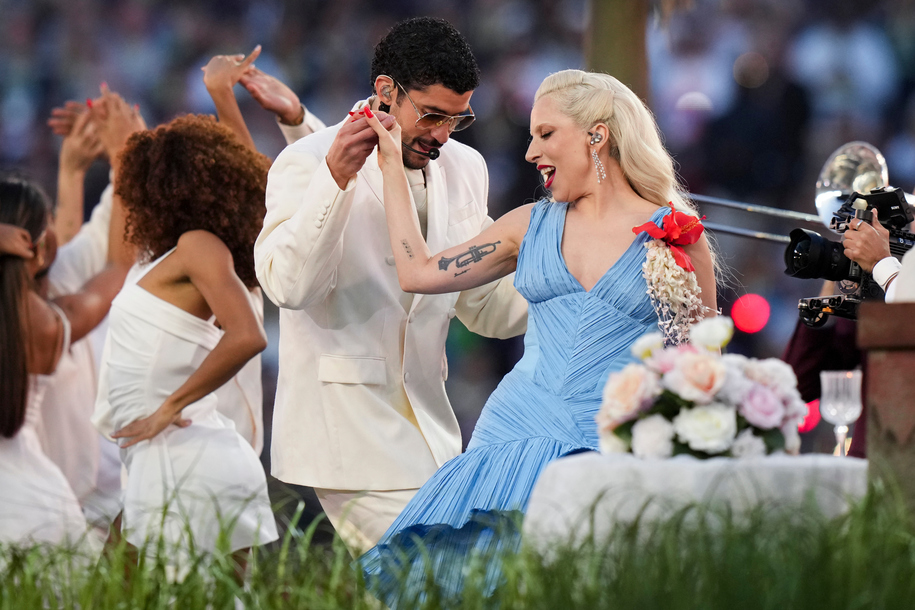
Bad Bunny’s Super Bowl halftime performance Sunday was groundbreaking as the first ever sung entirely in Spanish. And those who tuned in might have missed some of the references sprinkled throughout the 13-minute performance. Here’s a deeper look at Benito Antonio Martínez Ocasio and the symbolism laced into his halftime show.
The sugarcane fields
Amidst the wealth of football’s biggest night—wealth primarily among white men—Bad Bunny kicked off his performance by highlighting the blood, sweat, and slave labor that took place in Caribbean and Puerto Rican sugarcane fields.
On the football field, men pretended to harvest the sugarcane, but the act was an homage to those workers, known as jibaros, and to the Latin Americans who continue to toil in harvesting the crop.
The taco stand
Despite the performance taking place near San Francisco, the rapper gave Los Angeles a shoutout. In Southern California, the streets are ripe with mouthwatering al pastor and other fresh tacos made by Latino families—including Villa’s Tacos.
Now, the taco stand that started as a business in someone’s front yard went viral as Bad Bunny belted out his song “Titi Me Preguntó.”
According to ABC 7 Eyewitness News, Bad Bunny asked the owners to be a part of the show because he himself loves the food.
A much-needed siesta
At one point, the artist gave a shoutout to a long-lived, relatable Latin American tradition of finding children fast asleep, sprawled across folding chairs or any horizontal surface at family celebrations.
During the performance, the camera panned over to a child sleeping across the white seats before being lightly rustled awake by the singer.
Celebrity shoutouts
You might have needed to pause, rewind, and/or squint, but there were a number of cameos hiding out in Bad Bunny’s cheery, dance-filled segment.

Celebrities like rapper Cardi B, actor Jessica Alba, and singer Karol G were spotted grinning and grooving in the crowd. Actor Pedro Pascal, who has been outspoken against ongoing Immigration and Customs Enforcement operations, was also smiling alongside Bad Bunny at one point. Another unexpected celebrity appearance, however, was social media influencer Alix Earle.
Toñita
Bad Bunny’s show also referenced Puerto Rican culture in Brooklyn, New York. María Antonia Cay, known affectionately as Toñita, handed the artist a shot, but her experience with Benito goes much deeper.
Toñita’s Caribbean Social Club is a cultural staple in Williamsburg, where dominos and pool are played and where Latin music pours into the street late into the night. The business has faced the pressures of gentrification over the years, but Bad Bunny and other Latin artists have used their platform to boost awareness of the Brooklyn institution.
El Apagón
Bad Bunny sang his 2022 song “El Apagón,” which translates to “the blackout,” highlighting the ongoing power outages in Puerto Rico and the U.S. government’s negligence in assistance.
Following 2017’s deadly Hurricane Maria, the majority of Puerto Ricans went without power for a long time, some for many months. Because of the failed response during President Donald Trump’s first term, Puerto Ricans began taking electrical work into their own hands.
Boxing
Ducking under sparring men, Bad Bunny gave a quick wink to the rich Hispanic boxing culture by including professional boxers Xander Zayas and Emiliano Vargas.
The flag

While there wasn’t an overt political message to the performance, those with the historical knowledge just had to look at the color of the flag Bad Bunny carried to know what he was trying to say. During his performance, the singer carried a Puerto Rico flag colored with a light-blue triangle—which, to those who know, sends a message of pro-independence.
After the U.S. took control of the territory, Puerto Rico was ordered to assimilate its flag color with that of its new owner as a sign of unity. At one point, displaying the light-blue flag was considered a crime.
Lady Gaga
But Bad Bunny wasn’t the only person using meaningful colors. Lady Gaga also donned the light blue shade in her Spanish-style dress. And, more noticeably, the singer had a red flor de maga—the Puerto Rican national flower—pinned to her dress.
Ricky Martin
Singer Ricky Martin, who played a large role in mainstreaming Latin music in the U.S., performed a portion of “Lo Que Le Pasó a Hawaii,” which translates to “What Happened to Hawaii.”
Martin was particularly struck by Bad Bunny’s Grammy acceptance speech, saying, “I know what it means to succeed without letting go of where you come from. I know how heavy it is, what it costs, and what is sacrificed when you decide not to change because others ask you to. That’s why what you have achieved is not just a historic musical accomplishment, it’s a cultural and human victory,” according to Vulture.
Wedded Bliss

Bad Bunny superfans Thomas Wolter and Eleisa Aparicio sent the superstar an invite to their wedding, but he turned the tables and asked: Would you like to get married during the Super Bowl?
Those wedding vows you witnessed were real, and millions of people watched the couple from California become husband and wife in the most memorable way possible.
God Bless América
In a powerful closing moment, flags of North and South American countries filled the stadium as Bad Bunny reminded viewers, again, that “America” is a melting pot.
The artist named off almost every country on the two continents before saying “Seguimo’ aquí,” which translates to “We are still here.” The phrase is used to stand up to the cultural erasure and colonialism pushed on Latin American people.
More than anything, though, Bad Bunny used his halftime show to send a message of love, family, and unity as tens of millions of people tuned in from around the world.