
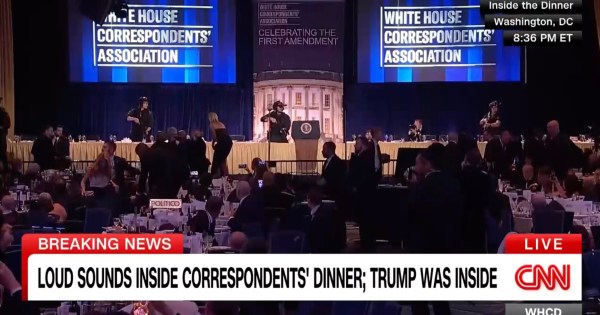
On Saturday, a gunman attempted to gain entry into the White House Correspondents’ Dinner, which featured the presence of President Donald Trump and members of his administration. The ensuing fracas inside and outside the ballroom prompted journalists at the gala to ditch whatever they were eating and drinking and start capturing the unfolding events in real time.
This included CNN journalists like the network’s longtime anchor Wolf Blitzer, who recounted how he was just a few feet away from the gunman, heard the gunshots, and was shielded by a policeman, who then took him and others to the men’s bathroom, where they took shelter.
Eric Hall, a CNN executive producer overseeing the network’s on-air coverage on Saturday night, anchored by John Berman and Laura Coates, told TVNewser that Blitzer was one of the many journalists who called into the control room to share what had happened that evening. The network, which was on a commercial break, dumped out of it at 8:35 p.m. ET and began its rolling breaking news coverage. It was the only network with its own live cam inside the ballroom for more than 45 minutes.
For our latest 5 Questions for… series, Hall and CNN’s technical production manager, David Foote, describe what was happening inside the CNN control room during the event. Here’s how they reacted when what was supposed to be a light-hearted affair quickly turned into a breaking news situation:
1. During a typical WHCD, what happens in the control room?
Hall: Typical WHCD coverage follows a scheduled event, with the most unpredictable moments being how far a comedian’s or the president’s roasts/jokes go, and analyzing accordingly.
Foote: Typically, it is a relaxed event, with the first part focused on the red carpet & other arrivals, including the president. Once the event starts, we put a pool feed on our air and follow the show.
2. From your vantage point, what was the first indication that something was wrong?
Hall: We were in the middle of a commercial break when we saw commotion in the room and people ducking. We broke out instantly, and Laura and John narrated live with only their eyes in real time.
Foote: The production manager in the control room heard a producer yell into the remote production conference bridge that they heard gunshots. She yelled to everyone in the control room that shots were fired near the dinner. The team on site evacuated to safety.
3. What happened next?
Hall: Brian Stelter smartly called in with his WebEx to give us the only eyes and ears of a first-person, ground-level eyewitness view of the room. From there, Kaitlan Collins, Wolf Blitzer, and a long list of CNN eyewitnesses called in to share what they saw. It was an amazing team effort to share the moment with viewers in real time.
Foote: We instinctively pivoted to breaking news mode. It is what we all do best. CNN was in a commercial break, so our director told Master Control to dump out of the break and come back to the control room. We were back live within seconds. We knew that our co-workers in the room would be calling in as soon as it was safe to do so. The control room team started getting feeds ready to get people on the air, streaming video from their phones. Others called in with voice only. The challenge was very poor cellphone reception since the ballroom is below ground. When Wolf Blitzer was safe, we immediately got him on the phone while a colleague used a second phone to stream his video. This was the best option to avoid the signal breaking up.
When our team on the red carpet evacuated, they left behind their cameras & equipment that was near the shooting; two of the cameras were still transmitting a live signal. We watched law enforcement secure the area. We then prepped for the worst: Were people hurt? Was our team ok? What was next? We started to get presidential pool feeds established, mainly the White House Briefing Room. One of our field teams used a rented bicycle to get close to the hotel’s exterior and establish a live-shot position to capture that angle.
4. How long were you in the control room?
Hall: Four hours of rolling coverage.
Foote: Our day started with pre-production at 3:30 p.m. ET. Once the shooting occurred, we were in the room for 4 hours, commercial-free, until midnight when CNN International took over our coverage.
5. What do you feel is the biggest responsibility during a moment like this?
Hall: The biggest responsibility is to bring viewers a minute-by-minute account while also not jumping to conclusions or getting ahead of reporting. John and Laura did a wonderful and compelling job of staying calm on the air, walking viewers through the scene, and telling them what we know and, more importantly, being transparent about what we don’t know.
Foote: We all feel the responsibility to inform the public when an important news event occurs. Knowing that our coverage was simulcasting on various CNN networks around the world, it was incredibly important to get the information out for all to see. As a technical lead, my role is to help the editorial teams tell the story & confirm the facts in real-time with the various tools at our disposal. Sometimes we need to get creative & use our career experience to get people on the air—this event was no different.
CTV is crowded—want to learn how brand fundamentals cut through the noise? Enroll in The ADWEEK MiniMBA in Marketing and build a strategy designed to last. Sign up here.