
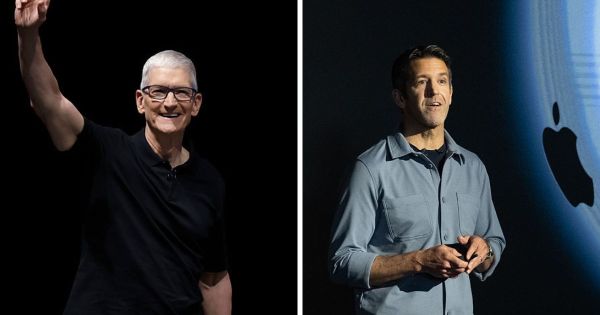
Tim Cook was never going to be Steve Jobs.
No one, possibly not even Jobs himself, could ever live up to the last great legend of 20th century business.
But, as his exit date is announced, how should marketers assess the man who stepped into those enormous, distressed sneakers in 2011 and took the helm at Apple?
When Cook took over Apple’s market cap sitting at around $350 billion. Today it sits at $4 trillion. So if we wanted to reduce his tenure to a single data point and this column to a superficial paragraph—which plenty of Wall Street analysts are perfectly happy to do—then there’s your proof point.
But there was more to Apple than just being profitable. And you can make a strong argument that the trajectory that Jobs had created before his departure accounts for a lot of that “success.” Fairly or not, we have all come to expect more from Cupertino. And the uncomfortable truth is that Cook’s Apple did not launch a single genuinely new product category that has actually mattered.
The Apple Watch? Clever. Profitable. A health device masquerading as a fashion item. But it didn’t redefine a category the way the iPhone redefined everything. AirPods were a solid hardware play—arguably Apple’s most culturally sticky product of the Cook era—but wireless earbuds were already a category.
Apple just executed better than everyone else. The HomePod was a commercial embarrassment. Apple TV remains a perennial also-ran. And the Vision Pro—the grand swing, the big bet, the $3,500 headset that solves a problem nobody had—launched in Cupertino to thunderous applause from journalists and near-total indifference from actual consumers. Not exactly the iPhone moment Cook’s supporters promised.
Meanwhile, the thing Cook is brilliant at—operational excellence and margin expansion—has been weaponized against customers in ways that deserve scrutiny.
The Services business, which Cook rightly transformed into Apple’s second engine, is built substantially on a tax on captive consumers. Google paying Apple somewhere north of $15 billion a year to remain the default search engine on Safari is a masterpiece of rent-seeking. Brilliant financially, but strategically shallow and ethically murky. So much so, that regulators on both sides of the Atlantic are circling.
Then there’s China. Cook bet big on its manufacturing, its consumers, and its growth. That bet made Apple vastly more profitable through the 2010s. It also created a strategic dependency that now looks genuinely dangerous. Relations between Washington and Beijing have deteriorated, Huawei is back, and Apple’s exposure to a single geography is a vulnerability that was entirely foreseeable and insufficiently hedged.
And then there is the future and the biggest miss of the Cook era: AI.
Every company has to be on top and ahead with AI. But it’s particularly crucial for Apple, whose brand is built on three pillars: simplicity, humanity, and creativity.
It should have led into the AI era. Instead, Siri is an idiot in a classroom filled with geniuses.
And there appears to be little if any plan to fix things any time soon.
And yet…
Go back to 2011. Steve Jobs is dead. The gravitational field that held Apple together has collapsed. The consensus view, quietly held by many in the industry, was that without Jobs’ fanatical product vision, Apple would revert to the mean.
Most founder-led companies do. Especially those so tightly wound around one human for their culture, coverage, leadership, and strategy.
But that did not happen.
Cook held the wheel while keeping the culture together. He expanded Apple’s geographic reach. He built Services into a recurring revenue behemoth that now generates over $85 billion annually and is growing faster than hardware. He executed the transition to Apple Silicon—one of the most technically ambitious platform transitions in tech history—with a smoothness that was almost suspicious.
He shepherded Apple through a global pandemic, a semiconductor shortage, and a supply chain crisis, and came out the other side with margins that made competitors weep.
He also did something Jobs never particularly bothered with: he put Apple on the right side of privacy. At a moment when the tech industry’s relationship with consumer data was becoming toxic, Cook made privacy a genuine differentiator. Whether you find it principled or cynical (it’s probably a bit of both), it was strategically astute and has become a meaningful brand pillar.
Cook’s Apple is the most financially successful company in human history. That’s extraordinary. He took an organization built on the charisma and genius of a singular individual and, keeping his own ego totally at bay, institutionalized it.
The honest assessment: Cook is a superb operator and a competent strategist who has been a mediocre product visionary.
He has maximized the value of what Jobs built, but has not meaningfully extended it into new territory. He saved the church. He just hasn’t delivered a new gospel.
The trillion-dollar question—What does Apple do next?—remains unanswered after 13 years.
When Cook took the helm, he was up against Samsung and Motorola. His replacement, John Ternus, now faces a much tougher, more paradigm-shifting assortment of rivals. And at some point, the market will stop being patient.
Perhaps we should stop asking how well Tim followed Steve, and ask what Ternus will do in September when he replaces Tim.