
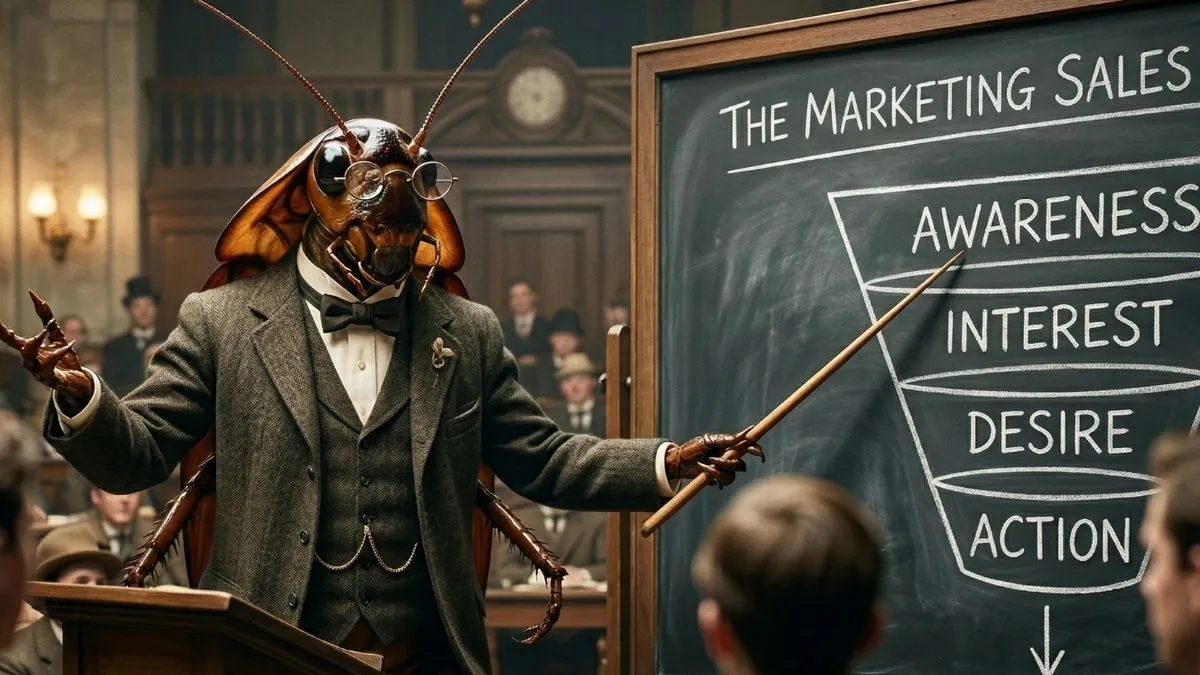
In 1898, a young Philadelphia ad man named Elias St. Elmo Lewis wrote something that would outlast almost everything else produced in the following marketing century. Working on life insurance campaigns, Lewis had noticed that the best salespeople followed a pattern. They grabbed attention, built interest, created desire, and then prompted action. He called it AIDA.
He didn’t call it a funnel—that visual wouldn’t come until 1924.
Fast-forward to last week at Amazon’s Immersion Day, where the centerpiece was a new AI-powered campaign type called Full-Funnel Campaigns. In Amazon’s own words, the goal is to “streamline the path from awareness to conversion.”
Amazon had organized its entire AI architecture around a concept Lewis sketched out with his pencil.
Tom Roach, the brand strategist and effectiveness expert at Jellyfish, captured the phenomenon well when he described the sales funnel as “the cockroach of marketing concepts.”
He meant it as a compliment.
The funnel survives everything thrown at it: academic critique, platform revolution, the endless march of Silicon Valley shamans declaring the next big thing.
Critique 1: The funnel is too generic
The first classic critique is that the funnel’s stages are too generic. Awareness, consideration, preference, purchase: what does that actually mean for a firm selling industrial lubricants to procurement managers in the Midwest?
If you’re running your marketing against a generic funnel pulled from a textbook, you’re doing it wrong. The solution is to build your own funnel.
In my consulting work and across the MiniMBA, I’ve always pushed clients and students to start with market research—talking to actual customers—and map a funnel that reflects how their specific market actually behaves.
A pharma company selling to oncologists runs a very different funnel from a mass-market beer brand. Custom funnels, built from real consumer insight, are one of the most powerful planning tools in the business.
Critique 2: The funnel is too linear
The second critique is that the funnel is too linear. Consumers don’t walk in an orderly line from unaware to loyal advocates. They jump around. They become aware of something, ignore it for two years, stumble on a Reddit thread, read three reviews, and buy on impulse while sitting on a train. Digital behavior makes this even messier.
But this argument fundamentally misunderstands what the funnel is. The funnel is not a description of the path any individual consumer took. It’s a snapshot of the entire market at any given moment, organized by proximity to purchase.
When I survey my market and find that 70% are aware of my brand, but only 20% have considered it recently, I don’t care how each of those people arrived at their position. I care about where they are right now, and what that gap tells me about where to invest. The consumer might have skipped consideration entirely to land at preference.
The funnel doesn’t track individuals. It tracks the market.
Critique 3: Tech has completely flattened the funnel
The third critique is the most modern and, superficially, the most persuasive. New communications technologies can apparently take a consumer from total ignorance to completed purchase in a single step. A well-targeted TikTok ad with a “shop now” link collapses the funnel. Why plan across stages when you can just convert?
This argument confuses tactics with diagnosis. The funnel’s job is not to dictate which tool you use. It’s to show you where your market actually sits before you choose one.
If you don’t know where it sits, you can’t choose the right tactic. The funnel contains customers, not tactics.
Critique 4: The funnel ignores the post-sale relationship
A fourth critique is that the funnel ignores what happens after the sale. The classic funnel just ends at conversion and abandons the relationship.
But the funnel is extendable. Any serious practitioner builds loyalty and advocacy stages onto the bottom and tracks movement there just as rigorously as above the purchase line.
And a proper custom funnel extends into the customer experience, reflecting the moment consumers first visit your website or engage with your product, and everything that follows.
This critique is less a reason to abandon the funnel and more a reminder not to use a generic, truncated version of it.
Critique 5: The funnel is just pitch deck decor
The fifth critique comes from Roach himself. The funnel has become a sales tool used by platforms and media agencies to organize their pitch decks. Upper funnel? That’s our premium video. Lower funnel? That’s our retargeting product. The funnel, in this reading, is less a planning framework and more a menu for vendors selling you things.
The funnel’s ubiquity has made it dangerously easy to misuse. But the answer is to own the framework rather than surrendering it. The funnel should drive your marketing strategy, not emerge from your media agency’s proposal.
This is why the funnel matters most, and why Amazon’s AI team reached for it first: One of the most consistent failures in marketing is the inability to set specific, measurable marketing objectives—not just financial targets.
It’s my go-to method for assessing the quality of a marketing plan and the marketer behind it: Show me your objectives.
The funnel gives you the scaffolding to do it properly. If your awareness sits at 40% and your main competitor is at 65%, you have an awareness problem. Your objective is clear, your metric is clear, your priority is clear.
If awareness is strong but consideration is lagging, the problem and the prescription both shift. Smart marketing objectives that specify a metric, a magnitude, and a timeframe are almost impossible to set without funnel data.
Too many marketing plans are built on vague aspirations (“increase brand love”) or empty financial targets (“grow B2B sales”) that say nothing about what needs to be done.
Funnel metrics connect strategy to execution and tell you clearly whether you got there after execution is complete.
Elias St. Elmo Lewis didn’t know any of this when he sat down in 1898 with his life insurance data and a hunch about how good salespeople worked. He just noticed a pattern.
Patterns that are true endure, even a century later.