
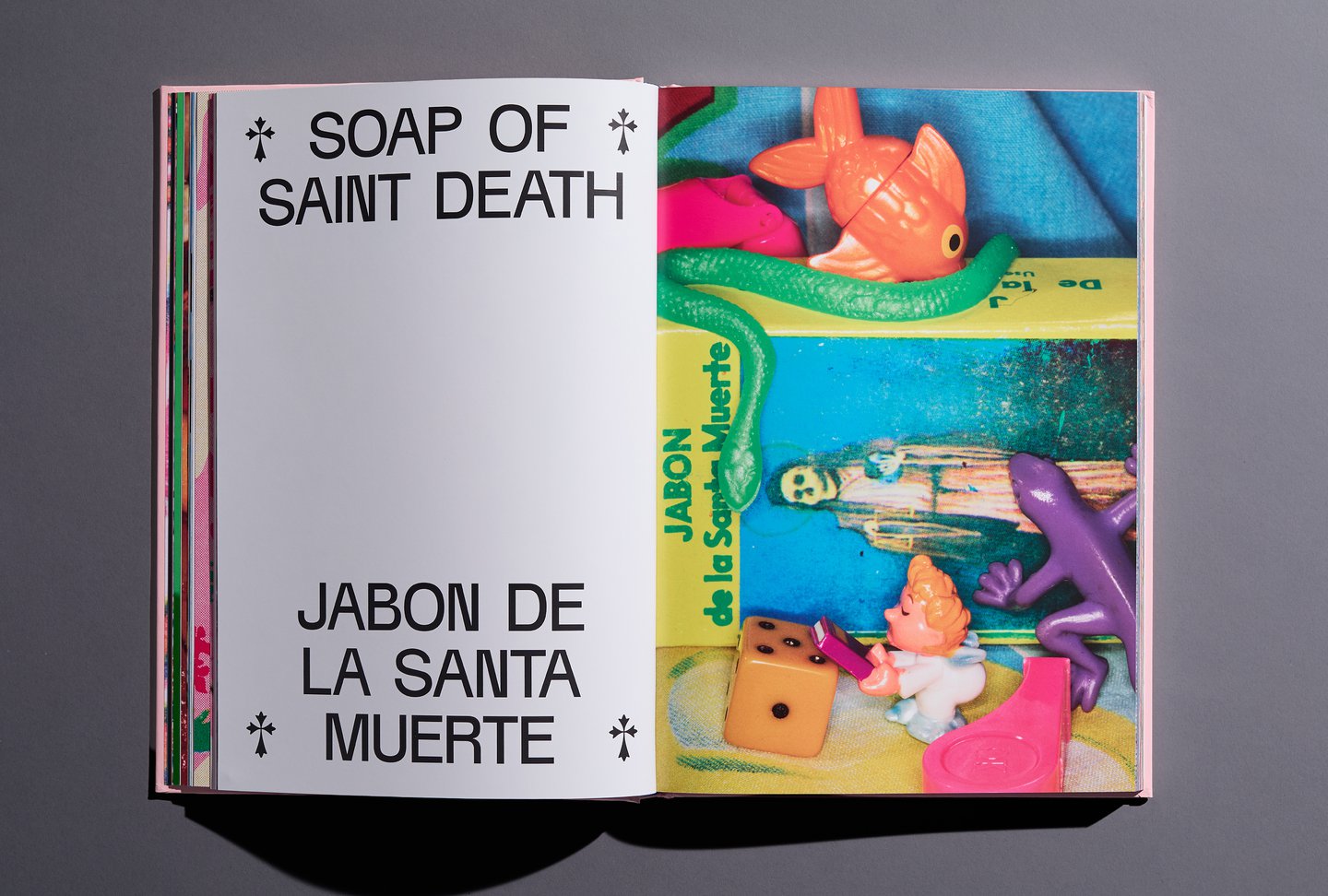
Each soap has its own visual world, with packaging design full of colour and decorative details, and a prescription or spell-like piece of copy that sits on the back of each box — texts that the designer found funny, fascinating and altogether quite bizarre. Initially keen to collect a number of soaps and document them as design artefacts, Stephanie parked the project for a few years. Returning to them after having some time apart from Mexico, the designer began to see the objects from a new angle. Outside of their packaging, illustrations and imprints, she decided she wanted to document everything the Soaps represented: “where I found them, and the themes interwoven in them, their playful innocence to the dark pain that creates a need for them”, she shares.
To make this happen, Stephanie brought Maisie on board. “We created back stories for the soaps: who was the character that bought it? What strife were they in? How did they feel?”, the designer says. Alongside these short imaginary narratives, Maisie developed a series of hypersaturated still life photographs in her signature maximalist style, where the presence of dirt, clumps of hair and slugs only add to a visceral image of the soaps cleansing properties.
Whilst a more is more approach to image making made the most of the soaps’ strong colours, religious iconography and distinct design identities, it was important that there was structure to “anchor the book within the chaos”, Stephanie says. Through endless experimenting with designer Tal Brosh, the pair developed repetitive typographic templates for the soaps surrounding stories, this included: “nested text blocks, exaggerated drop caps, and symmetrical page ornamentation speaks to prayer books and the religious heritage visible in the text”, Stephanie shares. Tal’s “liquid” illustrations as the designer describes them also helped link pages together and connote themes of magic and bathing.
Overall, the book’s design and rhythm allows you to digest this journey through a traditional witchcraft market in a number of ways. It serves a tactile tour of the packaging, an immersion into written narratives, and a photographic feast of the soaps themselves. “There’s different ways to enjoy it depending on your interests. Designers love the packaging for being authentically lo-fi. Others have enjoyed finding connection and meaning between the text and images,” the designer shares. “I’ve even heard from Mexico that people love the attention I gave to something that seems so insignificant in their culture. The project has made me think about what belief systems do for us. It’s not about granting our wishes really, but giving us a sense of control in a chaotic world.”