
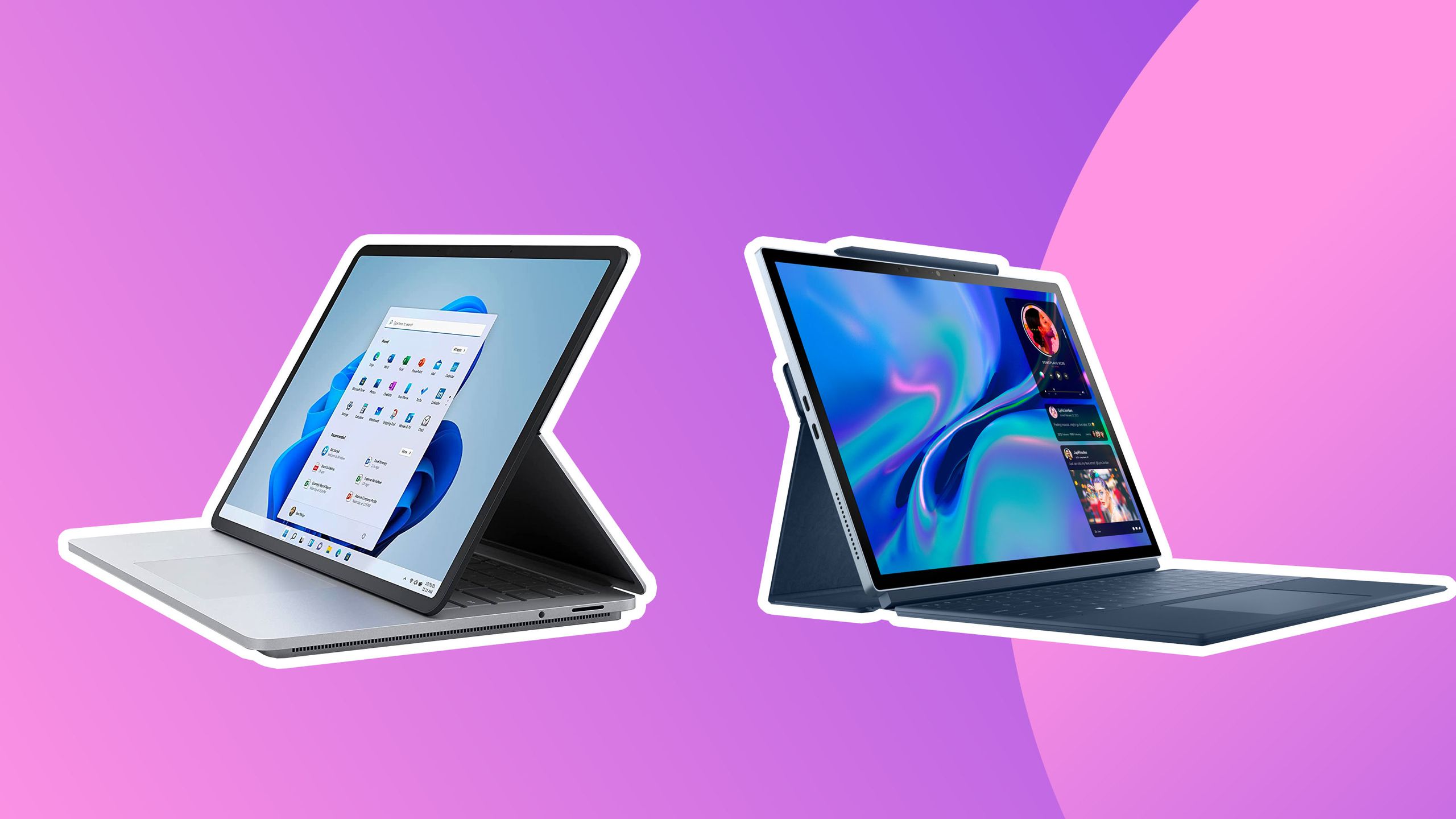
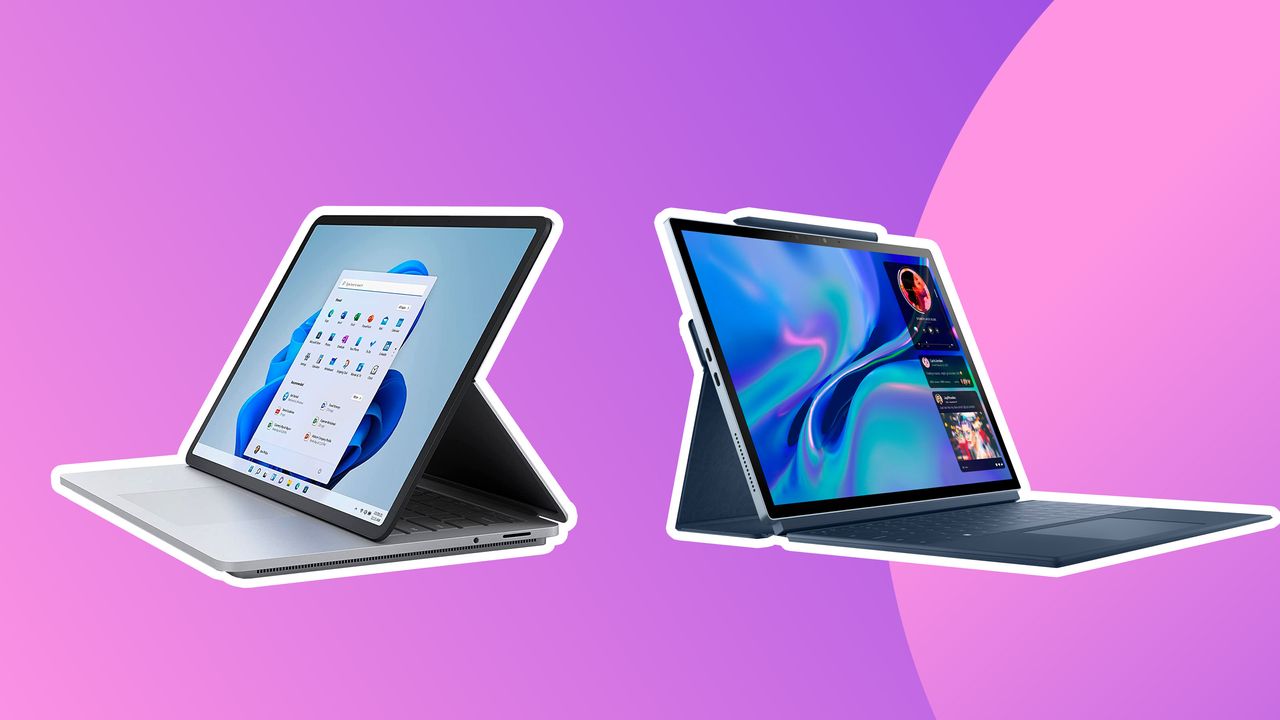
The best 2-in-1 laptops, aka hybrid laptops, combines the flexibility of a tablet with the power of a full laptop. And the latest generation of hybrid devices makes that balance feel genuinely seamless. Whether you want to sketch, edit photos, manage video projects, or simply move between desk and sofa without missing a beat, today’s 2-in-1s have you covered in ways their predecessors never quite managed.
Our team has hands-on experience with all five of these machines, testing them with real creative workflows, from Adobe Photoshop and Lightroom to Premiere Pro and Procreate, as well as industry-standard benchmarks (see the best laptops for Photoshop if you want something more standard).
The best 2-in-1 laptops for creatives
Why you can trust Creative Bloq
Our expert reviewers spend hours testing and comparing products and services so you can choose the best for you. Find out more about how we test.
The best 2-in-1 laptop overall
(Image credit: Paul Hatton)
01. Microsoft Surface Laptop Studio 2
The best 2-in-1 laptop overall
CPU: 13th Gen Intel Core H | Graphics: Intel Iris Xe / NVIDIA GeForce RTX 4060 and RTX 200 Ada laptop GPU | RAM: 16GB – 64GB | Screen: PixelSense Flow 14.4in 2400 x 1600 120Hz touch display | Storage: 512GB – 1TB SSD
Unique sliding-screen design
Stunning 3:2 display
Optional Nvidia RTX GPU
Exceptional build quality
Battery life suffers under GPU load
Surface Slim Pen 2 sold separately
Bulkier and heavier than most
The Surface Laptop Studio 2 has been out since late 2023, but it remains our top pick for creatives who want a single device that can do it all. It’s beautifully engineered: the screen doesn’t awkwardly fold backwards as on most convertibles, but instead glides forward over the keyboard to reveal an angled canvas (what Microsoft calls easel mode) that’s perfectly positioned for digital drawing. A further push brings it flat into studio mode for a fully horizontal working surface. These transitions are buttery smooth, and using them in practice never feels like a compromise.
The 14.4-inch PixelSense Flow display runs at 2400 x 1600 and 120Hz, with a 3:2 aspect ratio that gives you noticeably more vertical screen real estate than widescreen rivals (particularly useful when working on tall artboards or long documents). Under the hood, you get 13th Gen Intel Core i7, with options for Nvidia GeForce RTX 4050, 4060, or the professional RTX 2000 Ada generation GPU — meaning this machine can handle serious video editing, 3D rendering, and GPU-accelerated tasks in Photoshop or Blender.
RAM goes up to 64GB and storage to 2TB. The Surface Slim Pen 2 (sold separately) integrates beautifully with the haptic-enabled screen, with an almost imperceptible lag that makes drawing feel surprisingly natural. The battery life can be shorter than you might hope at higher performance settings, but for sheer creative versatility in a beautifully finished package, nothing comes close.
Best value 2-in-1 laptop
(Image credit: Acer)
02. Acer Chromebook Plus Spin 714
The best 2-in-1 laptop for value
CPU: Intel Core Ultra 5 115U | Graphics: Intel shared graphics | RAM: 8GB LPDDR5 | Screen: 14in WUXGA, 1920 x 1200, IPS touch | Storage: 256GB – 512GB SSD
Cheaper than a comparable Windows 2-in-1
On-device AI features are genuinely useful
Pressure-sensitive stylus included
Military-grade durability (MIL-STD-810H)
ChromeOS cannot run desktop Photoshop, Premiere Pro and other Windows apps
8GB RAM on the base model
IPS display lacks the contrast and colour depth of OLED screens
The Acer Chromebook Plus Spin 714 is the most affordable laptop on this list by some margin, though given that it starts at $699.99 / £849.99, it’s still not super-cheap. For the price though, you’re getting somewhat of a bargain: a premium, well-built 2-in-1 Chromebook that costs a lot less than an equivalent Windows machine, largely because ChromeOS carries a lower licence overhead.
Design-wise, you’re getting a durable aluminium chassis that meets MIL-STD-810H military standards, a crisp 14-inch WUXGA (1920 x 1200) IPS touchscreen with Gorilla Glass, and a 1440p QHD webcam with AI-enhanced video call tools. The Intel Core Ultra 5 processor handles multitasking with ease, and the on-device AI features (including live captions, Google’s Magic Editor for photo retouching, and Gemini AI integration in Google Docs, Sheets, and Gmail) are genuinely practical rather than gimmicky. A pressure-sensitive active stylus is also included and stows in an integrated garage on the chassis.
The reason you’re saving money here is that it runs ChromeOS, not Windows or macOS. That means you can’t, for example, run Photoshop or Premiere Pro natively; though Lightroom is available, as are Android apps and web-based creative tools.
In short, if your workflow is built around Google’s ecosystem, Microsoft 365, or browser-based apps, you’ll find this machine handles it all with ease. In which case, a creative 2-in-1 for lighter workflows, travel, and anyone embedded in Google’s tools, the Chromebook Plus Spin 714 punches well above its price.
The best premium 2-in-1 laptop
(Image credit: ASUS)
03. ASUS Zenbook Duo (2026)
The best 2-in-1 with premium features
CPU: Intel Core Ultra X9 388H / Core Ultra 9 386H / Core Ultra 7 355H | Graphics: Intel Arc B390 (12 Xe3 cores, top model) / Intel Arc (lower configs) | RAM: 32GB LPDDR5x-9600 | Screen: 2x 14in 2880 x 1800, 48–144Hz OLED touch | Storage: 1TB – 2TB PCIe Gen 4 SSD
Two screens!
New hideaway hinge
80% better graphics performance
Strong battery life
Expensive
Heavier than a typical laptop
Two screens can drain battery
The ASUS Zenbook Duo has always been a compelling proposition for creatives who crave screen real estate, and the 2026 model is the most polished version yet. (If you can’t imagine why you’d want two screens in a laptop, read My ASUS Zenbook Duo story.)
The headline improvement in this latest iteration is the new hideaway hinge, which reduces the gap between the two displays by 70% and (more importantly) allows both screens to sit completely flat and flush when opened. Previous models had an awkward step between the panels that made portrait-mode use slightly uncomfortable; that issue is now gone. The result is a setup that feels more like a unified workspace than two separate screens bolted together.
Under the lid, the 2026 model introduces Intel’s Core Ultra Series 3 processor alongside the new Arc B390 integrated GPU. The performance gains over the previous generation are substantial, particularly on the graphics side: in benchmarks, the Arc B390 scored around 80% higher than the integrated graphics in the 2024 model, and the laptop handles light gaming (including Cyberpunk 2077 with XeSS upscaling) at playable frame rates that would have seemed implausible from integrated graphics a couple of years ago.
For creatives, this translates to significantly faster GPU-accelerated rendering in Photoshop, Lightroom, and video editing tools. The 99WHr dual battery (a major increase over the 75WHr unit in the 2024 model) delivers over 14 hours on a single screen and a still-impressive 11 hours with both displays active. For a machine of this ambition, that battery life is genuinely remarkable.
The best 2-in-1 laptop with AI smarts
(Image credit: Future/Ian Evenden)
04. HP Spectre x360
The best 2-in-1 laptop with AI smarts
CPU: Intel Core Ultra 5 125H or Ultra 7 155H | Graphics: Intel Arc graphics | RAM: 16GB – 32GB LPDDR5 | Screen: 14in OLED, 2880 x 1800, 120Hz touch | Storage: 512GB – 2TB SSD
Lovely OLED screen
Excellent battery life
Stylus included
Outstanding webcam
No discrete GPU
Fan noise is noticeable
Port selection is limited
The HP’s Spectre x360 14 has long been one of the most elegant Windows laptops money can buy. The 14-inch OLED touchscreen — running at 2880 x 1800 and 120Hz, with 100% DCI-P3 coverage — is simply gorgeous: deep blacks, vivid colours, and excellent brightness make it a joy for photo editing, colour grading, and general creative work. HP includes its rechargeable MPP 2.0 stylus in the box, which is a thoughtful touch at this price tier and makes the convertible experience feel complete from day one.
Inside, you get Intel’s Core Ultra processors (5 or 7, depending on configuration) with Arc integrated graphics and a dedicated NPU for AI acceleration. Battery life regularly exceeds 10 hours in real-world use (unusually strong for an OLED laptop) and the build quality is exceptional: a CNC-machined metal chassis, the distinctive sliced corners that house the ports at an angle, and a 360-degree hinge with no wobble or flex. The dual-point hinge system makes tent mode and tablet mode feel solid and purposeful rather than flimsy.
A 9MP IR webcam sits above the screen, offering video call quality that embarrasses most rivals. The one caveat is the reliance on integrated graphics — there’s no discrete GPU, so it’s not the right choice if GPU-heavy rendering is central to your workflow. But for most creatives, it strikes a near-perfect balance.
Read more: HP Spectre x360 14 (2024) review
The best 2-in-1 laptop for drawing
(Image credit: Microsoft)
05. Microsoft Surface Pro 11
The best 2-in-1 laptop for drawing
CPU: Qualcomm Snapdragon X Plus (10-core) or X Elite (12-core) | Graphics: Qualcomm Adreno | RAM: 16GB – 32GB | Screen: 13in, 2880 x 1920, LCD (base) or OLED (upgrade), 120Hz touch | Storage: 256GB – 1TB SSD
Under 900g
New Flex Keyboard works wirelessly
Optional OLED display
Outstanding battery life
Keyboard sold separately
Some Windows apps incompatible
Only two Thunderbolt 4 ports
If digital drawing is important to you, the Surface Pro 11 is the device we’d steer you towards first. Microsoft’s latest iteration of its flagship tablet-laptop hybrid makes meaningful advances over its predecessors: the new Qualcomm Snapdragon X Plus and X Elite processors bring significant performance gains (Microsoft claims up to 90% faster than the Surface Pro 9) alongside a new Neural Processing Unit (NPU) for on-device AI tasks. The base model offers an LCD display, while upgrading to the OLED option gives you that striking contrast and colour depth that makes artwork look exactly as you intended.
At under 900g, it’s light enough to hold comfortably while sketching, and the kickstand provides a solid, wide range of angles for working on a desk or a table. The most significant practical upgrade, however, is the new Surface Pro Flex Keyboard: unlike previous generations, it can now be used wirelessly when detached from the device, which transforms the drawing experience. You can keep the keyboard on your lap or to one side while working stylus-only, without losing access to keyboard shortcuts in Photoshop or Illustrator.
The Surface Slim Pen (included with the Flex Keyboard bundle) offers 4,096 levels of pressure sensitivity and works beautifully with the display. A 1440p ultrawide front-facing webcam and Wi-Fi 7 round out a genuinely impressive package that starts at a relatively accessible price point for this category.
FAQs
How do you use a 2-in-1 laptop?
The best 2-in-1 laptops allow you to switch between laptop and tablet modes, and pick which setup is best for the creative task at hand. Sat at a desk needing to write emails? That may be more comfortable when the 2-in-1 is in laptop mode. Watching a film, doing some digital doodling on a train journey? That might be better suited to the tablet mode, or alternatively, you could look for the best drawing tablets for animation.
How do I use a 2-in-1 laptop for drawing?
In most cases, when you want to use a stylus on the touchscreen, be it for drawing or photo editing, you’re going to want to use the 2-in-1 laptop in tablet mode because when in laptop mode the screens aren’t usually fixed enough and will move at least a little when you apply pressure with the styus.
That said, Microsoft’s Surface Laptop Studio offers a neat middle option – easel mode – that allows you to prop the screen up fairly firmly in a vertical position over the keyboard. If you need a capable laptop for Photoshop, we have a dedicated guide for that, but many on here will be ideal too.
Are 2-in-1 laptops expensive?
2-in-1 laptops can be more expensive than traditional laptops, due to their convertible design and touchscreen capabilities. However, the price range varies between models, and there are many affordable options available.
How to choose the best 2-in-1 laptop
What type of 2-in-1 laptop is best for you? There are 2-in-1 laptops that turn from a laptop into a tablet by physically removing the keyboard. These are usually much thinner and lighter devices when used in tablet mode, but it does mean you need to store the keyboard carefully when it’s not being used.
Some 2-in-1 laptops with detachable keyboards have two batteries – one behind the screen and another in the keyboard. This offers longer battery life when in laptop mode. (If battery life is a particular worry of yours, you may want to check our list of the best power banks.)
Other 2-in-1 laptops feature a hinge that can flip the keyboard 360 degrees so that it is behind the screen. As the keyboard remains attached, these 2-in-1 laptops are usually a bit thicker and heavier than models with removable keyboards. However, you don’t have to worry about stashing an unused keyboard anywhere, and the hinge allows you to use the laptop in a variety of different ways. For example, you can flip the keyboard 90 degrees and use it as a stand, which makes it useful for watching media or presentations.
Many of the best 2-in-1 laptops also come with styluses that can be used with the touchscreen. This turns them into excellent digital drawing pads – again, making them ideal devices for digital creatives. (Should your desired convertible laptop not include a drawing apparatus, you can save some money by learning how to make a stylus using household items; seriously!).
How we test the best 2-in-1 laptops
Creative Bloq’s team of hardware experts bring with them many years of experience using, testing and benchmarking laptops with a focus on running creative applications. All the laptops in this guide have been tested by either using creative software or benchmarked to make sure the CPU and GPU are capable of running professional creative software without problems, including popular tools you’ll use such as Adobe Creative Cloud applications and more. We run different benchmark tests on each laptop depending on its intended use by its maker, but the benchmarks we’ve run all the laptops in this guide through include the following:
• Cinebench R23/2024 – this assesses the performance of a computer’s CPU and GPU using real-world 3D rendering tasks
• Handbrake – we use this free and open-source transcoder for digital video files to render a short 4K animated film, using the same file for all our tests
• Geekbench 5/6 – this tests the CPU’s processing power, both by using a single core for a single task at a time as well as all the CPU’s core to see its ability to multitask
• 3DMark – this assesses a laptop’s ability to run 3D graphic rendering tasks
But perhaps more importantly than benchmarking, we evaluate machines in real-world scenarios, pushing them to the limit with multiple applications running to see how they perform in project-like conditions. Power, speed, flexibility, and what a laptop looks and feels like to use are all criteria in our reviewing process. We do much more than simply unpack a test unit, run some benchmarks and then pack it up again; we have lived and worked with all of the above laptops, running them in real-life scenarios and done projects relevant to this guide, otherwise, we wouldn’t recommend these models to you.
Round up of today’s best deals