
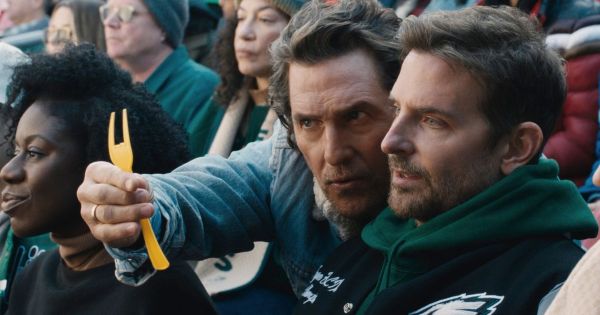
Matthew McConaughey loves making ads.
Inside his trailer near Uber Eats’ Super Bowl ad shoot, he can’t sit still as he describes the challenge of shaping a plot to fit within a 30- or 60-second window. He jumps up off the couch to reenact scenes, snaps his fingers rhythmically to illustrate the precision needed for comedic timing to work, and claps his hands loudly to signal a sudden shift in narrative strategy.
“For these scenes to work, especially in the comedy, it’s rhythm, and it’s timing, and it’s punch,” he tells ADWEEK, snapping his fingers.
The following conversation has been condensed and edited for flow and clarity.
ADWEEK: How do you decide whether to do an ad or not?
Matthew McConaughey: Does the ad reinforce some values I believe in and not siphon off of my credibility?
What reinforces my values? Pantalones Tequila. Someone’s gonna go, ‘How is tequila a value?’ Me and my wife, it’s our favorite drink together. I hold that valuable in my life.
Sometimes, I’m doing it because it’s philanthropic, a PSA. I love a good PSA. Whether it’s clean water, Covid, clean air. Hell, I’d do a PSA for pickles. I love pickles.
Sometimes I do it because it’s American-made and I like the product: Lincoln.
I do ads because I like sales and it’s good money.
What about Uber Eats?
There are a lot of ads where the first script’s not good, and you have to rewrite, rewrite, and find it.
The Uber Eats ads come in, you get the concept immediately.
Uber does something that I haven’t seen anybody do: They create an immense amount of the little socials that are funny that lead up to the entree. And they ladle it into the production. A prelude to the platter.
If those can become meme-able, it’s about measurement. These ads are direct to the consumer as they’re sitting there. Watch it, yep, yeah, I’m hungry—call Uber Eats.
And, I’m getting to work with Bradley [Cooper]. We hadn’t worked together since Failure to Launch.
You’re also reunited with Parker Posey, who you worked with on Dazed and Confused. What’s it like working with her now?
Yeah! I was just telling her! I hadn’t even met her yet in Dazed. I’m leaning against the wall outside the pool hall, right? The scene where I had the great line written: ‘That’s what I love about high school girls, they stay the same age.’
Right before that, Parker and a couple girlfriends walk out and they’re playing the drums and stuff, and she walks past me, leaning against the wall, then comes back with her right hand and gives me a reverse reacharound on my right ass cheek and pinches it, and I scoot in and she goes ‘Woo-OO!’ [Laughing] That was my hello to Parker. I reminded her of that today.
I’ve seen the approach when you reach out, but never the reverse reacharound, grab the old ass. She’s great.
Isn’t it cool? She’s been a one-of-one for a long time, and then boom. She gets in something that hits: White Lotus.
She was like, ‘You know what? And it feels right on time.’ I was like, ‘Badass.’
Your Uber Eats character was developed last year for the 2025 Super Bowl. What appeals to you about him?
They created the character of the conspiracy theorist guy who’s got it all figured out, and came to me for that.
I like playing characters that have an idiosyncrasy, or a specific detail that they latch onto, and think the world revolves around that. Someone who is consistent while the world’s changing, and the world’s going, ‘Don’t you see? It’s not making sense!’
That’s a delusional optimist.
Do these ads scratch a different itch for you than filmmaking?
I’ve been doing a lot of dramas. I hadn’t found any comedies to do. So I look at something like Uber Eats or some of the Salesforce ads I’m doing. I’m going, ‘Oh, great time for comedy.’ I can scratch that itch. And maybe somebody watches it and goes, ‘Oh, I forgot McConaughey’s funny!’
I look at them as little vacations.
Are there any other creative itches you scratched with this Uber Eats ad?
This is a big commercial, we’re doing a three-day shoot.
With Uber Eats, I’ve already got a shorthand with them. And for these scenes to work, especially in the comedy, [snapping his fingers] it’s rhythm, and it’s timing, and it’s punch.
You hear on set: ‘Can we do this faster?’ Because they’re already timing out the 60 seconds.
It does need a clip, because each scene’s gotta be beginning, middle, end. It’s gotta bop-bop-PUNCH. And it’s gotta HA. And so there’s a rhythm to the timing.
How’s that different from filmmaking?
In a two-hour film, you’ve got 35, 40 minutes of a first act, just let me introduce you to who I am.
And the scene doesn’t have to be about ‘What’s the conflict?’ We don’t have to be interrupted, which happens in act two of every story, right? We caught ‘em in their everyday life, before the conflict happens.
In this Uber ad we’re shooting, my act one’s already set up, Bradley’s act one’s already set up, and now we’re gonna collide.
You mentioned you like ads because they let you do comedy, but I was thinking about the Lincoln ad you filmed some years ago, which was more meditative.
We went the opposite way with those.
So slow, and it was so quiet, and our bet paid off.
We were conscious about going: What if we were the quietest commercial on TV? It was like cutting through soft butter, and that worked on that level.
And those ended up, for comedy’s sake, getting parodied. That’s even better for our ads in our campaign. Parody it! Just parody it well.
With Salesforce, you’re more than just a pitchman, you’re a creative advisor. What does that entail?
I work on the scripts.
Our first thing out of the gate was: Let’s make sure we gain trust. If you can get to baseline trust, I feel like that’s a safe place for my information management and access.
With AI agents, we have to watch that it’s not only the coast that knows.
In Silicon Valley, you can get in a bubble. How do you explain it, and how it can be useful to John and Jane Doe, who live on, as my brother calls it, real time?