

Why you can trust Creative Bloq
Our expert reviewers spend hours testing and comparing products and services so you can choose the best for you. Find out more about how we test.
The new Harrier in-ear monitor (IEM) by Juzear is noteworthy for three reasons. One, it symbolises Chinese Hi-Fi’s (Chi-Fi’s) dominance of the IEM space in 2026. Two, it’s an intriguing collaboration between Juzear and IEM supreme reviewer Mark Ryan, using his database of IEM sound graphs as a springboard to sculpt the Harrier’s sound profile. And three, it’s mathematically proven to be pleasing to the vast majority of audiophiles. Kind of.
At $330, it’s not going to make my list of the best budget audiophile headphones, but in the crowded ‘mid-fi’ market, it offers a specific sound profile that will make a section of users extremely happy.
Specs
Drivers: 1 dynamic driver + 6 balanced armatures + 2 micro planar drivers.
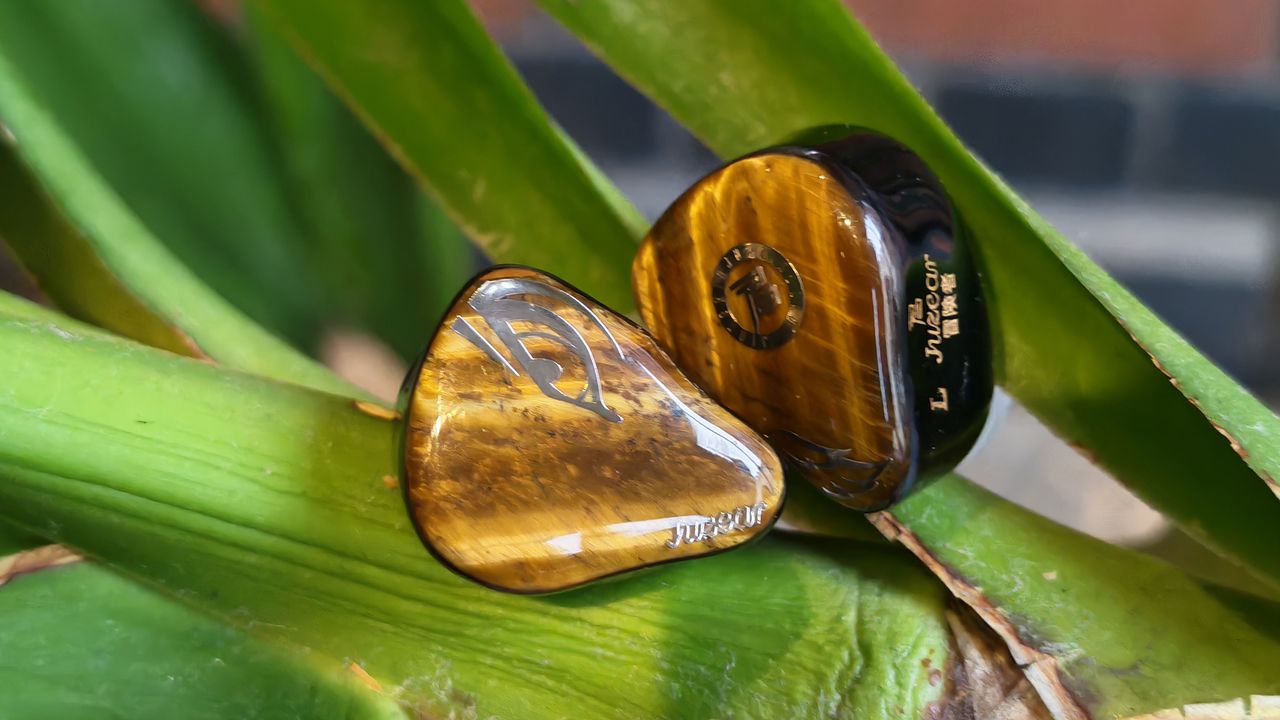
Faceplate: Blue Tiger’s Eye chatoyant gemstone
Cable:
Impedance: 32Ω
Sensitivity: 112dB
Frequency response 20Hz to 20kHz
Weight 7.1g each
Since China entered the largely Western-run space of IEMs around 10 years ago, Chi-Fi brands such as Moondrop, ThieAudio, Linsoul Audio and, since 2023, Juzear, have offered multi-driver IEMs for a fraction of the price of their Western counterparts. Chi-Fi offers more for less, and with the Harrier, you get a staggering nine driver set up for $330, as well as beautiful faceplates with real Hawk’s Eye stone over 3D-printed resin shells. This would have cost you $1,500 or more from a Western brand back in the day!
What sound is the Harrier aiming for?
(Image credit: Future)
Mark Ryan is behind the brilliant audiophile YouTube channel Super* Review, and he’s also well known for popularising Squiglink, a database of IEM and headphone frequency response graphs. He was head tuner of the Harrier and the marketing machine says he based its sound largely on the audio legend Crinacle’s In-Ear Fidelity Neutral target (with an added bass boost).
Although the IEF Neutral target doesn’t have the scientific backing of the industry standard Harman target (a target based on what the majority of listeners like), a lot of the hardest working audiophiles in the business are fans of it, Mark included. So, the Harrier isn’t what the people asked for, but it’s what a number of audio experts feel is most natural, most balanced and most… good!
Yet the Harrier is not an audiophile passion project – it’s a commercial product and so it needs a wide audience to succeed. So, is this bass-boosted, audiophile-approved IEM going to be a crowd pleaser? Or will its upper-mid/treble-softened profile leave listeners cold? I have no idea. But I can share my personal thoughts on it, after using it for several weeks. Here we go…
Sound profile
Image 1 of 4
(Image credit: Future)(Image credit: Future)(Image credit: Future)(Image credit: Future)
Overall I really enjoy the sound of the Harrier, whether it’s the punchy bass or really impressive treble response, which is detailed yet not bright. And yet I never caught myself smiling like an idiot at the sheer joy of it all, and that really should be the goal with all this audio stuff. Ultimately, it looks like it sounds: grown up, measured and chic, but not exactly a wild time.
The bass is good. The Harrier is going for Crinacle’s In-Ear Fidelity Neutral target, with a bass boost. The mid bass is big and confident, backed up with an extended sub bass, without bleeding too much into the also slightly elevated mids. On an excellently mixed track like Donald Fagen’s Morph the Cat, the bass sounds textured, not bloated. On a far more bass-forward mix like Eryka Badu’s Other Side of the Game, it’s about as much bass as I personally can take without being distracted. It’s not bloated, but it definitely dominates. If I’m generous, some of that bass brings a touch of energy to the mids. If I’m being critical (and for $330, I should be), there are IEMs with tighter bass out there for the money.
Mids sound full and detailed to me, with male and female vocals presenting themselves well in the sound soup. This may be due to the tamed treble, but the remarkable thing here is that the mids aren’t overly affected by the meaty bass. Yes, a touch of bass warms things up a bit, as mentioned above, but when I was focussing on the bass, I kept waiting to then hear it totally overwhelm the mids (as with similarly boosted bass sets I’ve heard), but that just didn’t happen. I was always aware of the bass, but the horns, vocals, guitars, pianos, snare drums and other instruments in the mid range sounded true and realistic to me. Nothing here was overly forward, or pushed back. It was just present, standing its ground.
The treble manages to be detailed and not fatiguing – this is definitely the Harrier’s unique selling point. Mark Ryan has mentioned that the treble was the area that he worked hardest on for the Harrier, and it shows. Usually detail and high, spiky treble goes hand in hand, but the Harrier’s treble is largely lower than the Harman target, with scoops around the 7k to 11k frequencies, and yet there’s still plenty of detail to be enjoyed.
To my ears the treble is beautifully balanced. Playing high-treble-mixed songs Billie Jean by Michael Jackson and Unbroken Chain by Grateful Dead, and the obnoxious highs are tamed without being neutered. I don’t want to overstate things, but this is basically magic. With well mixed tracks, the treble retains full detail, never sounding muffled or dark; and with poorly mixed tracks, the treble is still tastefully presented. Hey presto!
Detail and imaging is solid on the Harrier. Perceived detail is often just a forward treble response shining a bright light on everything. This can be done well, as with the Ziigaat Horizon (review incoming), where a couple of well-positioned treble peaks accentuate detail here and there throughout the mix. And it can be done poorly, as with the Beyerdynamic DT 990 headphone. Whack a murderous peak in the 8k region and sure, there will be lots of detail, but you’ll also have to deal with all the blood coming out of your ears.
The Harrier offers a fair amount of detail and clear imaging without the cost of fatiguing treble. The nine drivers in the Harrier also provide clarity especially in super busy passages of music. But really how much detail you pick up on is mostly the result of an IEM’s tuning, and the Harrier has been tuned exceptionally well. For context, this is not an IEM trying to convey massive amounts of detail – it doesn’t gouge out the upper mids and whack up 8k to present listeners with the illusion of soundstage and detail. It’s balanced and measured, and there are details to be gleaned, but if you want something super exciting and ‘detailed’, I’d look elsewhere.
Comfort, build & accessories
(Image credit: Juzear)
This set is really comfortable and well built, and with its exceptional options of tips, a great seal is guaranteed for all users. This really should be a standard for $300 IEMs, yet it isn’t. Pay attention IEM makers – this is how it’s done!
You get two boxes of ear tips – 15 pairs in total. There’s eight pairs of ‘Liquid silicone’, four pairs of normal silicone, and three pairs of wide-bore silicone tips.
You also get an really good cable. I really got on with this thing – not too tacky yet pleasant to handle; pliant and not too memory-prone; a good length at 1.2 meters and an aesthetically pleasing white-silver. It’s also modular, so you can swap between 3.5mm single-ended and 4.4mm balanced terminations, should that be your bag.
The Harrier shells are 3D-printed resin shells that are fairly lightweight at 7.1 grams a piece, and I found them very comfortable (once I found the right tips for my big ears). There definitely are smaller out there (again, the Ziigaat Horizons at 4.8g), I used these for hours at a time, and felt no discomfort.
Price, value, competition
(Image credit: Future)
It’s annoying when I like an audio product as much as I like the Harrier, only to be forced to score it down due to factors other than how it sounds. Based on the sound profile, I’d give the Harrier four stars, as it’s a safe allrounder that does at least one thing exceptionally well – the treble. But IEM reviews are not based on sound alone and price, value and competition have to be considered.
I think the $330 asking price is a little steep, which, if you’ve read the intro to this piece about the value that Chi-Fi has thrust upon the IEM market in the last decade, seems an insane thing to say. But in 2026, you can get an IEM to suit literally any taste, and many offer great value for their price. I don’t think the Harrier does that, and what’s more, it’s only worth $330 to a select user – people who want exceptional, not-bright-yet-detailed treble. If that’s you, the Harrier is an easy recommendation. If not, there are other alternatives to consider.
If you can stand a touch more treble, the Ziigaat Horizon is a fantastic set that I’m in the process of reviewing. It has tighter bass, similarly full mids (with clearer female vocals) and more treble in all the same spots that the Harrier accentuates. It’s also $330, and I’d say it offers more excitement than the Harrier while still being tasteful (incidentally, it’s also one of Mark Ryan’s favourite IEMs of 2025).
For $100 less, there’s the New Meta star, the Kiwi Ears KE4 at $200. I wouldn’t call the KE4 exciting like the Horizon, but it offers a neutral, balanced sound profile with a focus on full mids, and its own take on a less-ear-piercing treble. It also has a bass shelf, which isn’t as impactful as the Harrier. It’s another all-rounder, and I’d say it’s better value than the Harrier.
Should you buy it?
So, does the Harrier’s safe sound profile get sexy at all? Sexy, no. Seductive, quite possibly.
If you want to get blown away by an exciting sound profile, the Harrier isn’t teh way to go. But if you’re looking for a sophisticated, balanced and chic IEM, the Harrier is a great choice. It’s too grown up to be getting up to any shenanigans like some of the wilder, more energetic IEMs out there. But treble sensitivity is real, and if you want something that you can actually use for several hours at a time without your ears feeling over-worked, the Harrier is a fine bird to catch.
Whatever you play on the Harrier sounds great, and that’s a lot more than can be said for several IEMs at this price range.
For me, I enjoyed using the Harrier the more time I spent with it. But I’m a reviewer, and I didn’t pay $330 for the privilege. And honestly, given the choice I don’t think I would. That’s not because this is in any way a bad IEM. It’s a good IEM verging on great. But there are flat out great IEMs out there for the same price – even less – that may not do exactly what the Harrier does, but can get close, and offer better value in the process. That’s why the Harrier gets 3.5 stars.
However, if you are treble sensitive (or just an admirer of beautifully tuned treble) and that’s been a limiting factor in your enjoyment of IEMs in the past, the Harrier is well worth checking out.