
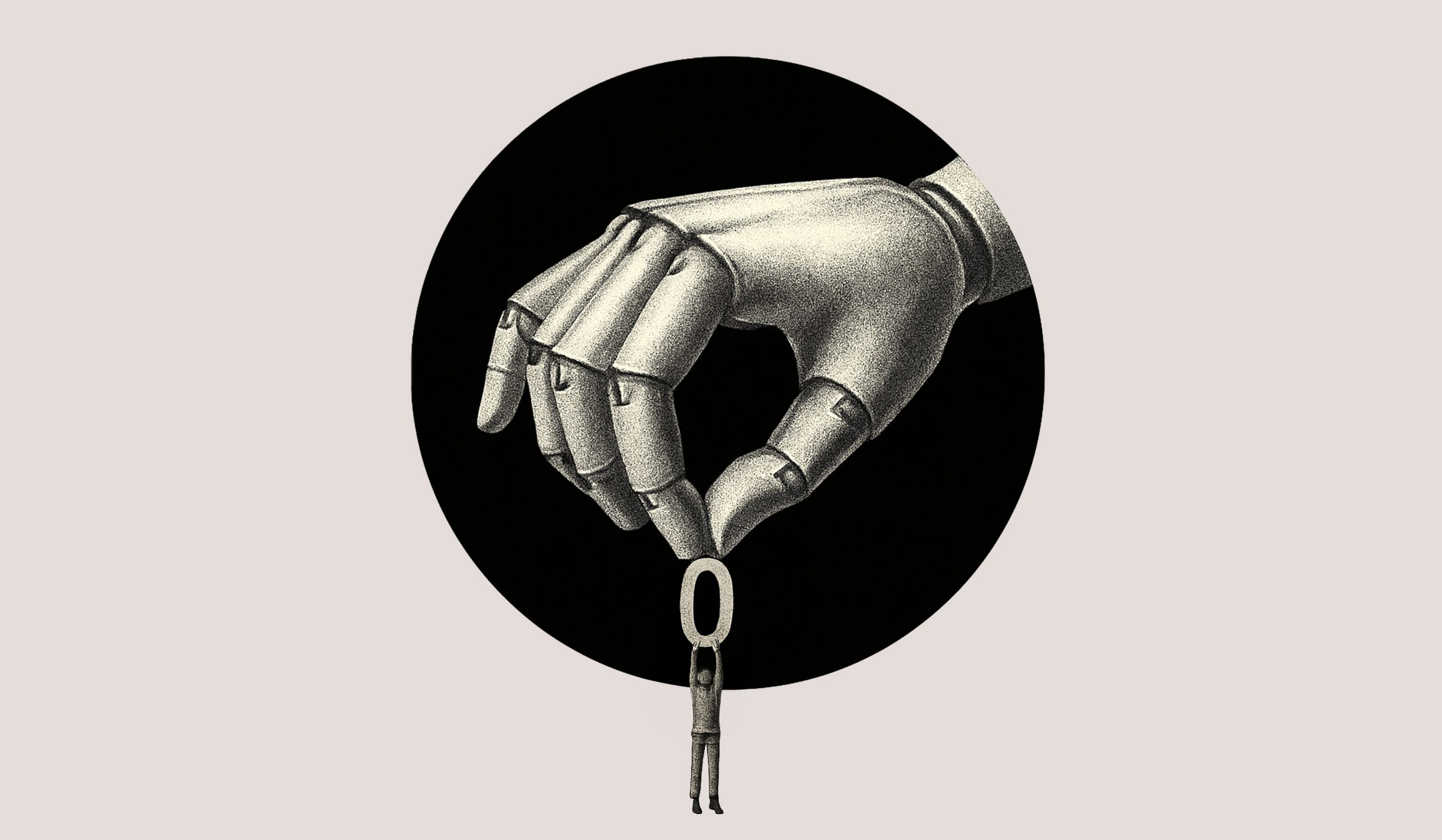
Programmatic marketers may not understand AI but they’re even more unsure of themselves.
That was the undercurrent at this week’s Digiday Programmatic Marketing Summit in New Orleans.
Onstage discussions, offstage pow wows and the usually candid town halls all pointed to the same tension: everyone talking about AI, yet few felt equipped to shape what comes next. The dynamic landed with real force. This moment isn’t about automation muscling out humans. It’s about a shift in which influence sits — technical literacy is the real source of value.
“We’re at an inflection point,” said Doug Paladino, head of programmatic at PMG. “Things have developed so much in the last six months. “There’s an LLM plugged into everything now.”
It’s not the most alarming of takes but it was impossible to escape. Everything returned to that point for a reason: AI is both everything and nothing to programmatic marketers. “AI agents” meant workflow support for some, optimization logic for others and near-automy for a select few. “Agenctic” carried the weight of infrastructure for engineers, while everyone else heard automation.
That fractured vocabulary hasn’t just muddled expectations, it’s blurred the industry’s ability to gauge its own preparedness, even as most acknowledge AI’s very real limits. Because readiness depends on what you think you’re preparing for.
This week in Louisiana made clear that everyone was preparing for something different. Agencies were weighing up how far generative AI could go in planning and summarizing. DSPs were sizing up determinist automation. Engineers were debating whether the open web’s plumbing can sustain a model-native future. Executives were imagining intelligent assistants embedded in every workflow.
Each of those paths requires its own skills, its own operating rhythms, its own guardrails. Fold them together under one banner and the industry loses sight of where the real readiness gaps sit, whether it’s the conceptual gap between the AI and the auction, the operational gap between planning tools and real-time systems or the structural gap embedded in the open web’s infrastructure.
“AI is very much here but it’s important to remember it’s also still a nascent technology,” said Ashmita Chatterjee, vp of client services at Rise, a Quad Agency. “We’re seeing successes and sometimes we’re pausing and pivoting.”
All the uncertainty around AI isn’t rooted in a lack of imagination. It’s the result of too many futures being discussed at once, without a shared map of what needs to change first.
One conversation on the sidelines made this especially clear. An ad exec told me they had a LLM running locally on their desktop — i.e. it was fast enough to handle real-time inference. The hardware exists. The models are here. The capability curve is accelerating faster than the industry’s assumptions. But the ecosystem isn’t structurally ready for any of it. The bottleneck isn’t so much the intelligence, but the foundation those systems would depend on.
That’s what the Agentic RTB Framework from the AB Tech Lab is trying to address. Not by dropping LLMs into the auction but by modernizing the open web’s operating environment so future intelligence, deterministic or otherwise can function safely and efficiently. Containerization, clean schemes, predictable protocols and tighter feedback loops: the unglamorous work required to move from model experimentation to model integration — or the coherence the walled gardens already enjoy and the open web still lacks.
The event’s session with Joshua Prismon, chief architect at Index Exchange and IAB Tech Lab’s director of addressability and privacy enhancing technologies really brought that into sharp focus.
“We’re focused on getting all the plumbing together and building the roads, the street and the sewer lines — all the unsexy stuff you need to support whatever gets built on top of it,” said Prismon.
Yet even as Prismon mapped the technical path forward, the room revealed how unsteady the human path remains. One attendee, Attention Arc’s evp of, media Investment and pptimization Christopher Francia put words to it: “There’s a lot of confusion. You guys keep throwing in terms like ‘AI agents’ and things like that. People hear ‘agent’ and think LLMs, and that’s not what this is at all.”
It was a candid acknowledgement of something everyone seemed to recognize: the infrastructure may be evolving but the industry’s understanding is not keeping pace — a reminder that programmatic’s deepest uncertainty isn’t about the tech itself so much as the industry’s grasp of what that technology actually means.
Or as another ad exec said under Chatham House rules: “My team doesn’t feel comfortable enough to know when it [AI] is wrong. They need to know enough to question it.”
Doing so, however, is harder than it sounds. Automation is hollowing out the very base where programmatic talent once learned the mechanics. As Paladino warned: “We’ve gotten so good at automating the entry-level work that I’m a little worried because those folks are supposed to become our managers in three to five years.”
When AI means everything and nothing, the industry doesn’t have a clear way to articulate what needs to be rebuilt. Knowing the limits of AI isn’t enough. It needs clarity on its own gaps — where the talent pipeline breaks down, where the pipes can’t support faster inference, where workflows introduce fragility and where governance has to evolve.
Until those structures mature, AI’s promise will remain just that — promise, not capability.
Numbers to know
- 4,000: The total number of global job cuts as a result of the Omnicom-IPG merger deal
- 35%: Regional average percentage discount for Black Friday deals in America this year
- 10.4%: Percentage by which e-commerce sales rose year-over-year in the U.S. on Black Friday
- 73%: Percentage of mid-market organizations which plan to increase investment in creator marketing five years from now
What we’ve covered
Visa extends its reach into the creator economy’s liquidity crunch
Turns out, creators still wait far too long to get paid, and by the time they get it (after each intermediary takes their cut), is a lot thinner. But Visa might have an answer: it’s using a creator financial platform to move that cash through Visa Direct, speeding up the whole process.
U.K. retailer Tesco wants advertisers to see it as equal to any traditional media partner
With five upfront events now under its belt, U.K. retailer Tesco is on a mission to change how advertisers perceive its retail media arm, Tesco Media. It doesn’t want to be an add on, it wants to be considered in the same context as traditional media owners, according to the company’s client development director, Nick Ashley.
The Trade Desk loosens its grip on pricing amid buyer pressure
After years of remaining tight on their position, The Trade Desk is finally open to negotiating fees for their clients, as it continues to battle against its rivals.
OpenX redraws the SSP-agency relationship
Supply-side platforms (SSPs) were originally built as publisher advocates, but its when they started working with advertisers that created tension. It turns out OpenX leaned into the idea of better data and smarter buying and how it would ultimately lead to higher revenue — and so far, it’s paying off.
What we’re reading
Omnicom to axe historic ad agencies and cut 4,000 jobs in IPG takeover
As with any restructure of a company, mergers and acquisitions typically come with job cuts, and this latest deal is no different. The structure is a direct result of the IPG takeover, and will see 4,000 staff laid off, according to Financial Times.
OpenAI CEO Declares ‘Code Red’ to Combat Threats to ChatGPT, Delays Ads Effort
In a memo to employees, CEO Sam Altman initiated a “code red” in a bid to improve ChatGPT, given the rise of its competition from Google and other AI companies. With resources being pulled in that direction, the knock on effect means delays to other initiatives such as its long-awaited ads, according to The Information.
Meta’s Zuckerberg Plans Deep Cuts for Metaverse Efforts
Forget the fact that Meta’s CEO was ‘all in’ on the metaverse not that long ago — so much so he rebranded the entire company after its efforts. But with AI and Superintelligence being the new primary focus for the business, it seems that Zuckerberg has finally decided to make cuts, up to 30% in its metaverse division, according to Bloomberg.