
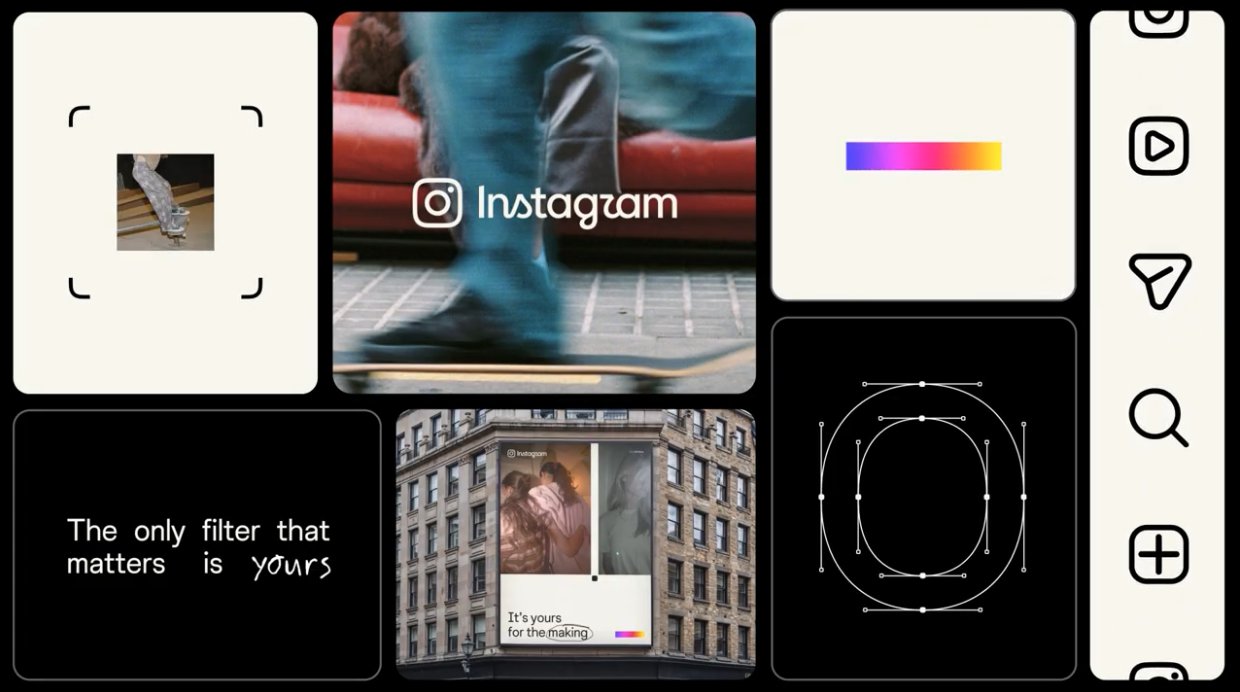
Instagram exists to showcase the work of its community, not the other way around. “We don’t like to talk about ourselves much,” says Cynthia. “Our storytelling focuses on the creators and content we’re celebrating.” This point of view was crystallised in the new identity. In this same spirit of realness, the refreshed identity consistently celebrates the act of making, not polished outcomes or perfect moments. In other words, it values the act of making, not only the act of posting. Christy describes this model as “a really well-designed sketchbook”. Something just structured enough to hold together while still remaining flexible enough to encourage weirdness and unexpected experimentation.
At a moment when many brands are looking to all things analogue as shorthand for humanity (not AI), Instagram’s team was all too aware of avoiding trend-chasing. But, they felt they had an authentic claim to much of the tactile visual language that’s percolating in the design world at the moment. In lieu of referencing creativity as an abstract concept, the new identity is rooted in the actual tools and rituals of photographic image-making – like contact sheets, registration marks and annotations. “That’s not a borrowed aesthetic,” Cynthia says. “That’s literally what happens on our platform every day.” Christy describes Instagram as, at its core, “the modern photo album”. In her mind, the redesign then is less a response to a trend than a return to something Instagram has always believed: that the platform exists to give anyone the tools to make an image and share it with the world. The tactile cues woven throughout the identity simply point back to the long-standing history of the camera and the darkroom, or even the family gathering around a slide projector to look at vacation snaps.
One of the most distinctive additions to the identity that speaks to this photographic history is the new viewfinder device. The form, derived from the camera glyph, frames imagery throughout the system and subtly “breaks the fourth wall” by drawing attention back to the act of taking the picture and, as Cynthia explains, “hopefully indicating the maker behind it”. The viewfinder is meant to remind the casual scroller that all the images they are seeing actually began in a real place: someone framing a shot, making a decision and choosing to share it with the world (and in a way, them specifically.)The team hopes the viewfinder framing in the design system can help make the act of taking a picture and putting it into the world feel “more accessible, more fun, and something we all can imagine ourselves doing”.