
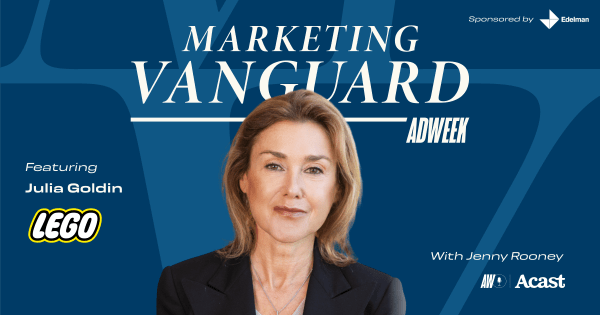
The Marketing Vanguard at Cannes series continues as host Jenny Rooney sits down with Julia Goldin, chief marketing and product officer at Lego.
In this conversation, Julia shares how Lego has grown from a children’s toy company into a global experience brand loved by kids, teens and adults, without losing the creative system that made it iconic in the first place.
She offers insights into the discipline behind that growth: knowing what to say no to, protecting authenticity, taking calculated risks and treating mistakes as part of the work.
What you’ll learn:
- How Lego expanded from a toy brand into a multi-generational creative experience
- Why saying no is one of the most important brand-building decisions a CMO can make
- How to balance innovation risk with consumer trust and brand authenticity
- Why mistakes are essential to learning, unlearning and relearning
- How Lego SmartPlay uses technology to enhance physical play without adding more screens
- Why human creativity is the real competitive advantage in the age of tech
- How partnerships like Formula 1 and World Cup campaigns become bigger than product launches
- This episode is part of a special vidcast series that was recorded live during Cannes 2026 and presented in partnership with Edelman
About our guest:
Julia Goldin is the Chief Marketing and Product Officer at Lego, where she has spent 11 years helping shape the brand into a multi-generational creative experience. Under her leadership, Lego has grown across children, teens and adults, while expanding its connection with girls and women builders.
From Lego SmartPlay to high-profile partnerships with Formula 1 and World Cup campaigns, she has helped Lego push into new spaces while staying grounded in authenticity, trust and the limitless possibilities of the Lego system in play.
Her leadership philosophy is clear: Creativity grows when teams are curious, willing to make mistakes and disciplined enough to protect what the brand stands for.
Episode Highlights:
[02:44] Why Lego’s Growth Comes from Limitless Possibility — Julia describes the Lego system in play as something with limitless creative potential. That belief shapes how she works with her team: Every idea can be built on, pushed further and made stronger. For marketers, this is the difference between treating a brand as a fixed asset and treating it as a creative platform. The strongest brands do not just repeat what worked before, but rather look for new expressions of the same truth.
[03:15] Why Saying No Protects Brand Authenticity — Julia is clear that Lego cannot and should not be everywhere. Consumers expect the brand to be authentic, which means not every partnership, extension or opportunity is right, even when it looks commercially attractive. That discipline matters because overextension can quietly weaken trust. For CMOs, the sharper question is not only what the brand can do next but also what the brand should refuse to do.
[06:30] Why Perfect Execution Can Kill Innovation — Julia makes the case that risk-taking is not optional if brands want to grow. In her view, if you remove risk, you end up playing too safe to succeed. She connects this to the act of building with Lego itself: if you never make a mistake while building, you are probably not really building properly. The same applies to marketing and product innovation. Mistakes are not proof that the work is broken. They are often proof that the team is learning.
[08:45] Making Lego More Accessible for Time-Starved Adults — Julia explains how Lego has evolved its adult offering beyond highly complex, time-intensive builds. While those products still matter, the brand now offers more accessible options for adults who want creativity but may not have hours to commit. That shift shows a sharp understanding of audience friction. Growth does not always require changing the brand promise. Sometimes it means removing the barriers that stop more people from participating in it.