
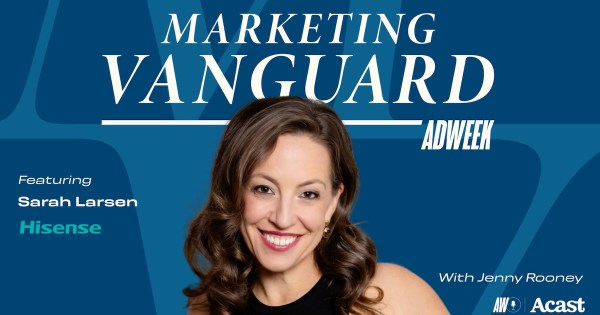
Consumer electronics marketing has a bad habit: It talks too much about the product and not enough about the person buying it.
In this episode of Marketing Vanguard, Sarah Larsen, CMO at Hisense USA, joins Jenny Rooney to unpack why she’s throwing tech speak out the window and rebuilding marketing around sell-out, consumer behavior, and real-life relevance.
As Hisense’s first overarching CMO, Sarah shares how she’s reinforcing one sharp mandate: Marketing needs to move product.
What you’ll learn:
- Why consumer electronics brands need to stop leading with tech specs
- How Sarah defines marketing success through sellout, not vanity metrics
- Why CMOs should act as the great unifiers across product, retail, sales and consumer insight
- How to turn global sponsorships like FIFA World Cup into real consumer connection
- Why research needs to be continuous, not a one-time path-to-purchase study
- How future-proofing your brand means investing in the buyers who are not yet your core demographic
About our guest:
Sarah Larsen is the chief marketing officer at Hisense USA, where she is the first leader to hold the company’s newly created overarching CMO role. With 30 years of experience across PR, earned media, social, digital, paid media, sponsorships, and consumer electronics, Sarah brings a nontraditional path to modern marketing leadership.
Before joining Hisense, Sarah built deep category expertise through roles connected to brands like LG, Samsung, and Motorola. At Hisense, she now leads a broad remit spanning product marketing, product management, retail, insights, communications, and go-to-market strategy, with one clear goal: marketing that drives sellout.
Episode Highlights:
[00:39] Building Hisense’s First Overarching CMO Role — Sarah explains what it means to step into a newly created CMO role at Hisense USA and why the opportunity felt like a “rocket ship” from the start. Rather than inheriting a traditional marketing setup, she is helping create a more unified structure across product, retail, communications, and insights. For modern CMOs, this is a reminder that the role is no longer just about brand campaigns. It is about connecting every part of the go-to-market engine to business outcomes.
[07:14] Marketing Needs to Tie Back to Sellout — Sarah makes her position clear: Marketing is ultimately responsible for moving products. At Hisense, her remit is directly tied to sellout, which means every campaign, retail decision, product marketing effort, and communication strategy needs to connect back to sales. It’s a sharp challenge to CMOs who are still hiding behind softer metrics. Awareness matters, but if marketing cannot prove its role in business growth, it is not doing the full job.
[08:50] Why Tech Specs Are Not Enough to Sell Consumer Electronics — In a category crowded with technical claims, Sarah argues that consumers do not want more jargon. They want to know why the product matters in their lives. Instead of leading with features, she focuses on showing how a TV, fridge, or appliance can make life easier, more convenient, or more enjoyable. The real shift is from “look what this product does” to “here’s why you should care.”
[15:53] Turning Global Sponsorships Into More Than Logo Soup — Sarah is honest about global sponsorships: they can go wrong fast. Without a clear strategy, they become expensive logo placement with no real connection to the shopper. Her approach to FIFA World Cup 2026 is to move beyond the superfan and build around a broader cultural behavior: hosting. That gives Hisense a more natural way to connect products to real moments in people’s homes, instead of treating the sponsorship as the entire message.
[20:20] Future-Proofing Your Brand Before It’s Too Late — Sarah’s warning to marketers is simple: your target demographic will not stay your target demographic forever. If brands only focus on today’s buyer and ignore the generations coming up next, they risk losing an entire cohort before they even age into the category. Future-proofing means dual targeting: serving current buyers while also building affinity with future ones. Waiting until they are ready to buy is already too late.