
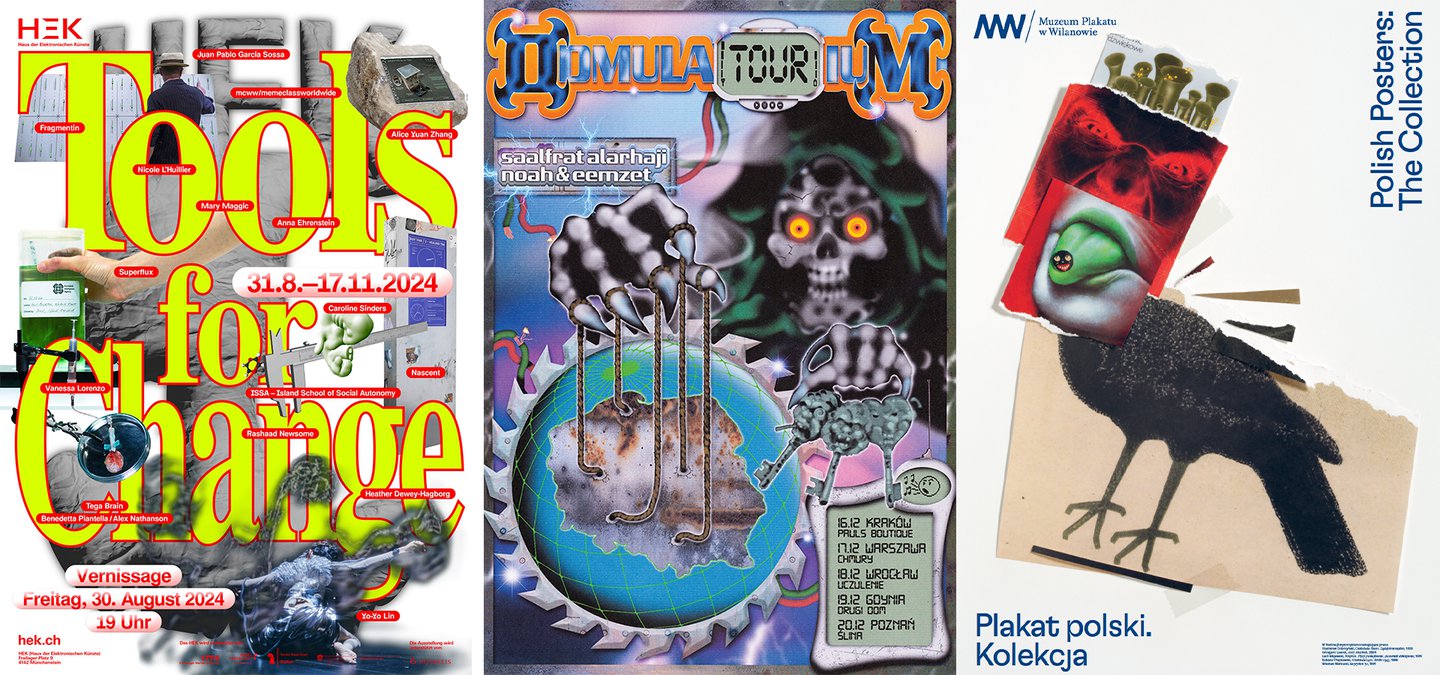
Part of the festival was a whopping eight-hour conference bringing together a wealth of designers from across Europe, from Switzerland’s ‘atelier’ Kolly Gujer and Graphic Matters to institutions such as the Academy of Fine Arts in Warsaw and the International Poster Biennale. The discussions, talks and panels reached topics such as ‘is the poster dead?’ and ‘does the poster still make sense in the age of screens?’ Of course, AI was always lingering.
Some design studios, such as designers Ivan Weiss and Michael Kryenbuhl of Johnson/Kingston, showed the audience how they use AI to create images from unreal realms for its event posters, feeding generative models until they break, digitally blending images through long processes of finding the dysfunctions of image generation and how that can be used to transport the viewer into previously unseen visual worlds. Designer Eunbee Lee took the audience through the entire process of working with AI prompts, from testing the intelligence’s ability to create legible fonts to identifying visual attitudes. Others, like James Gilchrist of Warriors Studio, argued that AI is a threat to lower-tier designers whose jobs will be taken over completely, and Coding Systems, a hybrid design practice led by Tim Rodenbröker and Martin Lorenz, argued that the danger with AI is the minimisation of human input – the code is all written for you. “Automation is death and the enemy of creativity,” said Tim, who is “in favour of the unfinished, for every gap is an invitation to the viewer to be part of the process.” The design duo asked ‘why use AI when you can customise the code itself?’ Coding can be just as human as painting or collage, a constant surprise that brings joy in the process, even if long and frustrating.
The question of community came up, with the creatives wondering what makes a community, and what a community even is. The feedback was affirming, with each one saying that they can see a huge community, filling out rooms, receiving submissions from over 110 countries for their respective competitions, etc. In our accelerated visual culture, questions were raised around what is ‘new’ or ‘original’ – especially in the age of AI. One designer had to google what ‘new’ is, because what really is it? Perhaps it’s something no one knows until it’s already done. It suggested that nothing is actually new, but the feelings in reaction to art are new. It’s all about creating a feeling of ‘newness.’