
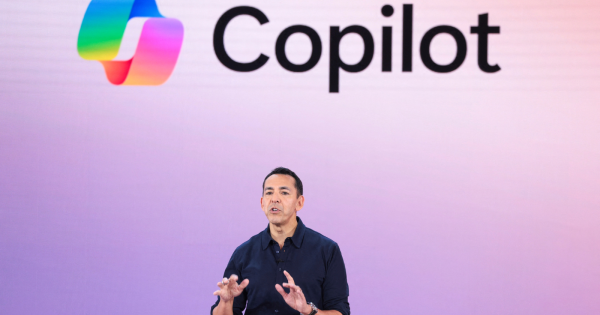
Microsoft chief consumer marketing officer Yusuf Mehdi, whose tenure with the company reaches back to the era of desktops and dialup, will leave the company in June 2027. Mehdi announced his departure in a post on LinkedIn.
“After 35 extraordinary years at Microsoft,” he wrote, “I’ve decided the time is right to begin planning for my next adventure.” (Mehdi could not immediately be reached for comment.)
Mehdi has held his current position since 2023 and oversees marketing for Microsoft’s marquee products and services including Windows and Microsoft 365. His remit also includes Surface laptops and tablets, the Edge browser, and Bing search engine. Most recently, Mehdi superintended the rollout of AI assistant Copilot.
As of press time, Microsoft had not named a successor to Mehdi, whose post—stating he’d “thought about this decision”—suggests that his departure is voluntary. Microsoft did not respond to ADWEEK’s request for comment.
Mehdi is the latest of several notable éminences grises to make highly visible departures from Microsoft.
In March, the company announced that Rajesh Jha, a 35-year Microsoft alum who runs the Experience + Devices group, will be retiring this year. Last month, Developer division head Julia Liuson, having spent 34 years with Microsoft, announced that she plans to retire in June.
Windows learning and development director Jeff Bogdan, who’d worked 33 years for Microsoft, got his walking papers in 2024. And in 2023, CMO Chris Capossela rode into the sunset after a 32-year run at Microsoft.
As big as the internet
In an interview with ADWEEK, Capossela likened AI to the change brought on by the internet itself. “I’ve seen that movie before,” he said. “I understand how disruptive it’s going to be.”
But AI has proven even more disruptive than Capossela hinted at.
The aggressive integration of AI into Windows 11 has prompted some users to call it “bloatware.” Last month, OpenAI and Microsoft put an end to their exclusive partnership, freeing OpenAI to partner with cloud-computing services that compete with Microsoft’s Azure.
But its virtual assistant Copilot has been a particular challenge.
Of the 450 million consumers who subscribe to the Microsoft 365 suite, fewer than 4.5% are willing to pay for Copilot. OpenAI’s ChatGPT commands a 60.6% market share among generative AI chatbots, according to SEO firm FirstPageSage. Copilot’s share is in third place, at 12.5%.
In October of last year, Microsoft chief commercial officer Judson Althoff took the CEO reins to allow Satya Nadella to focus his attention on AI. Speaking with Alex Springer CEO Mathias Döpfner on the MD Meets podcast in December, Nadella revealed that he was studying the playbooks of tech startups, and called Microsoft’s corporate bulk a “massive disadvantage.”
In April, Microsoft announced the first voluntary buyout plan in its 51-year history, offering a retirement program to anyone at the senior director level and to rank-and-file employees whose age and years of service tally to 70 or greater.
Mehdi joined Microsoft in January 1992, directing product management for Internet Explorer and Windows. At the time, the operating system—initially rolled out as a graphical user interface for MS-DOS—was just seven years old. After leading the launch of Internet Explorer 1.0 in 1995, Mehdi helped build it into the internet’s leading browser before the ascendancy of Google.
Mehdi also led the introduction of the Xbox One console and, starting in 2015, oversaw the global marketing efforts for the entire Windows family—software, apps, games, and devices.
“I’ve had the privilege of being a part of some of the most consequential shifts in technology,” Mehdi stated on LinkedIn, “from the rise of Windows and the early Internet, to search, gaming, devices, and now one of the most profound platform transitions yet: AI.”