
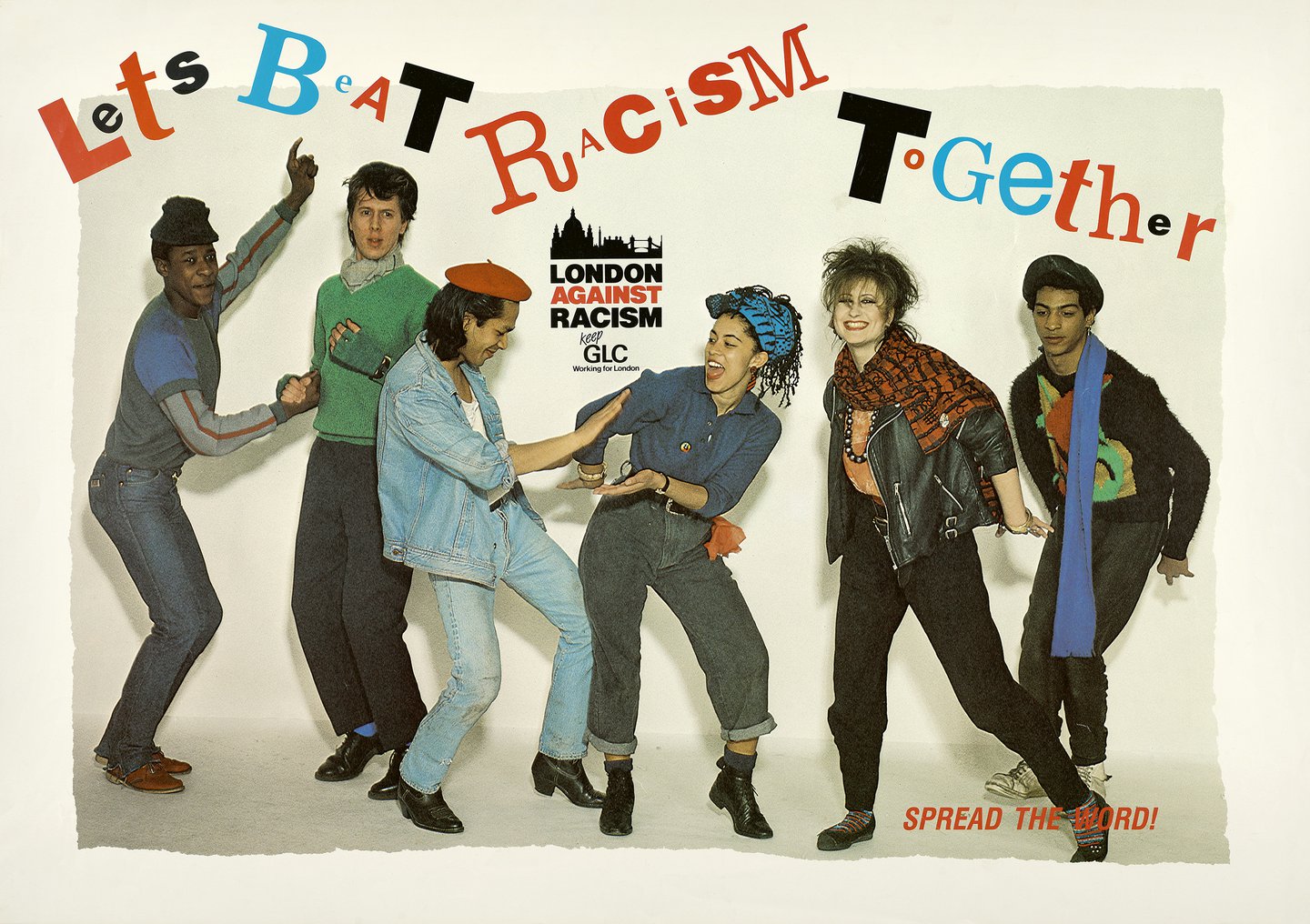
One of the most annoying things about Margaret Thatcher (there’s many), is how quotable she is. A classic of hers – ‘There’s no such thing as society’ – printed in a Woman’s Own interview in 1987, summarises her obsession with ‘individual responsibility’ and her incessant inability to see government as something that should be closely involved with the wellbeing of the nation’s people. Over the years I’ve found it a particularly enjoyable task to mentally log examples that proves just how wrong Thatcher was. A new book from publisher Four Corners, London’s Ours! Images from The Greater London Council 1981-1986, is a very beautiful and extensive piece of evidence to add to the list.
The Greater London Council (GLC) was a top-tier local government administrative body that ran from 1965-1986, involved in planning and governance of the capital. In 1981, it was won by Ken Livingstone who sat at the left of the Labour party and stood in fierce opposition to Thatcher’s rampant neoliberalism. Under Livingstone and his young, radical cohort, the GLC became overtly political, tackling issues of sexism, homophobia, racism, nuclear disarmament amongst other causes. Its core means of promoting and celebrating this alternative vision was art; over its five years, the Livingstone GLC produced countless posters, billboards and bold publicity stunts, all the while putting money into the pockets of artists and practitioners.
The new book’s bustling front cover directly echoes this plurality. It draws on a booklet produced by the GLC in 1986, which featured an image from a previous event – the June 1984 Change Festival. “The image used on this cover is a photograph from that same event,” says the book’s designer Claire Mason. “The sight of the people of London squashed into all nooks of County Hall speaks of an optimism and upbeat mood wrapped up in a festival atmosphere that perfectly captures the spirit of the book.” The mirroring of GLC ethos even extends into the typeface, Max R. Kaufmann’s 1939 design Balloon, which is “intentionally democratic” in its alignment and sizing. “As a brush script, it offers a human touch,” Claire continues. “In the 1980s, with shifts in technology, older typefaces like Balloon were revived and reused in new contexts. It was a perfect antidote to the corporate modernism of the previous era.”
Below, in conversation with It’s Nice That, the book’s writer – cultural historian and artist Hazel Atashroo – gives an enlightening deep dive into the visual methods of the GLC, highlighting its iconic campaigns, dedication to creative community and lasting impact on the legacy of political art.